

Read Time: 9 minutes
Table of Contents
Introduction
When many businesses attempt to calculate their contact center ROI, they tend to reach for the standard ROI formulas, often with the logic of software-purchase math baked in, assuming immediate deployment, fixed costs going in, and a clean return. However, contact center ROI needs a somewhat different set of assumptions going in. For one, contact centers are a workforce, not an inanimate tool, which already adds a layer of complexity to the math. Additionally, businesses need to factor in the time it takes for a contact center to get up to full mastery and efficiency with their products, services, procedures, and policies.
In this guide, we’re exploring contact center ROI: how to calculate it, what to do with that information, and how to maximize it. For a better understanding of your contact center ROI and how to evaluate a BPO partner’s ability to deliver it, read on.
Key takeaways
- The ROI formula must account for soft gains from outsourcing: Soft gains like CSAT increases, retention, and productivity gains need to use a sourced proxy value in order to be calculated alongside hard costs like labor rates.
- Dedicated vs. shared agent pricing and ROI: While dedicated agents cost up to 20-35% more than shared pool agents, the hard and soft gains of dedicated teams offset the additional costs. The increased consistency and deeper product knowledge create a better customer experience, which leads to increased revenue.
- Year-one ROI is almost always distorted by transition costs and ramp time. During your first year outsourcing, there are unusual costs that won’t be faced every year. Year-one ROI needs to account for a realistic payback-period calculation to help determine whether the investment was worth it.

What contact center ROI actually measures and where most calculations go wrong

Hard costs vs Soft gains in the ROI formula
In standard business, the formula for determining your Return on Investment is the following:

However, that model of ROI tends to break down under certain circumstances, including outsourcing. The main difference is that the standard ROI formula assumes fixed costs with immediate deployment, whereas outsourcing is a workforce transition with a productivity ramp curve. The simple ROI formula doesn’t account for things like hiring lag and attrition.
In actuality, the gains part of the formula is more complicated, as it is built from both hard gains and soft gains.
- Hard gains: Gains with concrete dollar amounts that you can point to on a spreadsheet. Without estimation, you can see the exact monetary value of these gains.
- Examples:
- Lowered labor costs. If one in-house agent was costing you $24/hour, and your outsourcing vendor charged you $14/hour, that’s a hard gain of $10/hour/agent.
- Reduced overhead costs. If you were spending money on equipment, tech licenses, and office space, and outsourcing removes the need for any of that, all of those removed costs are hard gains.
- Examples:
- Soft gains: Gains that don’t have a direct monetary amount, but are quantifiable improvements to the business that may indirectly improve the bottom line. Before being plugged into an ROI formula, these need to be converted to a “proxy value” or an estimated monetary equivalent of the improvement they provide.
- Examples:
- Improved CSAT. If customers are more satisfied with your services, they are more likely to continue their business relationship and more likely to recommend others, which generates additional revenue.
- Improved customer retention. It’s often more difficult to gain new business than it is to retain existing business. Improved retention correlates to more revenue.
- Higher agent productivity. The more productive each agent is, the less you need to spend on additional agents.
- Examples:
With hard and soft gains in mind, our modified formula for ROI in an outsourced contact center becomes:

Determining a proxy value for soft gains
To work out a proxy value for a soft gain, you’ll need to find a correlation between the soft gain and another stat that does have a monetary value.
For instance, if you need a proxy value for your improved CSAT, a common stat that CSAT correlates with is customer churn. If you look over your data and find that a 5-point increase in CSAT tends to correlate with a 2.5% reduction in customer churn, then you can turn that correlation into an estimate of your soft gains.
If you also know your average customer lifetime value (CLV) happens to be $2,500, and you have 8,000 total customers, then you have all the data you need to estimate a proxy value.
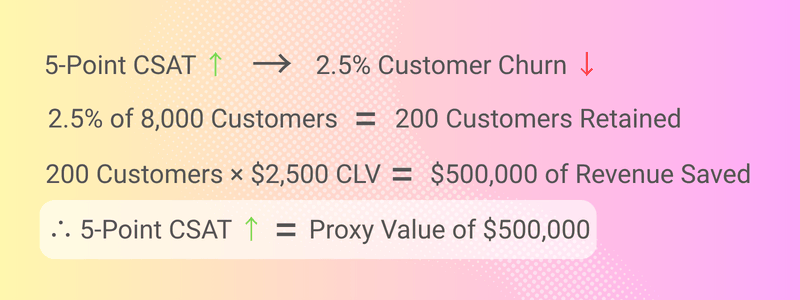
Therefore, in this case:
A 5-point CSAT increase translates to an estimated proxy value of $500,000.
That $500,000 can then be added to your soft gains figure and plugged into your ROI formula.
The ROI math for outsourced vs In-house contact centers
In-house costs vs Outsourced costs
In-house:
- Employee salary
- Employee benefits
- Recruiting and hiring
- Training
- Attrition
- Real estate
- Tech stack
- Management overhead
Outsourced:
- Contracted rate
- Dedicated agent premium, if applicable
- Transition and ramp-up cost
- QA oversight
Regional outsourced contact center price ranges

Break-even and payback period calculation
An important figure to consider when outsourcing your contact center operations is how long it will take to earn back your initial investment. In order to calculate an estimate for this number, you’ll need 4 pieces of information
- Initial outsourcing costs: What are the upfront costs of beginning your outsourcing arrangement?
- Monthly cost savings: In comparison to your in-house contact center, what do you save on still-existing operating expenses?
- Monthly incremental profit: How much additional profit do you generate monthly that is directly attributable to outsourcing?
- Monthly avoided costs: What costs do you avoid entirely every month by outsourcing?
With that information, you can then plug those numbers into the following formula:

So, for the sake of example, let’s assume a mid-sized business entering a contact center outsourcing engagement.
Let’s say that their initial outsourcing costs were $90,000. After outsourcing, their monthly cost savings are $20,000, their monthly incremental profit is $11,000, and they avoid a total of $4,500 every month.

Dedicated agents vs Shared-pool agents
In many conversations about contact center ROI, hourly rate tends to be the end-all, be-all factor discussed. However, one of the most useful places to look to maximize your ROI is to prioritize a team of dedicated agents over shared-pool agents.
Why brand-extension teams change the equation
Shared-pool agents, by the nature of their arrangement, have their attention pulled in various directions, sometimes handling calls for 5 or more brands in a single shift, forcing them to re-orient around different products, brand voices, and company policies. It effectively results in each agent becoming a “jack of all clients, but master of none.” While that arrangement usually costs less per hour, it has major limitations, especially when it comes to the customer experience, as shared-pool teams have a much higher variance in both FCR and brand voice consistency.
A dedicated team, on the other hand, is comprised of agents who work exclusively on your account. They don’t have to dilute their attention between you and a handful of other clients. Once trained on your products, brand voice, and your particular workflows, a dedicated team is essentially an extension of your brand. Though dedicated teams tend to cost more than shared-pool teams (usually about 20% to 35% higher cost), that difference is usually earned back at scale, and the higher quality provides soft gains that offset the upfront cost long-term.
Want to scale your business?
Global Response has a long track record of success in outsourcing customer service and call center operations. See what our team can do for you!
Evaluating a BPO partner's ROI before you sign
Any time a BPO vendor pitches their services to you, they’re selling you an ROI story. Some vendors have the numbers to back their claims, while some are less reliable. That puts you in the position of determining which vendors can be trusted with your brand.
Pricing transparency and red flags that predict a bad year one
A top priority to request from vendors is an itemized breakdown of their rates. Ask for unit economics instead of a blended rate so you can see what portions of the rate are going toward labor, tech, QA, overhead, etc. If you don’t know explicitly what you’re paying for, it’s difficult to determine if the margin has been padded at your expense.
You should also pay attention to ramp time (the time it takes for a team of agents to get to full productivity). Be sure to get your vendor’s expectations here in writing, as it’s all too easy for a vendor to overpromise. If a vendor can’t guarantee in their contract a certain ramp-up time, then you’ll be the one who ends up taking on the risk, and you can easily miss your year-one targets.
Get a good handle on the vendor’s approach to attrition: How is attrition reported, and how is it worked into pricing? And finally, what’s included in the sticker price, and what’s billed separately? See if QA, managerial costs, and reporting are part of the base cost, or if they are a la carte expenses.
If your business is evaluating BPO vendors that can maximize your contact center ROI, get in touch with Global Response today for a free quote!