

Read Time: 10 minutes
Table of Contents
Introduction
When determining how to improve customer experience, it’s important to remember that the gap isn’t usually a lack of knowledge, but one of executing on it. When you’ve done the research, made the plans, and pulled the trigger on some new tools, but your CSAT still stays stagnant, it’s time to change your approach.
Most companies in this situation fail in one or more of three different patterns:
- Agents are under-resourced
- Going off brand voice
- Fragmented ownership
Once you know which pattern your business falls into, what matters are the operating-model decisions you make to remedy the situation. Who answers the phones? How are they trained? Who is responsible for the outcome? And which decisions will actually make the difference?
Key takeaways
- Fix your operating model before buying more tools: When CX plateaus, it’s usually not because of a software gap, and almost always because of under-resourced agents, drift in brand voice, and fragmented ownership over the customer journey. Integrating a new customer service platform will improve visibility of your data, but doesn’t strengthen your capacity or accountability.
- Depth of product knowledge > Speed: Though speed of service is still important, your agents’ product knowledge is often a more reliable driver of CSAT, FCR, and CES than speed alone.
- Model costs over 3 years, not a single budget cycle. In-house costs tend to compound through hiring, training, and turnover, while outsourced models (especially dedicated teams) will scale more linearly year to year. This makes it easier to accurately weigh the comparative costs of in-house vs outsourced CX.

Why most customer experience improvement efforts stall

Once the easiest wins are accomplished, many CX programs plateau. Usually that isn’t because they have the wrong tools, but because they don’t have the right operating model.
The three failure patterns
- Tool-first thinking: Many companies rush to the decision to buy customer service software like Zendesk or Talkdesk first thing. However, this puts the cart before the horse, as the first problems to address are more operational in nature. It’s great to improve reporting, but the numbers won’t automatically change just because the tools are there.
- In-house ceiling: Many companies place their in-house agents in a no-win position, forcing agents to butt up against a capacity ceiling that wasn’t scoped for, falling short of their goals because of it. When headcount is sized incorrectly or can’t be scaled with real-world volume, it’s a potent recipe for burnout and worsening quality.
- Fragmented ownership: While a customer’s complaint may involve several teams (support handling a ticket, the product team owning the feature in question, marketing handling the messaging, etc.), it’s important for one party to own the customer’s journey from start to finish and integrate their efforts more effectively.
Why buying another platform rarely moves the needle
Integrating a new CX platform changes the information that agents can see, but it doesn’t automatically change anything about their call volume capacity. It doesn’t imbue them with deeper product knowledge. And it certainly doesn’t change who is accountable when cross-team handoffs cause a communication breakdown. Merely switching platforms in these cases doesn’t change anything because the software itself was never the problem.
The 7 levers that actually move CSAT, NPS, and CES
Voice of customer intelligence
With actionable feedback provided by VoC intelligence, agents can use customer feedback and surveys to close the loop on complaints. The root cause of the issue can be addressed, and the customer can be notified of what was done, rather than just letting the feedback live eternally as a data point.
Journey ownership and accountability
One person can take ownership of the customer’s entire journey, which not only improves CSAT, but allows for more actionable information in the long run with resolution per owner, instead of just the resolution of individual tickets.
Agent quality and product depth
Average handle time is an important metric, but it’s important to optimize for more than just speed. A higher CSAT is more likely to come from a team of agents with deep knowledge of the product than those who are just fast. You can easily see this by tracking first-contact resolution (FCR) by tenure band. Naturally, you will see that your most tenured agents have the most expertise, and will therefore have a higher FCR than newer agents.
Response speed and first-contact resolution
FCR is closely related to the Customer Effort Score (CES). If customers get their problems solved during their first interaction with a contact center, they are more likely to rate their experience as being easier, since they didn’t have to talk with multiple parties or follow up multiple times to get their needs met. To get the most relevant information, track CES by both channel and contact reason, as those variables can influence results.
Proactive communication and next-issue avoidance
By reaching out before problems arise, you can cultivate an environment where customers feel heard and cared for, while also greatly reducing repeat-contact rate, which is a major indicator of customer churn.
Omnichannel continuity (one identity, one history)
When customers are forced to repeat themselves or re-explain their complaint, it’s the kiss of death for CES. Through omnichannel customer service, customers are free to switch channels, knowing that agents will still have full context.
Measurement that ties to revenue (CLV, churn, expansion)
By emphasizing CX metrics such as customer lifetime value (CLV), customer churn, and expansion revenue, you can draw a direct line from CX efforts to the revenue they generate and protect, making it that much easier to keep your CX program funded.

How to build a customer experience improvement plan in 90 days
Days 1–30: Diagnose
Audit your most important KPIs, such as contact volume, route reasons, and CSAT drivers, and determine the 3 most common reasons that customers contact customer service, as well as where ownership of the customer journey tends to break down.
Days 31–60: Stabilize
Find solutions to your top 3 contact reasons, and deploy a QA framework that works consistently across each channel and vendor. Gather data to understand what works, and what needs fine-tuning.
Days 61–90: Scale
Move forward with a structural change to your operating model based on your findings in the first two phases. This can take the shape of new training, automation, or adding external capacity.
Want to scale your business?
Global Response has a long track record of success in outsourcing customer service and call center operations. See what our team can do for you!
In-house vs outsourced vs hybrid CX: Which model fits your stage?
When in-house wins
- Low volume
- High compliance sensitivity
- Deep product complexity
- Hard-to-transfer institutional knowledge
When outsourced wins
- Seasonal or unpredictable volume scaling
- Fast growth
- Moderate complexity
- Standardized processes that are transferable to a dedicated external team
The hybrid model and the co-sourcing variant
A hybrid model uses both in-house and outsourced agents. In-house agents handle the tickets with high complexity, high levels of risk, or highly technical tickets. Basically, any tickets that require strong institutional knowledge or require technical, high-risk judgement calls.
Meanwhile, the dedicated outsourced team takes on the bulk of the ticket volume, everything from the routine questions about common issues to tier-1 support. For issues that require deep institutional knowledge, the ticket can be escalated to the in-house team.
Finally, co-sourcing mixes in-house and outsourcing more tightly. Instead of splitting things by ticket type, the workflow is more shared, with both teams working through the same queue.
Cost and ROI of a customer experience overhaul
What in-house CX costs at scale
When estimating the cost of in-house CX, businesses often think first of the agent salary, but that’s only a small fraction of the cost of doing in-house CX. The fully loaded cost includes all of the costs associated with hiring an employee directly, which includes:
- Benefits
- Health insurance
- Retirement contributions
- PTO
- Payroll taxes
- Management
- Supervisory overhead
- Overhead costs
- Equipment
- Software
- Infrastructure
- Real estate
- Maintenance
Simply put, the cost of in-house CX is much more than the simple cost of salary alone.
What outsourced CX costs
Outsourced CX is typically priced differently than in-house. Instead of directly paying agent salaries and a laundry list of other costs, outsourced CX typically only requires businesses to pay per agent per month, usually based on full-time-equivalency (FTE). This is referred to as “per-FTE-per-month” pricing.
Outsourced CX can be accomplished through one of two different arrangements, shared or dedicated, which differ in cost and have their own pros and cons.
- Shared team CX outsourcing: Agents are shared between several different client accounts. This tends to be one of the least expensive options, but since the agents are split between accounts, they tend to have less in-depth knowledge of the product.
- Dedicated team CX outsourcing: Agents are arranged into teams who work exclusively on the CX of one client. Though dedicated teams tend to cost more than shared teams, they are still much less expensive than bringing CX in-house, with the added benefit of having much higher depth-of-knowledge when compared to shared teams.
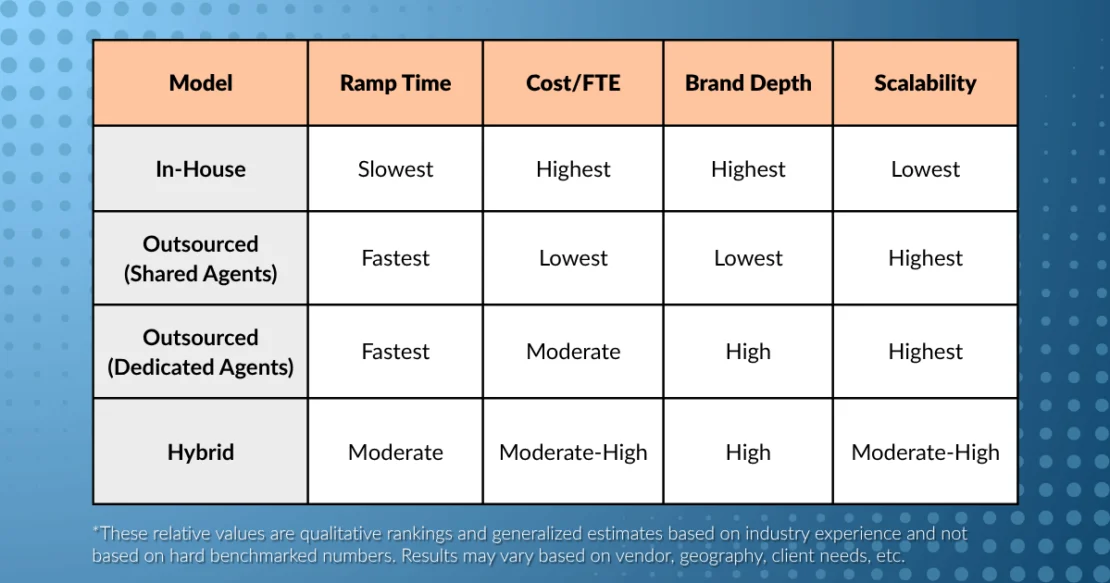
Three-year TCO model: In-house vs outsourced
The total cost of ownership (TCO) of each model is worth understanding, since their costs compound differently. For in-house CX, many of the costs, like hiring, tend to compound year to year instead of scaling linearly. Hiring isn’t ever as simple as hiring X amount of people and paying each of them $Y per year.
There are other costs aside from just salary to consider, including training and onboarding, and that’s before we even consider benefits and overhead. And then, not every hire will stick around for a full year, which means that if you want to continue with the same level of efficiency, you’re forced to start the recruiting, training, and onboarding process all over again, and even then it takes time to get back to where you were before. For those reasons, the 3-year TCO of in-house CX has a habit of getting much more complicated than a simple equation of “salary times 3”.
Outsourced CX, on the other hand, is much more straightforward. You don’t need to directly pay the salaries, benefits, hiring, training, overhead, and other costs of running an outsourced CX team, since you typically just pay a certain set rate per agent per month. When calculating the three-year TCO of an outsourced CX team, you only need to multiply the per-agent rate by the number of agents you need and multiply that figure by 36.
Want to see how you can improve your customer experience without hiring in-house agents? Get in touch with Global Response today to see how our dedicated teams can boost your CX for less!
FAQs
1. Is outsourcing customer experience actually a CX strategy, or just a cost cut?
With the right partner, CX outsourcing is a smart strategy. By working with a dedicated team of extensively trained outsourced agents, companies go beyond simple cost cuts, gaining benefits like higher CSAT and a reduction of customer effort, all while lowering the cost-per-contact for each interaction.