


Read Time: 17 minutes
Table of Contents
Introduction
As the years go by, outsourcing customer experience becomes a more and more common practice among businesses, not just for cost-cutting but as a strategic advantage on its own. However, a challenge that’s often overlooked in the transition from in-house to outsourced is adapting your current processes for success within an outsourced environment. A smartly crafted customer engagement model can make your outsourcing partner more effective at following your procedures, collecting the right data, and treating your customers in a way that’s consistent with your brand. It’s also a crucial step for brands in regulated industries where compliance is key.
If you’re attempting to make the switch to outsourced customer experience, this guide walks through the importance of customer engagement models as a framework and the operational realities of working with an outsourcing partner that these models address. Let’s take a look.
Key takeaways
- Your engagement model doesn’t transfer automatically: As you make the transition to an outsourced partner, it’s important to deliberately hand off the inner workings of your customer engagement model, including internal processes, expectations, and customer data.
- Creating value over fixing problems: An effective partnership is more than a mere matter of resolving tickets and fixing existing problems. It entails driving real business outcomes.
- Compliance and data governance are NOT OPTIONAL: While important in all industries, compliance and data security are especially important in heavily regulated industries, such as healthcare and finance. Your engagement model should specifically define expectations and standards for data handling and agent certification requirements before the partnership even kicks off.

What is a customer engagement model?

A customer engagement model is the framework used to define precisely how a company interacts with its customers at each point in the customer lifecycle. A well-crafted customer engagement model should designate who engages with customers and other details like which channels they engage through, how often they do so, and what their goals are at each touchpoint.
It’s also important to delineate the difference between customer engagement and customer service. Whereas the term customer service is reactive (agents respond to a customer problem after it has happened), customer engagement has a more holistic goal, using proactive outreach and relationship-building to stay in the loop about customer needs. A customer engagement model is handy for giving your outsourcing partner a guide that allows them to take over the customer relationship instead of merely handling ticket resolution.
How do I build a customer engagement model that still works after outsourcing?
The key to a successful customer engagement model in an outsourced environment is to remember that your model doesn’t automatically get transferred to your outsourcing partner. You have to hand it off deliberately. Start by documenting your existing model, and then use that info to rebuild it explicitly for an outsourced partner. Set clear expectations and guidelines for the acceptable level of quality, and ensure that you and the partner have a shared understanding and an open line of communication for future optimization.
Want to scale your business?
Global Response has a long track record of success in outsourcing customer service and call center operations. See what our team can do for you!
Core pillars of modern customer engagement models
Data centralization and omnichannel consistency
Your customer engagement model is only functional if agents have the data they need at hand, and your customers aren’t forced to repeat themselves. Data fragmentation is a common problem in the customer experience realm, and it causes a lot of delays, confusion, and frustration for both customers and agents alike, dashing efficiency in the process.
A key component of an effective customer engagement model is a well-crafted omnichannel infrastructure, including a robust CRM, a full customer interaction history, and established protocols for data governance between you and your BPO partner. When it comes to regulated industries, like financial services or healthcare, data governance is all the more important, carrying severe legal consequences if compliance with HIPAA, SOC 2, PCI-DSS, and GLBA isn’t observed. Ensure that your engagement model takes these into account and specifies important procedures like:
- Access controls
- Agent certification requirements
- Audit trail standards
- Data handling
Proactive vs. reactive interaction loops
Many BPO providers operate from a reactive framework, where the provider handles incoming calls, meets the requirements of the service level agreement (SLA), and closes customer tickets. Customer engagement models can build in a more proactive approach, with scheduled check-ins and smart alerts based on milestones or warning signs, allowing agents to address at-risk accounts before problems mature.
Proactive engagement in an outsourced environment can be challenging if the BPO provider doesn’t have the full context or fluency with your brand. Though proactive engagement should be your goal, be prepared for a transition period as your provider gets up to speed and becomes capable of high-quality proactive outreach.
Strategic customer success engagement model integration
A helpful way to frame this shift is to consider that, as a company working with a BPO, you are making an upgrade from the goal of merely “fixing problems” to the goal of “creating value”. It shifts the focus slightly from metrics like average handle times to the actual customer outcomes.
Medium and larger businesses should map their complete customer journey, zooming out to take a look at the full picture, paying attention to onboarding milestones, product adoption checkpoints, renewal windows, and expansion triggers. A BPO partner should be clued into this roadmap, and not the service queue alone. Medium and large businesses should ensure that their trusted partners have visibility on data tied to real business outcomes outside of satisfaction metrics, such as customer lifecycle stage indicators, customer health scores, and escalation criteria.
For proper integration, it’s important to build an engagement model that treats your outsourced team as a growth engine and facilitates the value-producing work they do.
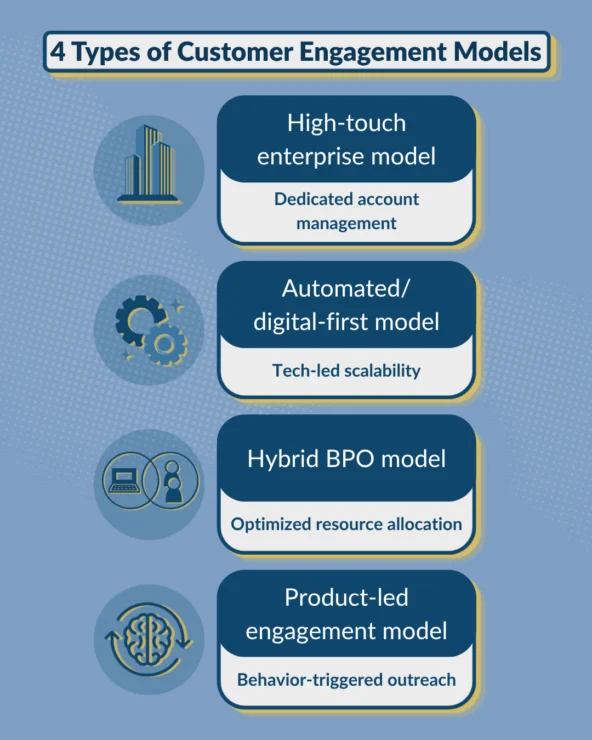
4 types of customer engagement models for large organizations
High-touch enterprise model
This is the best match for high-value accounts with a lot of complexity. In these situations, relationship-building and consistency are very effective at fostering retention. BPOs typically tackle high-touch accounts with dedicated teams, which means that the same agents will always handle interactions for that brand. This allows those teams the focus they need to provide consistently high-quality customer experiences that display deep knowledge of the brand’s products, services, and policies.
Automated/digital-first model
An automated customer engagement model is a good option for businesses that see high volumes but with low-complexity tasks. In these models, AI-powered solutions can be used to triage customers based on needs, and chatbots and self-service portals can keep call volumes manageable while simultaneously lowering your cost per contact.
Hybrid BPO model
The most common way that large companies approach customer engagement is to automate the inquiries at tier-1, provide human escalations at tier-2, and specialized agents trained on interactions that involve regulated or sensitive info at tier-3. In order to make this model most effective, it’s important to use a clear escalation protocol that is understood by all agents, preferably in writing and approved by your compliance team.
Product-led engagement model
SaaS and tech companies often use data from product usage to provide engagement triggers. When customers haven’t logged in, when they key feature adoption milestones, when they approach some kind of usage threshold, etc. These triggers send your BPO team alerts, allowing for engagement based on user behaviors. To use this model, it’s important to close data-sharing agreements between all involved parties, including the product team, customer success, and your BPO partner, as well as outlining a clear protocol for what agents are meant to do with those signals.
Implementing the framework: A roadmap for outsourced environments
- Document your current engagement model. Ahead of the transition, ensure that you have an accurate idea of the ins and outs of your current model and put it on the record. It’s difficult to hand off a task to an outsourcing partner if you haven’t defined what the task is.
- Audit compliance requirements. Understand your various customer segments and their behavior, figuring out which interactions require HIPAA, GLBA, or PCI compliance, and make sure that they are accounted for in the contract.
- Establish KPI framework. You and your outsourcing partner should have a shared understanding of KPI metrics to keep you both on the same page. SLA metrics are important, but so are outcome metrics, such as CSAT, NPS, first contact resolution, and churn rate by segment.
- Explicitly define the transition period. Work with your partner to set clear expectations for the duration of the ramp-up time, including milestone goals along the way, before reaching full volume.
- Assign an internal liaison. This is a person on your team who owns the brand voice and holds your BPO accountable for brand consistency matters.
- Create a brand and tone guide. Provide your BPO partner with an explicit guide for brand-consistent customer interactions, including the specific language used for escalations, and which phrasings to avoid altogether, especially within regulated contexts.
- Create a feedback loop. Regularly meet with your BPO partner for QA reviews to ensure that everything is running on track.
The model is the differentiator
The design of your customer engagement model can mean the difference between slowly deteriorating customer relationships and actively building them.
If you are taking a second look at your outsourced CX strategy, Global Response can work closely with you to design, implement, and optimize your customer engagement mode. Get in touch today!