

Read Time: 11 minutes
Table of Contents
Introduction
Every conversation with a customer holds insight, but unfortunately in most call centers those insights go untapped. Out of the millions of interactions that happen daily, only a fraction are ever reviewed, leaving critical insights into CX buried in unstructured voice data.
Speech analytics call center technology can fix this by analyzing 100% of conversations in real time. What was once invisible becomes measurable, which creates the foundation for improvement.
Enterprises navigating complex environments should use speech analytics to stay ahead of the competition. Being powered by speech analytics Ai allows leaders to move from reactive decision making to a more proactive approach.
This technology is redefining how organizations evaluate performance and drive ROI across outsourced and in-house operations.
Key takeaways
- Speech analytics call center platforms enable 100% interaction visibility, replacing outdated manual QA sampling methods.
- Real-time speech analytics empowers agents and supervisors to intervene during live interactions, improving outcomes instantly.
- Speech analytics AI enhances compliance, sentiment detection, and performance monitoring across distributed BPO teams.
- Enterprises can reduce AHT and improve FCR by identifying root causes of recurring issues.
- BPO speech analytics ROI is driven by efficiency gains, risk reduction, and customer retention improvements.
- A structured implementation approach is essential for success

Speech Analytics Call Center Framework

Scaling customer support as your company grows is no easy feat and the need for deeper visibility into voice interactions becomes increasingly important. A solid speech analytics call center framework will help transform conversations into actionable intelligence that can be used across the organization. Speech data should be thought of as a strategic asset that can be used to create a clever path to performance improvement.
What is Speech Analytics in a Call Center Environment?
At its core, speech analytics is the process of using artificial intelligence (AI), natural language processing (NLP), and machine learning to analyze spoken conversations between agents and customers.
In a speech analytics call center, this technology will capture interactions, then transcribe them, and then evaluate the interactions. This analysis reveals patterns and trends that can be used to address any issues or make improvements to the customer experience. Speech analytics goes beyond surface-level metrics to interpret tone, intent, and context.
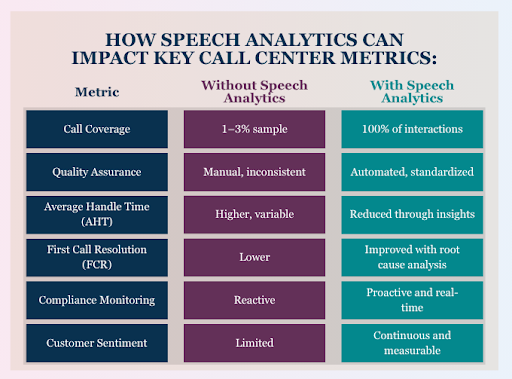
Typically quality assurance teams can only review 1-3% of total calls because of time and resource constraints. This limited visibility is also tainted by bias and leaves a huge number of insights undiscovered.
Modern speech analytics tools remove these limitations by analyzing 100% of interactions ensuring:
- Comprehensive performance evaluation
- Consistent quality standards
- Data-driven coaching opportunities
This shift represents a fundamental evolution from reactive to proactive monitoring.
There are two primary modes of analysis:
- Post-Call Analysis
- Evaluates interactions after completion
- Identifies trends over time
- Supports training and strategic decision making
- Real-Time- Speech Analytics
- Processes conversations as they happen
- Provides live prompts to agents
- Flags compliance risks instantly
- Enables supervisors to intervene mid-call
As companies begin to utilize these capabilities, understanding the full range of features that power them becomes essential.
Call Center Speech Analytics Core Capabilities for Enterprises and mid-sized growth
To get maximum value from a speech analytics call center, you need insights you can act on. It has to work for everyone including: supervisors, compliance teams, and leadership. Speech analytics should make it easy to spot issues and improve results across the board.
Speech analytics AI is often a popular tool that is used to help this function improve overtime.
Advanced Features of Customer Care Speech Analytics
Customer care speech analytics, also just another way speech analytics is referenced, is valuable because of how it helps teams better understand and respond to customer needs in the moment. Organizations are able to automatically detect customer sentiment which provides insight on where conversations are going off track.
These tools also play a critical role in maintaining compliance. Instead of relying on manual reviews, speech analytics solutions can automatically flag things like missed disclosures, risky language, or deviations from required scripts. This kind of automated quality assurance is a major asset, especially in highly regulated industries.
Another helpful feature of customer care speech analytics is keyword tracking. This allows you to:
- Monitor mentions of competitors
- Track marketing campaigns
- Identify common customer issues
It is a simple but powerful way to connect customer conversations to business performance.
Together, these features turn everyday conversations into a reliable source of insight, setting the stage for the measurable and operational impact and scalability that speech analytics brings to BPO environments.
Operational Impact and BPO Selection
Running a call center, especially one that is partially or fully outsourced, can be challenging. Trying to deliver fast, consistent service while keeping an eye on quality and compliance can feel nearly impossible without clear visibility.
This is where speech analytics call center technology can be extremely beneficial. It gives you a continuous picture of every interaction so you can see patterns and trends in real-time. That kind of insight is great for improving day-to-day operations and can help you make smarter decisions about which BPO partners or internal processes are delivering results.
The adoption of speech analytics is growing rapidly across industries.. According to Fortune Business Insights, the global speech analytics market was valued at $4.94 billion in 2025 and is projected to reach $15.31 billion by 2034. This growth shows why more businesses are integrating speech analytics in a call center to improve not only the customer experience, but efficiency as well.
Even small improvements can have a huge financial impact. For example, reducing AHT by just 10 seconds across a 500+ seat call center can translate into millions of dollars in annual savings. When you factor in improved FCR and fewer repeat contacts, these operational efficiencies compound.
Why Decision Makers Require Speech Analytics Call Center Integration
Leaders need to know their teams and partners are performing and they need to see it in the data. Relying on small call samples or subjective reports is no longer enough. Speech analytics in a call center provides a clear view of every conversation so leaders can make decisions based on facts and not assumptions.
The top ways speech analytics can help are:
- Full visibility
- Analyze 100% of calls rather than just a small sample.
- Improved efficiency
- Identify friction points, streamline workflows, and refine scripts so agents can resolve issues faster.
- Lower average handle time (AHT)
- Removes unnecessary steps without cutting corners so calls are smoother for both agents and customers.
- Higher first call resolution (FCR)
- Identifies why customers are calling back and provides suggestions on how to fix the issue.
- Stronger compliance
- Automatically monitors for risky language or deviation from required scripts.
These advantages will also help organizations see measurable, tangible results. Customer satisfaction improves and your BPO partners are held to a clear, data-driven standard.
So, what does all this look like in practice?
Want to scale your business?
Global Response has a long track record of success in outsourcing customer service and call center operations. See what our team can do for you!
Real-World Applications and Evidence
Seeing the impact of speech analytics call center technology is easier when you look at real results. A financial services company worked with Global Response to transform their customer experience. Before the partnership, conversion rates were low and customers often felt frustrated during interactions.
Global Response was able to redesign call flows, streamline communication, and refine targeted messaging, which tripled the company’s eligible conversion rates. Every interaction turned into an opportunity to create a memorable customer interaction while delivering measurable business results.
Speech analytics could amplify results in a transformation like this by:
- Using real-time and post-call analysis to pinpoint exactly where customers were getting confused in the call flow.
- Analyze which scripts or phrases are driving higher engagement so teams can adjust language in real-time.
- Provide insights from conversations that identify unnecessary steps or misrouted calls to improve processes.
- Measuring impact via sentiment analysis call center tools and continuous QA to provide data that shows what is working and what needs improvement.
The blend of smart workflows, targeted messaging, and speech analytics helps organizations create consistently better experiences for customers.
Implementation Strategy
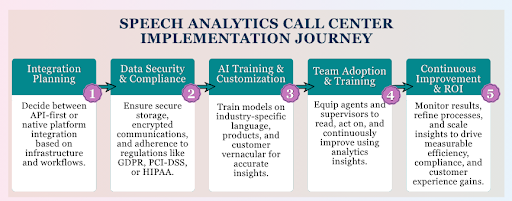
Integrating speech analytics call center tools into your operations will transform your business. To get the most value, you need to create a plan that fits your team, processes, and customers. One option organizations can use is API-first integrations, which offer flexibility to connect analytics to existing platforms and workflows. This integration option is recommended for companies with custom workflows or multiple systems. Another option is using native platform solutions that are built directly into the call center software for faster setup. Which one you choose depends on your infrastructure and long-term goals.
Your implementation strategy should also have a big focus on protecting customer data. Any speech analytics implementation should include:
- Secure storage and encrypted communication
- Compliance with regulations like PCI DSS and HIPPA (if applicable)
- Role-based access controls so only the right people see the right data
These safeguards ensure that your analytics strategy doesn’t create new risks while unlocking insights.
For speech analytics to deliver meaningful insights, it should understand the language of your business. In-depth training on industry specific terms, product names, and customer vernacular helps it understand intent and context. The better AI understands your industry, the more actionable its insights become.
Even the best technology can fail if your team does not know how to use it. Make sure to:
- Train teams on how to read and act on insights
- Align analytics goals with business objectives
- Build feedback loops to ensure continuous improvement
While speech analytics software can be powerful, implementing it is rarely plug-and-play. Some organizations face technical debt, integration hurdles, and workflow misalignments that can be hard to overcome. API connections may require custom mapping and native integrations can conflict with existing CRMs. Planning for these friction points upfront will help to ensure the implementation doesn’t stall and that teams are ready to use insights effectively from day one.
Speech analytics turns customer conversations into actionable insights that drive better decisions and create measurable ROI. With the right strategy in place, every interaction can help to improve efficiency and customer satisfaction. Global Response can help you make every conversation count. Get connected with one of our experts to learn more.
FAQs
1. What is speech analytics call center technology?
Speech analytics call center technology uses AI and NLP to analyze voice interactions and provide insights into customer sentiment and internal operations.
2. How does AI speech analytics improve BPO performance?
It enables real-time monitoring and automated quality assurance so there can be more data-driven decision making. It also ensures that compliance standards are being met and improves efficiency.
3. What is the difference between speech analytics and voice analytics?
Speech analytics focuses on the content and meaning of conversations, while voice analytics focuses on tone and pitch.
4. Can speech analytics call center tools help with compliance?
Yes because they help detect compliance risks and provide audit-ready documentation.
5. How long does it take to see ROI from speech analytics in a call center?
Many organizations begin seeing ROI within 3-6 months, depending on implementation scale.
6. Is real-time speech analytics better than post-call analysis?
Both have value, but real-time speech analytics provides immediate intervention opportunities which helps improve outcomes during live interactions.