


Read Time: 16 minutes
Table of Contents
Introduction
Customer expectations have undergone a fundamental shift. In a world where digital interactions dominate and choices are endless, customer experience has become the primary driver of brand loyalty. Today’s customers expect seamless, personalized, and proactive engagement at every touchpoint, and they’re quick to disengage when those expectations aren’t met. For businesses, this means rethinking traditional support models and embracing a more strategic, technology-driven approach to Customer Experience (CX) — one that not only keeps pace with change, but anticipates it.
Key takeaways
- Customer Experience is now a primary growth driver, directly impacting retention, loyalty, and revenue.
- Proactive, data-driven strategies are essential. Modern CX requires leveraging data, AI, and journey mapping to anticipate customer needs.
- Scalability requires the right technology and partnerships.
- Delivering high-quality CX at scale depends on omnichannel platforms, automation, and BPO partnerships to maintain efficiency, consistency, and personalization during periods of growth or high demand.

Customer Experience Strategy Optimization for Outsourced Service Models

Businesses once relied on reactive support and in-person interactions to build loyalty.
Today, every digital interaction shapes brand perception. Customers expect fast, seamless, and proactive service across every channel — and they’re quick to leave after a single poor experience.
To compete, organizations must move beyond support and adopt a modern Customer Experience (CX) strategy built on data, personalization, and scalability.
Defining the modern Customer Experience strategy
Future-proof digital customer experience strategies combine data, technology, and omnichannel support to deliver consistent, personalized experiences across the full customer journey.
Modern CX strategy follows these steps:
- Maps the customer journey across all channels (phone, video, email, chat, SMS, and social media).
- Optimizes touchpoints via streamlined workflows in a unified contact center technology platform.
- Analyzes historical and live Voice of the Customer data to identify trends, understand preferences, and predict behavior.
- Implements changes to enhance CX through self-service, Customer Feedback Management, and customer service dedicated to continuous improvement.
The shift from tactical support to strategic CX
Data shows that one-third of customers leave a business after a single bad experience. Customers value trust and efficiency, requiring brands to shift to proactive, personalized care that puts the customer first.
CX technology gathers data and implements strategies at scale, making a CX transformation framework built on continuous improvement.
This shift organizes your approach for better operational efficiency. It shows, rather than tells, your customers that you see and value them, key to building trust and driving action.
Aligning organizational vision with customer expectations
A modern CX strategy doesn’t make you choose between efficiency and satisfaction. It optimizes both in a framework built to grow with the times, centering customer feedback to drive real customer experience improvement.
Future-proof CX aligns organizational and customer success. Follow these steps to treat customers as stakeholders of your business and implement their ideas effectively:
- Understand who your customers are, what they value, and how they perceive your products and services.
- Plan three to five years ahead. Address needs and align strategies with your organizational mission.
- Unify communications across marketing, product, and sales teams to break down silos and deliver a seamless experience.
- Monitor success and adapt strategies for continuous improvement.
Aligning organizational vision with customer expectations
A modern CX strategy doesn’t make you choose between efficiency and satisfaction. It optimizes both in a framework built to grow with the times, centering customer feedback to drive real customer experience improvement.
Future-proof CX aligns organizational and customer success. Follow these steps to treat customers as stakeholders of your business and implement their ideas effectively:
- Understand who your customers are, what they value, and how they perceive your products and services.
- Plan three to five years ahead. Address needs and align strategies with your organizational mission.
- Unify communications across marketing, product, and sales teams to break down silos and deliver a seamless experience.
- Monitor success and adapt strategies for continuous improvement.
Why Customer Experience strategy is the primary driver of enterprise growth
McKinsey finds that successful experience-led strategies deliver breakthrough growth for incumbent companies — often more than double their competitors — and that 80% of the value achieved comes from existing customers. Vital to building brand loyalty, Customer Experience strategy creates value that leads to real business improvements.
Operational efficiency
- Optimized experiences increase agent productivity and service capacity while reducing overwhelm and wait and handle times.
- Better service quality raises conversion rates, satisfaction, referenceability, and Customer Lifetime Value while reducing churn.
- Standardized processes raise service consistency and reduce errors.
Personalization at scale
- Intelligent routing aligns customers with the most appropriate agent for their inquiry and skill needs.
- Automated workflows service customers faster than ever.
- Accurately meeting customer needs fosters and maintains growth.
Cost-efficiency
- Acquiring new customers is 5 to 25 times more expensive than retaining existing customers.
- Forrester reports that customer-obsessed organizations see 41% faster revenue growth, 49% faster profit growth, and 51% better customer retention than other organizations.

Pillars of Customer Experience improvement
Customer experience is a living, breathing strategy suited for 2026 and beyond. Achieve results with a strategy built around these five core pillars:
- Constant innovation
- Understanding customer expectations
- Seamless omnichannel interactions
- Personalization
- Continuous improvement
Consult with a BPO partner to see how they can implement these aspects of CX improvement into your strategy.
Frameworks for continuous Customer Experience improvement
Digital customer experience will get messy without a clear framework that outlines your plan. It should include these elements:
- CX goals (efficiency, performance metrics and customer engagement data)
- Planned strategies, with defined key players
- AI tools and technology integrations
- Achieved results, viewed in customizable reports
- Adaptive strategies that implement feedback for improvement
Find these pillars of CX and more in the following CX transformation frameworks.
Data-driven journey mapping for high-volume environments
Customer journey mapping is only effective if it accurately captures how customers engage with businesses in lulls or periods of peak demand.
High-volume settings such as eCommerce, retail, financial services, and healthcare put your services to the test. Tools should analyze massive amounts of multi-channel interaction data and highlight trends and issues that might otherwise slip through the tracks.
Data-driven journey mapping facilitates CX improvement in tangible ways:
- Automates data collection and interpretation
- Offers real-time visibility into customer behavior across touchpoints
- Leverages predictive analytics to anticipate needs and pain points
- Triggers timely personalized offers and proactive support
- Reduces wait times and overwhelm while increasing conversion and retention
- Visualizes data to inform business strategy
Closing the feedback loop: VoC (Voice of the Customer) integration
Understanding the voice, or opinions and sentiments, of your customers is fundamental to CX experience. It helps you prioritize high-impact issues and gain a holistic view of all customer sentiments, identifying
- Service gaps and problem areas
- Successes and wins to build upon
- Opportunities to align CX with business outcomes
- A unified view of customer feedback
A robust VoC CX framework listens to customers, analyzes data, acts to improve individual and systemic journeys, and adapts according to measured outcomes.
Integrating BPO partners into your CX strategy
Optimizing CX on your own is a high risk without the resources or experience to manage the moving parts of a new strategy alongside your regular customer support efforts. Outsourcing leverages the skills, tools, and frameworks of experts in your field and in CX, reducing operational costs while allowing you to focus on core competencies.
BPO service integration smoothly shifts operations without disrupting core workflows. But to do so takes effective processes, planning, and a commitment to exceptional methods and results.
Maintaining brand fidelity in outsourced service models
Many business leaders are hesitant to outsource, wary of giving up operational oversight or risking security, quality, and brand integrity. However, the right BPO partner is just as invested in your business as you are.
Top-quality BPO providers check all of these boxes to maintain brand fidelity in outsourced operations:
- Has experience in your industry delivering the services you require
- Accesses a global agent pool of experts and specialists
- Drives the results you seek
- Utilizes powerful advanced CX technologies
- Securely integrates systems in compliance with regulations relevant to your industry
- Immerses agents in brand culture to align voice
- Unifies CRM and CXM for consistent service delivery
- Clearly defines and communicates goals and performance
Want to scale your business?
Global Response has a long track record of success in outsourcing customer service and call center operations. See what our team can do for you!
Setting KPIs beyond Average Handle Time (AHT)
As important as Average Handle Time is in evaluating the efficiency of your support team, it takes more to evaluate Customer Experience improvement and success. Work with your BPO provider to evaluate these other metrics to determine CX ROI.
- Net Promoter Score (NPS) measures how likely a customer is to recommend your company, product, or service.
- Customer Satisfaction Score (CSAT) evaluates satisfaction after specific interactions.
- Customer Effort Score (CES) determines how easy it is for a customer to complete a task.
- Churn Rate is the percentage of customers who stop doing business with you.
- First-Contact Resolution (FCR) measures the success of solutions via the percentage of issues that are resolved the first time a customer reaches out for help.
Your BPO provider should follow these steps for effective performance tracking:
- Work with you to determine metrics to track success.
- Benchmark your current top performers to set baselines for success.
- Track metrics daily, weekly, monthly, and yearly to evaluate performance over time.
- Offer regular business reviews to evaluate performance and improvement strategies.
- Inform agent coaching with data-driven insights and live AI assistance.
Training for emotional intelligence and brand voice alignment
Another requirement of the right BPO is cultural fit. How well their values, operations, and tactics fit with yours sets the tone for your partnership. The right partner should understand or suit your culture, values, and voice to act as a seamless extension of your company.
This understanding will influence how your BPO trains agents for emotional intelligence and voice. They should implement these strategies internally to optimize CX as the new face of your brand:
- Develop or follow brand guidelines
- Expertly de-escalate tense situations
- Train team on soft skills and emotional intelligence
- Immerse agents in brand culture and communication
- Standardize scripts, protocols, and processes in a unified system
- Regularly coach agents based on real-time performance data and feedback
- Seamlessly collaborate with internal teams

Technological infrastructure for scaled CX
Scalable CX infrastructure is foundational to enterprise customer service outsourcing, but it’s not exclusive to large corporations. Small- and medium-sized businesses experiencing high volume or growth require scalable technology solutions. This infrastructure also powers continuous growth, adaptable CX, AI-powered support, flexible omnichannel strategy, and deep insights into customer experience.
Digital customer experience strategy and AI implementation
AI has been transforming customer journeys for the last few years, but it’s growing at an almost exponential rate as it takes a more pivotal role implementing and informing intuitive customer support. Developers are continuously refining AI capabilities, cultivating more sophisticated solutions than ever using real-time data about customer preferences and behavior.
AI is a critical player across all steps of the digital customer experience, but it requires human oversight, or a human-in-the-loop strategy, for effective customer experience and agent productivity.
Customer-facing
- Agentic AI completes complex tasks with minimal human supervision.
- AI-powered self-service empowers customers to answer their own questions.
- Automated routing directs customers to appropriate teams and agents.
- Customer actions trigger automated emails and workflows.
- Chatbots and AI agents provide 24/7 availability.
Agent-facing
- AI-powered training streamlines onboarding while increasing agent confidence and proficiency.
- Agent Assist offers live tips, response suggestions, compliance flagging, and escalation guidance to agents based on real-time conversations.
- Accent neutralization, voice conversion, and automated language translation technologies enhance communication, understanding, and speech clarity.
- Automated summaries, reports, and coaching improve service quality.
Predictive analytics for proactive issue resolution
Core to scalable Customer Experience and enterprise customer service outsourcing, predictive analytics tracks, evaluates, and analyzes patterns in historical customer interaction data, using statistical modeling to anticipate future customer behaviors, preferences, and outcomes.
Purpose: Predictive analytics empowers proactive, anticipatory support to increase satisfaction, reduce tickets, prevent issues, and accurately allocate resources.
Application: In addition to capturing trends and issues, BPO providers use predictive analytics to anticipate staffing needs, scaling workforces for maximum cost-efficiency and productivity.
Personalization: Advanced CX systems allow organizations to personalize marketing, sales, and support efforts at scale. AI-driven personalization optimizes every interaction, engaging customers at stages when they are most likely to take meaningful action.
Omnichannel consistency across chat, voice, and social
Outdated, disconnected technologies force agents to switch between tools for different channels, creating silos that raise inefficiencies, customer effort, dissatisfaction, and service inconsistency.
Now, modern CX technologies unify the customer journey across voice, chat, text, email, and social media to customers where they’re at.
Look for a BPO provider who understands and applies these key aspects of consistent omnichannel support to their support strategy:
- Comprehensive data: Track all customer interaction channels to get a complete view of customer sentiments.
- Channel nuance: Understand how customers use each channel to tailor communications while upholding brand voice, policies, and style.
- Synchronized interaction handling: Connected systems allow customers to move seamlessly between touchpoints, reducing the need to repeat themselves.
Real-world applications and results
With a host of moving parts, customer experience is more than just a theory. It’s a necessary practice, mindset, and prioritization that can directly influence customer behavior. See how industry leaders have worked with outsourced CX experts to achieve real results in organizational and customer success.
Case study: Enterprise CX transformation
FILA’s previous third-party call center failed to live up to the brand’s support standards, leading to a lack of trust in the partnership and a loss of online sales. Hundreds of backlogged cases and months-long response times delayed fulfillment, refunds, and returns, significantly impacting customer satisfaction.
FILA turned to Global Response at one of their busiest times of the year in 2020. Global Response’s Customer Experience Management team streamlined solutions and response times through these CX best practices:
- Onboarded a scalable team of highly skilled, brand-aligned agents
- Trained agents to align with brand standards
- Captured and communicated Voice of the Customer insights to internal team
- Prioritized issues, increasing transparency through standardized procedures and templates

Fila Case Study
Read the full FILA case study to see how the “one-team” partnership improved customer experience and relationships.
Use case: Scalability during peak seasons without quality degradation
One of the most compelling reasons to outsource is a BPO provider’s ability to optimize flexibility, costs, and service quality when your teams would otherwise be too overwhelmed by volume to even handle requests in a timely manner.
BPOs access global talent in secure remote set-ups, supported by advanced tools built to enrich CX. Outsourcing scales operations in service lulls and peaks, maximizing costs and customer experience with consistent high-quality performance.
Learn more about how call center outsourcing helps companies scale to determine potential CX ROI.
Measuring strategy success
A good CX strategy is built around data — the gathering, interpretation, and prediction or application of insights — and that also includes performance data. Measuring success involves setting the right goals, tracking the right metrics, considering the context, coaching for improvement, and measuring the success of each adapted strategy.
Quantifying the ROI of a customer experience strategy
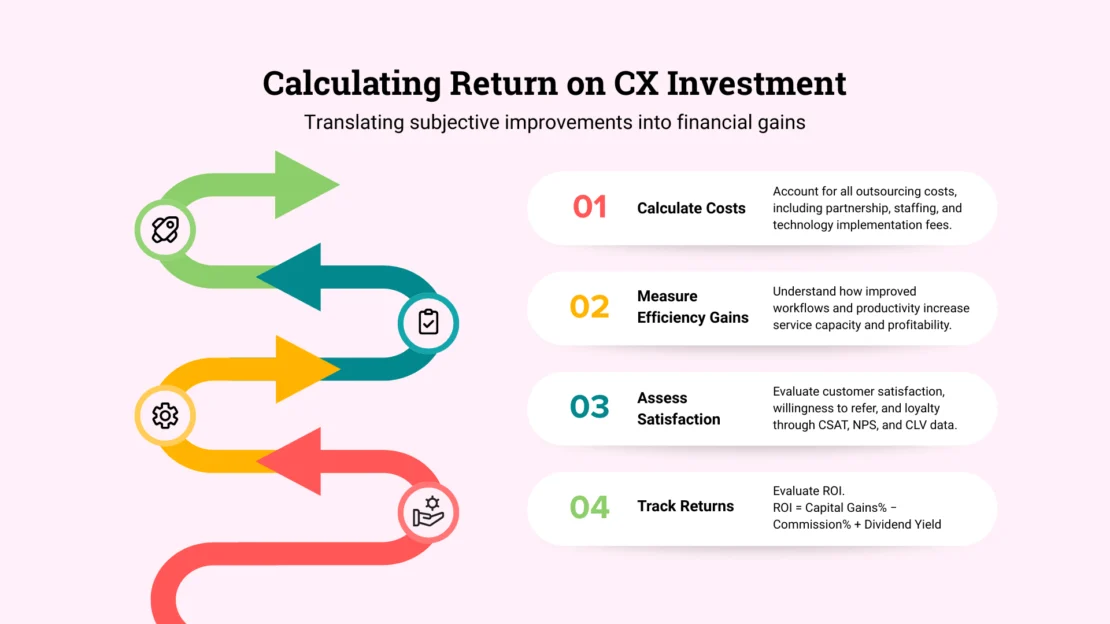
While comparing costs with revenue can provide high-level insights on the success of overall changes, a more detailed look into the impact of each solution will help you more accurately identify the return on your CX investment. CX can be complex, with subjective and intangible factors that are difficult to translate to financial gains.
So CX ROI depends on what goals you set. Successful CX-obsessed corporations prioritize these metrics for greater revenue capture and return on investment:
- Reduced churn
- Increased customer satisfaction and loyalty
- Operational cost savings
Operational efficiency gains through optimized CX workflows
Efficiency gains can also be difficult to track and fit into the CX ROI formula, but they are by no means unimportant! Greater efficiency doesn’t only mean greater satisfaction and agent productivity. It also has a domino effect across all operations such as service capacity, sales opportunities, and operational spend.
Track these operational efficiency KPIs to see how optimized CX workflows leave a lasting impact on your business:
- First-Call Resolution
- Average Handle Time
- Escalations
- Cost-to-Serve
- Resource Utilization Rate
- Quality Assurance
Correlating NPS and CSAT with Customer Lifetime Value (CLV)
No single metric captures the full customer experience, but satisfaction, referral, and retention data help brands measure CX success and identify what makes a high-value customer. These metrics give you deep insights into what actually brings in the revenue over time.
- CSAT evaluates satisfaction with specific solutions immediately following interactions.
- NPS gauges long-term loyalty and overall sentiment.
- CLV is the revenue a company can expect from a single customer over the entire relationship with the brand.
FAQs
- What is a customer experience strategy?
A customer experience strategy refers to the tools, processes, automations, and support tactics a business uses to understand and improve customer experiences. It includes mapping and streamlining customer journey touchpoints across all channels in a unified system for increased service quality and consistency. CX strategy targets high-value customers to reduce churn and increase loyalty.
- How do you measure customer experience improvement?
Brands can measure customer experience improvement by tracking these key satisfaction, performance, and efficiency metrics:
- Customer Satisfaction (CSAT)
- Net Promoter Score (NPS)
- Customer Lifetime Value (CLV)
- Average Handle Time (AHT)
- Customer Effort Score (CES)
- Churn Rate
- First-Contact Resolution (FCR)
- Escalations
- Cost-to-Serve
- Resource Utilization Rate
- Quality Assurance (QA)
- What are the 4 pillars of customer experience?
The 4 pillars of customer experience are understanding customer expectations, seamless omnichannel interactions, personalization, and continuous improvement.
- How does outsourcing impact customer experience strategy?
Outsourcing can help brands completely revolutionize their customer experience strategy, at lower costs and through dedicated expert support. BPO experts leverage CX tools and innovative strategies for a company while providing brand-aligned end-to-end care.
- What is the difference between customer service and customer experience?
Customer service refers to the support that call center agents offer customers to resolve issues or answer questions about products and services.
Customer experience (CX) focuses on the customer’s perceptions, feelings, and overall impression of the brand. CX optimization involves these key strategies:
- Mapping the customer journey to understand expectations
- Optimizing touchpoints of the customer journey for all communication channels to make experiences more seamless and consistent.
- Implementing advanced technology solutions to provide proactive, personalized care
- How do you create a CX strategy for a large enterprise?
CX strategies for large enterprises use the same strategies small- and medium-sized companies follow, using platforms to accommodate large batches of constantly fluctuating data:
- Understand the Voice of the Customer, including customer expectations, preferences, and behavior across the customer journey.
- Unify processes and communications in a single omnichannel CX platform.
- Personalize service at scale via AI tools, workflows, and automations.
- Measure success and evaluate feedback to adapt for improvement.
- Why is journey mapping essential for CX?
Customer journey mapping is essential for CX because it helps brands understand how customers engage with their services and processes. It identifies pain points and successes in all touchpoints and communication channels to inform CX improvement strategy.
- What role does AI play in customer experience strategy?
AI plays multiple key roles in modern customer experience strategy:
- Predictive analytics, including customer sentiment and trend tracking
- Automated reporting
- Automated workflows
- Automated routing
- 24/7 availability in chatbots and AI agents
- Personalization at scale
- Performance analytics
- Escalation management
- Live agent assistance
- Improvement insights
Although AI powers and automates many aspects of CX enrichment, it also requires human oversight, or a human-in-the-loop strategy, for contextually aware implementation.