


What is customer experience technology and how does it drive business growth?
Customer experience technology is a set of tools and systems designed to manage, analyze, and improve customer interactions and perceptions across all touchpoints. It drives business growth by streamlining operations, enabling personalization, and using data-driven insights to boost efficiency, satisfaction, loyalty, and revenue.
Read Time: 10 minutes
Table of Contents
Introduction
Customer experience and technology are no longer separate disciplines. They are deeply intertwined drivers of modern business success. This blog explores how CX technology streamlines interactions, enhances operational efficiency, and enables organizations to better understand and serve their customers across every touchpoint of the customer journey. From core functionalities to emerging trends, it outlines how integrated CX tech empowers smarter, more personalized, and future-ready customer experiences.
Key takeaways
- CX technology unifies data, interactions, and insights across the customer journey.
- AI, automation, and personalization are central to operational efficiency and customer loyalty.
- Strategic, ethical CX tech integration is essential for long-term success.
- A scalable, interoperable CX tech stack helps businesses reduce friction, maintain trust, and stay ahead of evolving customer expectations and industry trends.

The intersection of Customer Experience and technology

Seamlessly managing interactions with customers requires powerful infrastructure, expert teams, and advanced technologies. Customer experience technology makes the job easy and secure, streamlining processes and empowering effective engagement that drives real results in operational efficiency and business success.
Customer experience technology refers to the innovative tools, systems, and software that are designed to enhance CX. Built to optimize interactions across platforms and channels, CX tech enables faster, smarter support, cultivating better experiences across the customer journey.
While traditional Customer Relationship Management platforms maintain detailed records of customer interactions, CX technology focuses on customer experiences and perceptions while providing insights to improve. Advanced features track, analyze, and manage the perceptions customers have about a business, enabling teams to enrich various touchpoints of the customer journey.
What is CX technology? Core functionalities
Understanding how customer experience tech operates allows you to accurately and effectively use available capabilities to their full potential, making the most of your investment and ensuring a smooth operational transition. These core functions push CX technology forward for industry-leading CX strategies.
Data aggregation and management
CX technology aggregates, or collects, data from various sources, summarizing information into a single dataset that can then be analyzed into actionable insights. Data aggregation sorts information by time, location, or attribute for deep looks into customer behaviors and preferences.
CX technologies automate data annotation, aggregation, and management, leveling up operations and data analysis in distinct ways.
- Efficiency: Automated data compilation allows teams to focus on face-to-face interactions, business strategies, or other complex tasks.
- Accuracy: Software tools and algorithms remove human error common in manual data collection, cleaning, and management.
- Scalability: CX tech seamlessly and quickly handles large amounts of data, making it ideal for large-scale projects or industries experiencing fluctuating demand.
Interaction orchestration
Interaction orchestration is how a CX technology system works with other systems to align various automated tasks in one place, creating a unified framework that optimizes the entire customer journey. This boosts operational efficiency in key ways:
- Securely integrates with external systems
- Allows brands to customize their CX tech stack integration to specific needs
- Ensures seamless workflows
- Elevates and maintains service consistency
Performance analytics and reporting
CX technologies analyze the success of your solutions and your team, scoring quality based on predefined criteria and customer feedback. Automated performance analytics is essential to enhancing operational efficiency and continued business success.
Use analytics and reporting tools in these ways to optimize your customer experience and technology strategy.
- Collect the right data. Utilize CRM logs, helpdesk information, post-interaction surveys, and live customer sentiment data for a comprehensive view of CX performance.
- Clearly define Key Performance Indicators (KPIs). Assess relevant metrics to evaluate success. Track Net Promoter Score (NPS), Customer Satisfaction (CSAT), Customer Effort Score (CES), First-Contact Resolution (FCR), Average Speed of Answer (ASA), and Average Handle Time (AHT).
- Visualize data. Customize reports into dynamic interfaces to identify anomalies or trends.
- Automate reports. Weekly and monthly insights empower teams to proactively resolve issues or act on emerging trends when it matters most.
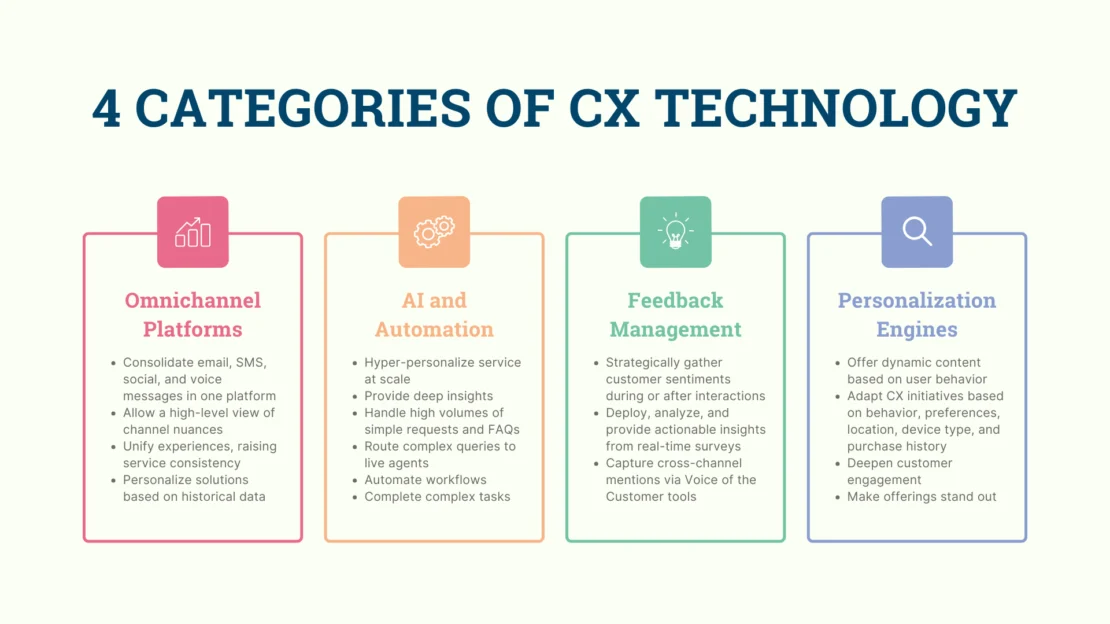
Primary categories of Customer Experience tech
Sifting through the wealth of CX systems available can be a hefty task. Find the right fit for your needs by searching in the right place. Tailor your search to what you need in a CX engagement management platform by aligning your requirements with one of these types of CX tech.
Omnichannel communication platforms
Some CX systems specialize as a one-stop shop for handling all kinds of customer queries. They consolidate email, SMS, social, and voice interactions in a single platform, allowing a high-level view of channel nuances and advanced strategies tailored at enhancing CX in every platform.
This focus enables dynamic customer engagement, elevating service in key ways.
- Real-time responses meet customers where they’re at for more convenient, faster care.
- Historical data highlights areas to personalize service, providing solutions proven to increase satisfaction.
- Example: Automatically matching customers with ideal agents based on language, location, history, skillset, or preference.
- Unified experiences foster strong relationships with customers, boosting loyalty.
- Real-time feedback provides tips for keeping up with evolving customer expectations.
Artificial Intelligence and automation
AI and automation CX platforms transform customer interactions and hyper-personalize service in ways humans cannot do alone. These features are particularly effective for significantly boosting operational capacity, reducing costs, and streamlining processes. AI-focused CX platforms use the following tools for increased efficiency and responsiveness.
- Natural Language Processing (NLP) enables programs to understand and generate human language in meaningful ways.
- Chatbots handle simple requests and FAQs, effectively managing volume.
- Automated routing directs customers to live agents for complex queries, reducing wait times.
- Automated workflow triggers offer fast, effective service based on predefined rules and actions.
- Examples: Sending happy birthday emails and notifications to customers or diverting tickets to relevant teams.
- Agentic AI platforms complete complex tasks with minimal human supervision.
Customer Feedback Management (CFM)
Vital to enhancing CX and helping customers feel seen and heard is understanding and acting on customer feedback. CFM-focused technology sees the importance of this, using strategic methods to proactively gather customer insights and implement them into business strategy.
Use these methods to better understand, interact with, and serve customers.
- Real-time surveys: Gather more insights into how customers feel about solutions and service by asking for quick feedback during or immediately following interactions.
- Sentiment analysis: CFM-focused CX technology tracks how customers feel about provided solutions for advanced service offerings and live agent assistance.
- Voice of the Customer (VoC) tools: Capture what customers are saying about your business across channels to understand what they expect from your products or services.
Want to scale your business?
Global Response has a long track record of success in outsourcing customer service and call center operations. See what our team can do for you!
Personalization engines
Automation is enabling BPOs to hyper-personalize service at scale. Adjust your strategies for each user by utilizing customer-centric CX tools that offer dynamic content delivery based on user behavior. Customize what a user sees in real time to deepen customer engagement and make your offerings stand out.
Advanced CX should adapt content based on unique context:
- Behavior
- Preferences
- Location
- Device type
- Purchase history
Strategic importance: Why integrated CX tech matters
CX tech isn’t just an item to check off a list of things every business should have. It plays a crucial role in developing the types of relationships you want to have with customers — relationships founded in understanding, inspiring meaningful action.
Discover these additional benefits of strategically integrating CX technology into your business model. These benefits can also help you measure the success of your CX technology integration, identifying areas for further growth.
Reduced friction in the customer journey
CX tech alerts teams to hiccups, bugs, issues, and inefficiencies across touchpoints of the customer journey, allowing businesses to make meaningful adjustments that reflect their commitment to quality.
Reduced friction drives real improvements in key performance areas:
- Customer satisfaction
- Customer loyalty
- Conversion rates
- Net Promoter Score (brand reputation)
Increased Customer Lifetime Value (CLV)
While every purchase is a win, loyalty is becoming increasingly important in this ever-evolving digital marketplace. Personalization is raising standards, catching and holding attention when it matters most. Engage customers as valued members of your community by integrating CX technology into your strategy.
Dive into best practices for increasing CLV to develop a strategy that stands the test of time.
Operational cost reduction via self-service automation
A CX tech stack integration will optimize operational costs and boost efficiency and engagement, proving a more than worthwhile investment for your business. AI features will also increase service capacity and efficiency for extra benefits to your bottom line.
- Expanded self-service tools and automated support empower customers to resolve issues outside of business hours or during peak times, reducing the reliance on human agents.
- As AI tools grow more sophisticated, models will be able to complete increasingly complex requests for more dynamic, personalized support.
- Customizable options allow teams to balance artificial intelligence with emotional intelligence, routing customers to live agents when necessary and preserving the irreplaceable human touch in CX.
Building a CX tech stack: Implementation steps
Once you’ve found your ideal CX tech stack, get ready to implement it into your operations. Follow these steps to ensure a smooth, secure transition pointed toward success.
- Audit existing legacy systems. Look for inefficiencies and errors and document steps for managing them, along with areas to improve.
- Prioritize interoperability and API flexibility. Whether your new CX tech stack is a total change or a supplemental add-on, it should empower seamless communication between all systems you plan to use. Define standards for accessing and updating records for effective communications.
- Consider scalability needs. Particularly important for growing enterprises, scalability is vital for cost-effective operations experiencing fluctuating demand or rapid growth. CX technology should easily handle your expected volume, reducing or eliminating downtime or technical issues.
Emerging trends in CX tech
As CX tech usage grows, so does the flexibility and power of each AI feature. Leaders in CX keep ahead of the trends, evaluating performance and identifying areas not only to improve but also to use tools in innovative ways to exceed customer needs.
Proactively monitor and plan for further CX technology success by analyzing the future of customer service agents and keeping an eye on these customer experience technology trends in 2026.
Predictive CX
Predictive analytics allow teams to pivot from reactive to proactive service. They analyze historical and real-time data, detecting trends and predicting behavior with more accuracy and speed than ever before.
Hyper-personalization via generative AI
Cutting-edge CX technology tailor interactions to user behaviors, preferences, and needs for more successful interactions. Leverage AI in customer support with these tactics:
- Real-time content that adapts to user behavior
- AI-driven product recommendations
- Dynamic pricing based on demand and competitor pricing
- Virtual shopping assistants
Ethical data usage and privacy-first CX
Crucial for maintaining trust and compliance adherence with privacy laws, ethical usage should follow key practices. Evaluate data compliance within CX platforms for secure operations.
- Data privacy: Customer data is collected only for legitimate purposes, giving customers control over usage. Data collection and usage should be transparent.
- Bias audits: Regularly audit models for biases to produce fair results and avoid discrimination.
- Clear consent: Plain-language consent agreements, with options for opting in or out easy and respectful without degrading experiences.
- Data minimization and encryption: Only collect necessary data. Use encryption to protect sensitive information.
- Discrimination protections: Design AI systems to avoid unjust treatment.
- Notice and explanation: Clearly disclose the use of automations and explain how they impact users.
- Human alternatives: Provide options to access human support when necessary.
Learn more about risk-free CX operations following laws such as GDPR and CCPA in this call center compliance guide.
CX Technology Frequently Asked Questions
- What is the difference between CRM and customer experience tech?
A CRM is a Customer Relationship Management platform that maintains detailed records of customer interactions. CX technology focuses on elevating customer experience. It uses AI tools to track, analyze, manage, and enrich the customer journey based on real-time data. - How does CX technology improve customer retention?
CX technology improves customer retention by raising the quality and speed of customer experiences, building brand loyalty through personalized support and smoother customer journeys. - What are the most essential tools in a CX tech stack?
The most essential tools in a CX tech stack include these components:- A flexible API that includes or seamlessly interacts with a CRM
- Predictive analytics
- Feedback gathering tools
- Product information management
- AI-powered omnichannel communication
- A strict security framework, with access controls and encryption
- Personalization engines
- Is AI a requirement for modern cx technology?
AI is not a requirement for modern CX technology, but it is propelling innovations in understanding, managing, predicting, and personalizing customer experiences, behaviors, and relationships. AI is helping brands offer more intuitive care to stand out in a competitive marketplace and build increasingly important customer loyalty.