

Read Time: 10 minutes
Table of Contents
Introduction
Most digital transformation budgets are already committed, but a majority of initiatives underdeliver — not for lack of technology, but for lack of talent, integration, and execution capacity. Outsourcing offers companies the fastest route to transforming talent and tooling. High-quality providers leverage digital transformation and business process outsourcing to access and optimize talent and create value in measurable customer success improvements. Use this guide to understand what makes a good digital transformation BPO partner, what these strategies cost, and how to implement a strategy built for the future.
Key takeaways
- Digital transformation is key to remaining competitive in an ever-evolving digital landscape.
- BPO helps companies access expert human talent to unify experiences, transforming operations and success with powerful technology solutions.
- Large enterprises can spend $27.5 million on digital transformation. Outsourcing drops that down to $270 thousand per year with dedicated agent support.
- Companies should choose a digital transformation BPO partner by evaluating their data security measures, technology integration depth, transition plan, reporting cadence, agent attrition rates, and dedicated agent models as well as their historic success.

How business process outsourcing accelerates digital transformation

Business Process Outsourcing (BPO) accelerates digital transformation by connecting brands with expert talent and implementing cutting-edge tools that expand operational efficiency and capacity. Once solely a cost-saving play, BPO has shifted to digital transformation and business process outsourcing as a transformation engine as organizations use technology advancements to not only streamline operations but also enhance CX. Understanding how outsourcing accelerates digital transformation positions brands as leaders and innovators in a competitive landscape.
The technologies a modern BPO partner brings
Digital transformation outsourcing now represents 70% of total BPO contract value, up from 30% four years ago. As technologies and customer expectations grow at an unprecedented rate, modern providers keep up with BPO and digital transformation strategies equipped with key CX tools.
- Artificial intelligence (AI): AI tools replicate human language and thought to perform tasks requiring intelligence.
- Robotic Process Automation (RPA): Programs use software robots, or bots, to automate repetitive rules-based digital tasks.
- Intelligent automation: IA combines AI, RPA, and business process management to automate complex tasks older models struggle to complete. IA analyzes data, learns from patterns, and makes decisions to improve accuracy and processing speed.
- Analytics: AI analytics use Machine Learning (ML), Natural Language Processing (NLP), and data management techniques to find patterns in data, foresee trends, extract insights, and make predictions to inform decision-making.
- Omnichannel technologies: Modern partners bridge gaps in service across social media, email, live chat, phones, self-service portals, chatbots, and SMS text messaging in a single space.
Where digital transformation and BPO create the most value
Without a clear strategy, a unified vision, expert human talent, and enthusiasm to embrace unfamiliar systems, companies are reluctant to incorporate digital transformation across processes. Instead, they rely on technology-driven support for only certain aspects of their process enrichment, like repetitive back-office tasks. This fails to capture the potential of the fully integrated and optimized systems of digital outsourcing, leading to resource waste and lessened operational impact.
Front-office CX transformation vs. back-office process transformation
Digital transformation in BPO compounds when the customer-facing layer and the process layer are digitized together. Administrative, or back-office, tasks handle the routine requests and queries at scale and enable companies to scale, but without predictive analytics and intelligence automation, brands remain reactive to fluctuating market landscapes — putting them behind in efficiency and innovation.
Digitally optimized front-end CX transformation puts the power back in your hands, starting with back office digital transformation for increased efficiency. Picture business process outsourcing digital transformation in terms of these front- and back-end capabilities.
- Front-end: Omnichannel. Unified interaction management eliminates siloes, streamlines the customer journey, and increases messaging consistency at scale.
- Front-end: AI capabilities. Auto-QA, live chat, real-time language conversion, auto-generated reports, and live agent assist increase service quality and consistency.
- Back-office: Automation. High-powered tools increase efficiency and capacity, reducing reliance on human talent for manual tasks. BPO automation and AI are becoming the standard for high-performing brands.
- Back-office: Analytics. Real-time analytics capture trends and insights, allowing proactive, personalized decision-making that reduces errors and increases loyalty.
Want to scale your business?
Global Response has a long track record of success in outsourcing customer service and call center operations. See what our team can do for you!
What it costs and how to model the ROI
Digital transformation presents significant ROI, both upfront and long-term, if implemented strategically. Work out how to capture your customer experience digital transformation ROI goals by understanding what the different approaches to digital transformation and digital outsourcing require.
Key factors
Companies should build digital transformation outsourcing budgets taking into account how key factors not only drive costs and savings but also impact operational efficiency and customer success.
Project scope: Higher upfront expenses for long, detailed outsourcing projects significantly boost service quality, consistency, and capacity across teams, optimizing costs and enhancing long-term scalability and business success.
Organizational reconfiguration: Labor arbitrage is cornerstone to outsourcing’s digital transformation cost-efficacy. Shifting work to regions where labor costs significantly less reduces operational expenses while allowing internal teams to focus on core competencies or other revenue-generating initiatives. By prompting businesses to make comprehensive organizational changes, digital transformation boosts efficiency, realigns strategic initiatives, and enhances productivity.
This reinvestment loop provides continuous opportunities for cost savings and increased efficiency, allowing brands to see true BPO transformation across their digital transformation outsourcing services.
Outsourcing → Savings → Reinvestment of Resources → Funding Automation → Further Savings.
Technology investments: Worldwide spending on digital transformation is forecast to reach almost $4 trillion in 2027. Digital transformation outsourcing helps companies access new tools at reduced rates, often waiving implementation fees or providing additional tech and moderation support.
Cost breakdown
BPO transformation outsourcing costs depend on the operational model (dedicated agents vs. shared), services offered, and project scope. Dedicated agents are billed hourly, per-agent, while shared agents are billed per-minute or per-interaction. Prices also vary by sourcing location, each offering varying levels of expertise, purpose, and brand alignment to help companies find the best fit.
- Dedicated agents billed per-hour, per-agent
- Onshore: $40k-$60k per seat per year
- Nearshore: $18k-$32k per seat per year
- Offshore: $9k-$20k per seat per year
- Shared agents billed per-minute or per-interaction, per agent
- $1/min, 5-min average calls per agent, per month
- $15k-$30k per seat per year
Total Cost of Ownership is the complete financial estimate of acquiring, operating, maintaining, and disposing of a service over the entire lifecycle, including direct and indirect costs of customer experience digital transformation. This metric is critical in gaining a realistic view of long-term financial impact of digital transformation initiatives and optimizing spending according to your needs.

ROI signals
Savvy decision-makers understand that numbers only tell one side of the story. Anticipate how well a vendor can meet quotes by looking at their approach and how their results back them up. Demand these ROI signals to determine quality, prevent the hidden costs of scope drift or rework, and find a partner who measures up to your bottom line.
- CSAT lift measures how much the partner can increase a client’s Customer Satisfaction Score. This is key to understanding customers and proactively adjusting BPO automation and AI strategies to meet needs.
- Cost-per-contact reduction is how much a BPO provider lowers the cost of handling a single customer interaction without sacrificing service quality.
- Time to value is the period between contract signature to when the client experiences a meaningful, measurable benefit — or the agreed-upon value — from the service.
How to choose a BPO partner for digital transformation
Digital transformation is so named because the right BPO partner views technology not just as a standard feature of customer support, but as an overarching mindset that transforms each aspect of your operations. Competitive BPO transformation vendors are leaders in customer experience enrichment, using powerful operational models and innovating the latest in technology to better understand and meet evolving customer needs.
Vendor evaluation
Every outsourcing digital transformation option will say they’re the best, impressing with flashy sales pitches and claims that can be difficult to verify. Funnel your BPO search into an accredited, secure, brand-aligned partner by asking key questions to understand what their operations are really like.
Score answers using this vendor-evaluation checklist:
- Prioritizes data security and compliance with PCI DSS, HIPAA, SOC 2, and industry-specific regulations using secure encryptions and strict access controls.
- Smoothly integrates with existing stack.
- Implements a thorough, rigorous, transition and onboarding plan that optimizes time to value without disrupting operations.
- Sets and follows through with regular reporting cadence and Quarterly Business Reviews, tracking and analyzing key metrics.
- Improves agent retention rates and tenure
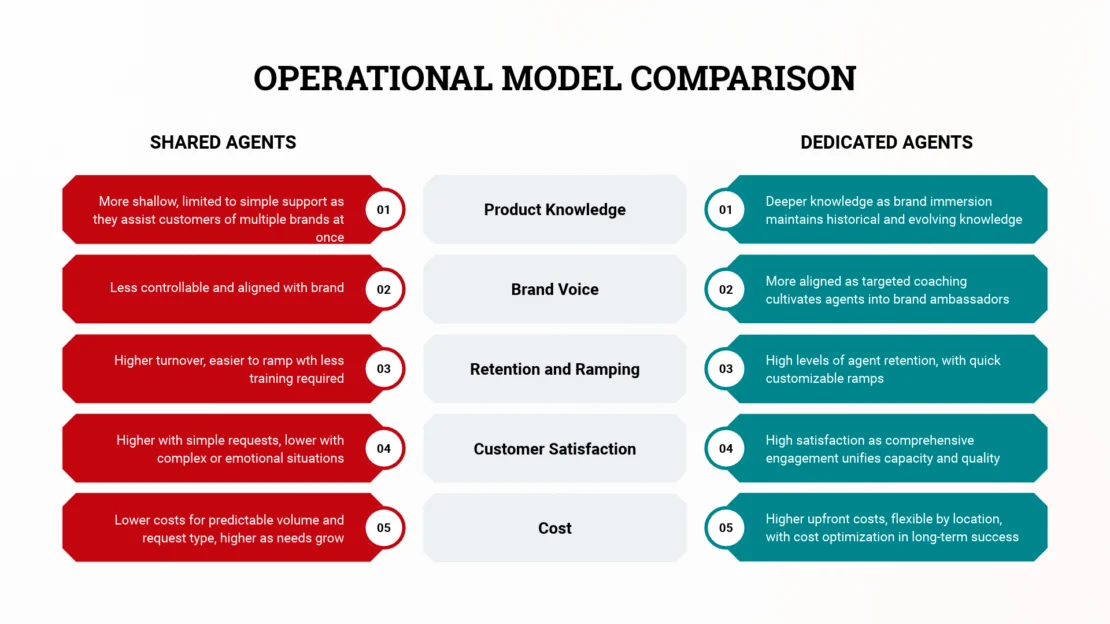
Dedicated agents vs. shared-pool agents as a transformation lever
Not every brand is ready to outsource dedicated agents, but businesses situated to make the change should look at the partnership as an opportunity for transformation, not just cost savings. Digital transformation optimizes processes, customer journeys, and workflows, but it requires expert human governance to ensure security, maintain quality, and personalize service the way customers are coming to expect in the modern age.
Invest in the right talent, using the right tools, in the right setup. Competitive businesses know when to use shared vs. dedicated agents.
Shared agents, contracted per-minute or per-interaction, are best for short-term projects with predictable volume and simple requests. They work for multiple brands at once, limiting depth of knowledge or escalation handling capability.
Dedicated agents, contracted hourly per-agent, work only for your company. This grants you and your partnership the freedom to strategically allocate their resources to turn support from reactive service to proactive engagement. With advanced tools, brand immersion, and continuous coaching and training, agents can be brand ambassadors who make significant improvements in customer satisfaction and loyalty.
Agents who “eat, sleep, and breathe your brand” and work only for you internalize product knowledge and culture in a way shared ticket-farm models cannot.
Needing a customer engagement solution that could adapt to changing technologies without losing its signature luxury brand, LACOSTE chose Global Response for our industry best practices and engagement of Brand Specialists to deliver the best service possible to every customer. Global Response’s technological innovation, brand alignment, and superior service embodied LACOSTE’s values and increased customer conversion and retention.
Real-world results
Digital transformation is making waves across industries as companies enrich experiences with advanced, comprehensive, human-led, tech-driven support. See how the approach makes significant impacts in key metrics for today’s leading brands.
Expanded coverage: Rack Room struggled to integrate customer care across all channels, particularly emerging ones. They partnered with Global Response, whose Brand Care team supported not only the original request of calls and emails but also implemented social media monitoring and management to understand customers’ perception of the brand.
Integrating customer care with marketing, public relations, and leadership teams and using streamlined processes and unified workflows, Global Response helped Rack Room capture 84% savings on social monitoring while expanding coverage by 110%.
eCommerce transition performance: Demand surge overwhelmed ASICS, who lacked an omnichannel solution to support increased customer contacts or a shift in volume to eCommerce and direct customer sales. ASICS needed a highly skilled and strategic customer experience team to support the rapid transition into more extensive sales during the COVID-19 pandemic.
Global Response helped them transform their omnichannel customer solutions and scale for outstanding business results. Our scalable team proactively addressed demand in a one-team mindset, boosting eCommerce transition performance by 130%.
Online sales: FILA saw increased complaints about their previous BPO provider, leading to a significant negative impact on FILA’s sales. Global Response turned customer experience around from frustration and lack of trust to brand-obsessed repeat customers by standardizing support and reflecting the voice of the customer in a unified, collaborative, one-team mindset.
Order and refund queries dropped by 28% after CX overhaul, with retail and eCommerce sales increasing by 25% for FILA.
FAQs
How does business process outsourcing accelerate digital transformation?
Business process outsourcing accelerates digital transformation by helping brands access leading technology solutions and expert global talent at reduced rates, unifying service and improving efficiency throughout the customer journey.
What is the difference between digital transformation and BPO?
BPO is the practice of contracting with a third-party service provider to handle certain business processes. Digital transformation is a service outsourcing companies can provide by implementing omnichannel technology to streamline back-end workflows and front-end customer experiences.
Is outsourcing digital transformation cheaper than doing it in-house?
Yes, outsourcing digital transformation is often cheaper than trying it in-house. BPOs help brands target the solutions they need, managing the solutions and support for them with cost-saving workforce solutions and often waiving implementation or service fees.
Can outsourced agents represent our brand during a transformation?
Yes, outsourced agents represent your brand during the transformation. A reputable BPO provider immerses agents in your standards, processes, and culture and follows a thorough transition plan to maintain service quality during implementation.
What technologies do BPO providers use for digital transformation?
BPO providers use omnichannel customer experience enrichment technologies, often AI-driven, for digital transformation. These can include their own innovative solutions or programs built for customer experience management and interaction handling, including telephony and workforce management. Technologies integrate seamlessly and securely with a variety of CRMs for a smooth turnover.
How do you choose a BPO partner for digital transformation?
Leaders should choose a BPO partner for digital transformation based on relevant technologies and services available, access to specialized talent, attention to brand culture, dedication to security and compliance, and experience driving the results they seek.
How long does it take to see results from BPO-led digital transformation?
Time to value for BPO-led digital transformation depends on the goals and expectations set, but partners should expect to see results in the first 30 to 60 days, with continuous improvement.
Does digital transformation through BPO mean replacing people with AI?
No, digital transformation through BPO doesn’t necessarily mean replacing people with AI. AI requires human governance to maintain accuracy, security, compliance, and brand-aligned engagement. However, AI can streamline manual processes and handle simple-to-complex queries, increasing service capacity and quality so human support can focus on other tasks or initiatives.