


Read Time: 11 minutes
Introduction
Table of Contents
The dynamic, omnichannel shopping experience full of flashy, ever-evolving competition demands brands prioritize an equally compelling customer experience of their own.
But knowing how to get there takes effort, first in understanding what customer experience, or CX, is. The term “customer experience” may sound vague, especially since it varies so largely between industries and companies. On the other hand, the “CX” abbreviation can sound too limiting, a piece of jargon that brings to mind a tech-forward approach some people think doesn’t apply to their business.
We’re here to help you get the full picture of what CX really includes. Customer service has three dimensions, and gaining a deep understanding of each will help you identify and implement actionable insights to revolutionize your strategy and impact.
Key takeaways
- Customer experience has three essential dimensions: functional (efficiency and usability), emotional (how customers feel), and social (identity and values). Each must be addressed to deliver a truly impactful experience.
- Balancing all three dimensions leads to stronger customer relationships, increased loyalty, and long-term success across industries like retail, tech, and healthcare.
- Tools like journey mapping, empathy training, and Voice of Customer programs help businesses identify gaps and improve experiences across every stage of the customer journey.

What are the 3 dimensions of customer experience?

Breaking customer experience into three dimensions, or aspects, will help you enrich operational efficiency without sacrificing customer experience. In fact, focusing on each dimension ensures you fully understand your customers’ approaches to your products and services. Learn how to serve their needs and align your goals with theirs by optimizing these customer experience dimensions.
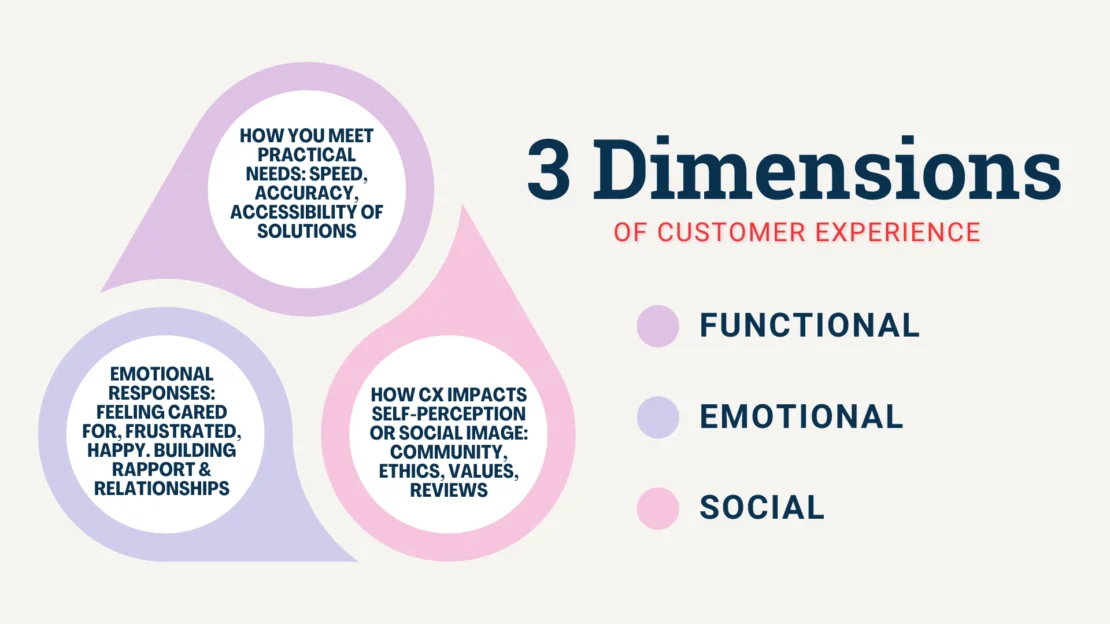
1. Functional dimension: Getting the job done
Functional CX is how you meet your customers’ practical needs. Customers gain value because they can complete a task they came to your platform or service to do. This can be measured by the speed, accuracy, and accessibility of a solution or feature.
Some examples of functional CX:
- An easy-to-use app
- A fast checkout experience
- On-time delivery
In short, functional CX is the effectiveness of your solutions. It sounds simple, but opportunities abound for bugs, fixes, and extra time- or experience-saving efforts. Optimize your functional CX starting with these basic strategies:
- UX design: Is it user-friendly? What UX research should you implement to ensure it is?
- Clear processes: Are steps and procedures intuitive, with clear benchmarks or sub-processes for tangential tasks?
- Automation: What automated responses, tips, live chats, or other features can help customers resolve their own problems or answer their own questions?
Functional CX can come in the form of self-service options, which contribute to your 24/7 availability and scalability.

Download our Key Traits of 3-Dimensial CX Checklist
2. Emotional dimension: How the customer feels
The emotional response to interactions, services, issues, or resolutions is just as important as the solution itself — if not more. People have selective memories, so negative experiences can have a greater impact than positive ones. Prioritizing customers’ emotions will not only help agents de-escalate situations, but it can also turn frustrated or ambivalent customers into loyal ones.
Examples of emotional CX:
- Feeling cared for by support staff
- Frustration from being on hold too long
- Wanting to feel understood or listened to by a support agent
- Establishing rapport between agent and customer
- Building relationships based on common product-related passions
Follow these simple but effective steps to optimize your emotional CX:
- Implement empathy training
- Coach agents on the potential effects of various tones of voice
- Personalize service
- Use sentiment tracking technology to analyze how emotions evolve across different touchpoints and channels
- Implement a customer feedback loop
When customers feel seen and heard, dissatisfaction wanes, opening opportunities to ensure satisfaction, retention, and loyalty soar.
3. Social dimension: Identity and belonging
The social aspect of CX is how the experience impacts the customer’s self-perception or social image. Easy to overlook, social CX is important because even the simplest of products can play a vital role in someone’s everyday life, and how you engage with this directly validates or invalidates that.
Some examples of social CX:
- Feeling part of a brand community
- Ethical business practices
- Company values
- Products or services made for a specific purpose or demographic
- Social media conversations about a business
- Reviews
Optimizing social CX sets your business apart by building more positive experiences that deeply resonate with customers. Make sure you’re covering these bases when optimizing social CX:
- Brand alignment: How does your branding or product messaging build the customer’s sense of self?
- Social proof: What are the social conversations around your products, branding, or community? How does your company stay relevant and necessary to conversations you want to be a part of, and how do you avoid the others?
- Loyalty programs: How do you strategically target, incentivize, and engage with the customers that are most loyal to your business?
Understanding the social impact of your products, services, and engagement strategies will help you appropriately enhance the overall customer experience.
Why understanding all three dimensions matters
As with most things, achieving balance between all three customer experience dimensions ensures each is accurately represented in your strategy, helping you achieve more goals with higher-quality efforts. You cast a wider net when all your bases are covered, effectively meeting the needs of customers regardless of whether they prioritize function, emotional needs, or social impact. Also remember to consider these important factors of achieving balance in your comprehensive CX.
The risk of focusing only on functionality
Functionality is a great starting point for enhancing CX. Without a functioning website, app, or processes, you lose customers before you even get them, and customers can’t even complete the journey they want to undertake.
However, beware the pitfall of focusing too much on functionality. Companies that over-engineer without emotional or social context lose the sauce that makes them special, and soon get lost in the sea of competition. Without an emotional impact or a social pull, you forget to focus on what the customer seeks: engagement, connection, a tangible answer to an emotional problem, and social capital.
Our tip: While enhancing touchpoint experiences, look across the journey to understand what it takes to achieve a goal, practically and the emotional or social influences on these steps, touchpoints, and goals.
Emotional experience as a loyalty driver
Emotional CX is so important because it gives customers a reason to choose your business over any other, time and time again. Emotional bonds help companies transcend transactional relationships. Create stronger relationships that drive long-term customer retention with these suggestions:
- Create shared experiences
- Align values with the specific purpose of your brand
- Build community – discussion boards or social media pages
Our tip: Don’t be afraid to grow with your audience and adapt specific messaging to changes in customer sentiments to constantly keep up with your audience’s emotional motivators.
Social CX and modern brand expectations
In the modern age, what customers expect from companies goes beyond the products offered. More interaction brings higher accountability, and more competition — plus plenty of dangerous sources online — brings a sharper eye on your services, communications, and processes.
Customers expect brands to reflect their values and identity not because they’re overly critical but because trust is crucial to building brand loyalty. Especially in times of economic or political turmoil, customers place more value on where they spend their dollar.
Brands that successfully communicate their values and show that they leave a positive impact on society are more likely to foster strong relationships with customers than brands that don’t value social CX.
Our tip: Utilize artificial intelligence to track and analyze the issues most important to customers and emotional intelligence to make human connections that demonstrate your commitment to addressing them.
Want to scale your business?
Global Response has a long track record of success in outsourcing customer service and call center operations. See what our team can do for you!
How to apply the 3 dimensions across industries
We’ve covered the basics of the dimensions of customer satisfaction and some general tips for applying best practices, but we know that application also varies by industry and topic. Try these ideas for enhancing social vs. functional vs. emotional experience in three common industries.
Retail and eCommerce
Retail is more than simply buying a product: It’s investing in a company, voting with your dollar, supporting a small business, or achieving a goal.
Functional: Ensure your checkout processes online and in store are seamless, intuitive, and bug-free.
Emotional: Beware emotional cues in product packaging. Thoroughly test messaging in pre-production, edit in production, and promptly address errors or innuendos that slipped through.
Social: Professionally respond to positive and negative social proof via reviews. Create opportunities to leverage social capital through influencer tie-ins relevant to your business or brand culture.
SaaS and tech
Turn your software and technology company into an industry leader by adding value to your business with these critical customer perception drivers.
Functional: Streamline onboarding user experience (UX) with issue-free customizable features.
Emotional: Offer compassionate 24/7 technical and product support. Foster community engagement in forums and show that you value members’ ideas.
Social: Build advocacy and referral programs to get the word out about your product, with live demos, FAQs, and user tips.
Healthcare and wellness
Whether your business is a healthcare provider or a wellness product, personal safety and security are of the utmost importance to establishing trust and fostering relationships with patients.
Functional: Strictly follow all relevant regulations and use HIPAA-compliant agents and methods to ensure patients can access records or book appointments.
Emotional: Establish a high standard of empathy in care by continuously training staff on common issues, proper responses, and de-escalation or active listening techniques.
Social: Be transparent about practices and values. Contribute to health equity by removing barriers, educating audiences, and following clearly defined ethical practices.

Tools and strategies to improve all 3 dimensions
With imagination and the proper resources, there’s no limit to the amount of ways you can enhance customer experiences functionally, emotionally, and socially. Thankfully, those resources include more than just your brain. You can optimize the efficiency and effectiveness of CX by using these industry-specific tools and customer care strategies:
- Voice of Customer programs: Track customer feedback, needs, expectations, and preferences in surveys, focus groups, and online content analysis.
- Journey mapping: Map the customer journey from beginning to end to identify problem points and evaluate effectiveness of processes from touchpoint to touchpoint.
- Empathy training for teams: Sophisticated technology analyzes communications and offers real-time and post-interaction sentiment and solution feedback. Regularly train individuals and teams for empathy in high-stress situations.
- Brand storytelling alignment: Focus on core values to offer customers compelling reasons to be loyal to your business or program.
- CX measurement frameworks: Regularly evaluate how customers feel about your efforts and adapt strategies according to responses in Net Promoter surveys, Customer Effort Score, and Customer Satisfaction scores.
Conclusion
Enriching the functional, emotional, and social aspects of customer experience is key to understanding audiences and connecting more deeply with customers. This cross-dimensional thinking in designing CX creates a connection that increases loyalty and drives long-term success.
Each dimension plays a vital role: the functional ensures seamless, efficient service; the emotional builds trust and connection; and the social strengthens a customer’s sense of identity and community with your brand. When thoughtfully balanced, these elements create an experience that feels intuitive, personal, and meaningful.
Whether you’re in retail, tech, healthcare, or any other industry, optimizing all three dimensions isn’t just good practice — it’s essential for sustainable growth. Use the tools, strategies, and insights outlined here to develop a CX approach that not only meets customer expectations but consistently exceeds them.
Audit your customer journey or download this checklist to optimize the three dimensions of your CX.
3 Dimensions of CX FAQs
The three key components or dimensions of customer service are functional, emotional, and social customer experience.
Functional differs from emotional CX by focusing on the practical aspect of customer experience, such as how platforms work and how quickly customers receive assistance, while emotional focuses on how customers feel about solutions.
Yes, you can improve emotional experience with automation! Automations can streamline operations and answer questions easily, reducing frustration and improving emotional experience by offering customers the solutions they’re seeking.
Yes! The 3 dimensions of customer experience are equally important. Balancing efforts between functional, emotional, and social experience ensures every customer need and expectation is met and customers have a comprehensive experience with a company.