


Read Time: 17 minutes
Table of Contents
Introduction
Imagine you’re seven months into a new outsourcing partnership. Customer satisfaction is slipping, your top agents are leaving your organization, reporting is nonexistent, and every request seems to trigger a change order. These problems didn’t just randomly start in month seven. They started way before the contract was even signed, when the right outsourcing questions weren’t asked.
The challenge is that many questions to ask outsourcing companies produce polished, yet predictable answers. Vendors can easily point to certifications, years in business, and stunning references. Those credentials are absolutely important, but they don’t show how a partner performs during peak season, how they maintain your brand voice, or how transparent they will be when issues arise.
The questions on outsourcing in customer experience that truly matter are the ones that expose operational maturity. This guide goes beyond generic due diligence and provides the strategic questions every CX leader should ask before signing with a contact center partner.
Key takeaways
Standard vendor questions validate credibility but rarely predict long-term performance.
Dedicated agents often provide stronger brand consistency and customer outcomes than shared-agent models.
Ask account-specific questions about attrition, onboarding, QA visibility, and governance—not company-wide averages.
AI governance, pricing transparency, and exit terms should all be defined before contract signature.
Strong outsourcing partners welcome detailed evaluation because they have documented processes and measurable results to support their answers.

Why Generic Outsourcing Questions Get Generic Answers

When you are evaluating a contact center partner, it’s easy to default to a list of basic questions:
- How long have you been in business?
- What industries do you serve?
- Which certifications do you have?
- Can you provide client references?
- What are your prices?
These questions are a fantastic way to determine whether the business is legitimate or not. While these are necessary call center outsourcing questions, they are only the starting point.
Buyers today are evaluating outsourcing differently than in previous years. According to Deloitte’s Global Outsourcing Survey, cost reduction has become a less dominant driver for outsourcing decisions because organizations are starting to focus more on scalability and customer service outcomes. This means that as expectations evolve, so should the questions to ask outsourcing companies during the evaluation process.
The first step in asking better outsourcing questions is recognizing the difference between questions that validate a vendor’s credentials and questions that reveal how they will actually perform once your program is live.
The Three Things Standard Due Diligence Actually Measures
Traditional due diligence plays an important role in any vendor evaluation, but it’s important to understand what it actually measures. Most standard call center outsourcing questions are designed to confirm that a provider is qualified and able to support your business.
Generally, standard due diligence evaluates three core areas:
- Operational credibility: Is the provider financially stable, established in the industry, and equipped with the infrastructure needed to support your business?
- Risk and compliance: Do they meet your security and regulatory requirements through certifications and compliance standards?
- General experience: Have they successfully supported organizations in your industry or with similar customer bases and can they provide references or case studies that demonstrate those capabilities?
These are foundational call center outsourcing questions that every buyer should ask. A provider can have decades of experience and every major certification but can still struggle with inconsistent staffing or poor communication after the contract is signed. Organizations need to dive deeper in order to determine if the outsourcing provider is the right fit.
What It Misses and Why It Matters for Customer Experience
The most successful outsourcing relationships are defined by what happens after the sales team hands your account to operations. Therefore the most valuable questions on outsourcing in customer experience focus on how work actually gets done.
For example:
- Are agents dedicated (they work exclusively with your brand) or are they shared (they work with multiple brands)?
- How does the provider maintain brand consistency when new agents join the program?
- What visibility will your organization have into quality assurance?
- Who governs AI-powered customer interactions and how are changes made?
- What happens when contact volumes spike unexpectedly or a customer issue falls outside of standard procedures?
- If pricing changes during the partnership, what triggers those changes?
It is questions like these that will reveal the maturity of the provider rather than just asking how many years they have been in service. They also will give you insight into the people and processes that will shape the customer experience after implementation. A provider’s ability to maintain consistency and adapt as your brand evolves will have a greater impact on long-term success than any credential listed in a proposal.
One of the best places to start is by understanding who will represent your brand. That’s why one of the most important areas to evaluate is the provider’s agent model and approach to brand alignment.
Questions About Agent Model and Brand Fit
Agent staffing models are one of the main areas that outsourcing providers will vary. Many organizations assume they are receiving dedicated agents but in reality some providers use shared agents where representatives work for multiple brands. That distinction has enormous implications for customer experience because it influences everything from product knowledge and average handle time to brand consistency and customer loyalty.
Want to scale your business?
Global Response has a long track record of success in outsourcing customer service and call center operations. See what our team can do for you!
Are the Agents Who Support Our Account Dedicated Exclusively to Our Brand or Shared Across Clients?
This is one of the most important questions to ask a BPO before signing because the answer affects almost every customer interaction.
A dedicated team spends every shift immersed in your products, policies, and customer expectations. This consistency helps agents develop a better understanding of your business which in turn makes it easier for them to resolve customer issues and represent your brand more authentically. Shared agent models differ because they require agents to switch between multiple clients throughout the day, making it more difficult to build the same level of expertise.
In addition to asking if agents are dedicated, look into how the staffing model works in practice. You will better understand the experience your customers will receive by asking if the agents will work exclusively on your account, how many brands each agent supports, how often staffing changes occur, and under which circumstances agents could be reassigned.
How Do You Hire and Train Agents Specifically for Our Brand, Not Just for the Role?
Hiring customer service representatives is one thing. Hiring representatives who reflect your brand is another.
A good provider will find candidates that have the personality, experience, and working style that best aligns with the brand(s) they will represent. Once hired, those agents will receive in-depth training on your brand.
If you are unsure about what to ask a contact center outsourcing vendor, here are a few questions you can pull from:
- How are candidates matched to specific brands?
- What does brand immersion training include?
- How is product knowledge validated before agents go live?
- What ongoing coaching reinforces our brand voice over time?
The strongest outsourcing partners view brand education as an ongoing investment rather than a one-time onboarding activity.
At Global Response, for example, we selectively match agents to each client’s brand and emphasize brand immersion from the start. We believe in helping agents understand exactly what the brand sells as well as how the company wants the customers to feel. This helps create interactions that feel like they came directly from the client’s team rather than a third-party contact center.
What Happens to Brand Voice Consistency When a New Agent Joins Mid-Engagement?
Even the most stable contact center will experience staffing changes so it is crucial to ask about how those changes are managed. A mature outsourcing partner will have a set of processes that ensure new agents are prepared before they even start interacting with customers.
To get a better understanding of these processes, ask about how new hires are onboarded and who certifies they are ready. You should also ask how they train agents and how brand knowledge is transferred when experienced team members leave. Looking into this aspect of the organization will reveal whether the brand is equipped to provide consistent experiences to your customers or not.
This is where long-term staffing stability becomes a competitive advantage. When agents are immersed in your brand and supported by long-term operational stability, the impact drives measurable business results.

Questions About Team Stability and Agent Retention
Many outsourcing providers are happy to share company-wide retention metrics, but those numbers don’t necessarily reflect the team that will support your account. Different programs, industries, and locations can experience very different levels of turnover which makes account-specific stability a much more important indicator.
That distinction matters because every departing agent takes valuable product knowledge, customer familiarity, and operational experience with them. Frequent staffing changes also negatively affect onboarding cycles, service quality, and the overall customer experience.
Instead of focusing on organization-wide averages, look at the stability of the team that is going to represent your brand day in and day out.
What Is the Rolling 12-Month Agent Attrition Rate for the Team Type That Would Support Our Account?
One of the best questions to ask a BPO about agent attrition is also one of the most overlooked. Unlike a single annual attrition figure, a rolling 12-month attrition rate measures the percentage of employees who have left over the most recent 12-month period, regardless of when the reporting year begins. This information will give you a more current view of workforce stability and helps account for seasonal fluctuations or operational changes.
It’s also important that you ask for data that is specific to the type of team supporting your account. A BPO might have excellent retention overall while experiencing higher turnover in certain industries or locations. This matters because if your team has high turnover rates that means agents are going to provide inconsistent customer experiences. More often than not this will also hurt your customer satisfaction scores (CSAT) as well.
Instead of asking for an attrition percentage, look further into what that number actually means. A strong response should explain:
- The annual attrition rate for programs similar to yours
- How that compares to industry benchmarks
- The primary reasons agents leave
- The initiatives in place to retain experienced employees
- How frequently seasoned agents are replaced with new hires
Ultimately, a lower attrition rate often means your customers are interacting with experienced agents who understand your brand.
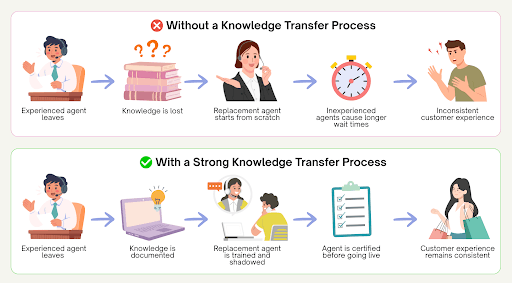
What Is Your Knowledge Transfer Protocol When a Trained Agent Leaves?
As mentioned previously, at some point providers will have agents leave, so you need to look into how effectively knowledge is transferred when they do. You should ask prospective partners to walk you through the entire transition process, from the moment an employee gives notice to the point a replacement agent is fully certified.
The key here is to listen for evidence of a structured process. A good provider will be able to explain how they maintain documentation, keep standard operations going, certify replacement agents before they begin taking contacts, and ensure knowledge is preserved throughout the transition.
A standard process in place ensures your customer experience will not be negatively affected when staffing changes occur.
How Long Have the Managers and Team Leads Assigned to Client Accounts Typically Tenured?
Having a team of experienced agents is great, but equally important is having an experienced leadership team because they will have a stronger influence on long-term program success.
The operational lead assigned to your account will play an important role in this program’s success far more than the sales rep who you signed a contract with. To put it into perspective, the manager you work with will not only be your main source of communication. They will be the ones shaping coaching, workforce planning, quality assurance, escalations, reporting, and strategic recommendations.
When you are thinking about how to evaluate a BPO partner with the right questions, don’t stop at asking who your account manager will be. Get more information on the leadership team behind your program by asking:
- How long have the managers supporting similar accounts been with the company?
- How many client programs does each manager oversee?
- What experience do they have within our industry?
- Will we work with the same person the entire time, or will there be changes?
At Global Response, long agent tenure is complemented by experienced operational leadership which helps create the consistency needed to deliver memorable customer experiences throughout the partnership.
Questions About Operations, QA, and Exception Handling
Operational excellence is measured by how a provider responds when something unexpected happens. Customers are not always going to follow scripted paths and neither should your outsourcing partner.
Every contact center will have established processes for handling everyday inquiries. What separates an average provider from a strategic CX partner is how they manage the situations that fall outside of those standard workflows. Operational maturity is going to be reflected in the processes, governance, and communication that support those unexpected moments.
A good evaluation of potential providers should look beyond quality assurance programs and AI capabilities and will instead focus on how those processes are being managed and how much visibility your organization will have once the program is live. The right partner for your company will have clearly defined procedures in place that help make operational changes without impacting the customer experience.
The following questions are designed to help you evaluate that operational discipline, giving you a better understanding of how a provider will perform when challenges arise.
Walk Me Through Your Exception Handling Process, What Happens When a Contact Falls Outside Standard Parameters?
It doesn’t matter how good your workflows are, there will always be situations that do not fit into predefined processes. The way a provider handles situations like a customer reporting an unusual issue or a policy exception needing to be made is how you will be able to determine if they are the right fit for your company.
Instead of accepting a vague, one sentence answer to this question, you are going to ask them to walk you through their processes from beginning to end. To get them to elaborate further you should also ask:
- How are exceptions identified?
- Who owns the decision-making process?
- What service level agreements apply to escalations?
- How are recurring exceptions documented and incorporated into future workflows?
- How are clients notified when exceptions become trends?
Look for providers that treat exceptions as opportunities to improve operations.
What Does Client-Visible Quality Assurance Look Like, What Access Do I Have to Scoring and Calibration Data?
Nearly every outsourcing provider will tell you they have a quality assurance program. The more important question is what you will actually be able to see.
Some providers may only share monthly scores or high-level summaries, which makes it harder to see how quality is measured and how coaching decisions are made. Other BPO providers will provide ongoing access to QA dashboards, calibration sessions, and agent performance data, which gives clients greater confidence that quality standards are being met.
While every provider’s reporting will look different, it is crucial that you have visibility into the metrics that matter most to your business and understand how those metrics are being used to improve performance.
A client facing QA scorecard or dashboard doesn’t need to be too complex, but it should provide meaningful insight into both agent performance and overall program health.
The specific metrics will vary depending on your program but the goal remains the same: providing transparency into how quality is measured, monitored, and continuously improved. The more visibility you have into a provider’s quality assurance processes, the easier it is to ensure the customer experience aligns with your brand standards.
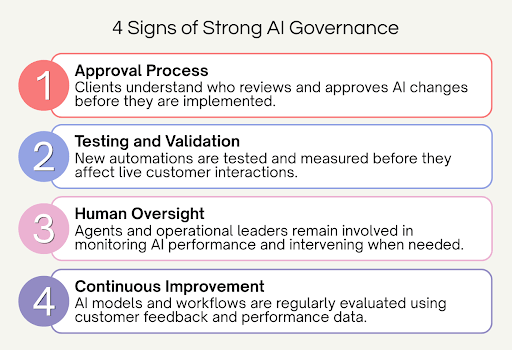
How Is AI and Automation Governed on Our Account and Who Controls Changes to That Layer?
Artificial intelligence has quickly become a major piece of customer experience, but implementation of it should never come at the expense of oversight. As more organizations start to introduce AI-powered tools like chatbots or agent assist, governance becomes just as important as the technology itself. This question will help you understand how the provider is managing AI systems and who is responsible for ensuring it aligns with business goals.
The provider should be able to tell you who approves changes to AI-driven workflows, how new automations are tested before deployment, and what level of visibility you will have into those decisions. They should also explain how human oversight is maintained especially when AI is used in customer interactions.
The strongest partners are the ones who combine technology with clear approval processes, ongoing monitoring, and human expertise to ensure AI systems enhance the overall experience of agents and customers.
Questions About Onboarding and the First 90 Days
Unfortunately, selecting a customer experience outsourcing partner does not end when the contract is signed because that is when the real work begins. The first 90 days are crucial to this partnership because they establish the operational foundation for the entire program.
A thoughtful onboarding process ensures both organizations are aligned before customer interactions begin. It is also a great way to identify potential challenges early, establish ownership, and create a framework for measuring success as the program starts. Without that structure you leave a lot of opportunities for mistakes.
Look for evidence of a well-defined implementation strategy rather than vague assurances that onboarding will be smooth. The questions below will help you understand how a potential provider approaches the transition from signing the contract to operations being up and running.
Can You Provide a Written 30/60/90 Day Ramp Plan Before We Sign, With Named Milestones?
One of the best ways you can evaluate a provider is to ask them to show you exactly how they plan to launch your program. A detailed 30/60/90 day ramp plan should highlight milestones, responsibilities, timelines, training activities, reporting expectations, and success metrics. Every implementation plan will be different, but the right outsourcing partner for your organization will be able to give you a structured roadmap that shows how they will move your program from kickoff to steady operations.
It is not a good sign if a provider is unable to articulate their implementation process before the contract is signed because chances are it will be difficult for them to execute afterward. A clear, written roadmap creates accountability and establishes clear expectations before the work even begins.

Who Is My Named Operational Lead and When Do I Meet Them Before Contract Signature?
Many buyers spend weeks building relationships with sales representatives but never meet the operations lead who will actually be managing their account. This is a missed opportunity because your operational lead will be your primary partner throughout the partnership. Their experience and understanding of your business will play a huge role in the success of the partnership long after the sales process ends.
Before signing a contact, ask to meet the individual who will be responsible for your program. The conversation you have with them should help you understand how they:
- Approach client communication
- Manage performance
- Handle challenges
- Collaborate with internal teams
This is also a great opportunity to gauge whether they understand your business objectives and have experience with organizations with similar needs.
Meeting your operational lead early will also give you insight into how the provider approaches partnerships. Providers that encourage these introductions often have confidence in their teams and a commitment to building long-term relationships.
Questions About Pricing Transparency and Total Cost
Price is always a major piece of the conversation when you are evaluating potential BPO providers. However, the quoted hourly rate will rarely reflect the full cost of an outsourcing partnership. It is important that you get a clear understanding of what is included and what isn’t to prevent unexpected expenses after implementation.
Greater pricing transparency also makes it easier to compare providers based on long-term value rather than upfront pricing alone, helping you identify meaningful call center cost savings.
What Is and Is Not Included in the Base Rate, Line by Line?
Nothing is worse than getting the contract signed and the program running only to find out your organization owes more than you thought you did. There are a variety of hidden costs associated with BPO outsourcing so this question will surface those costs before the contract is even signed.
Rather than asking for a single price, you are going to request a line-by-line breakdown of what is included in the base rate. Areas worth clarifying include:
- Onboarding and implementation
- Ongoing training
- Technology licensing
- Quality assurance
- Reporting
- Compliance updates
- Workforce management
Transparent providers should be comfortable explaining these costs upfront instead of relying on assumptions later. The more detailed the pricing conversation is before a contract is signed, the fewer surprises you will have as your program grows or support needs evolve.
What Triggers a Pricing Escalation and What Is the Change Order Process?
It is natural for business needs to evolve over time because new products launch, contact volumes fluctuate, and customer expectations change. You need to understand how your outsourcing partner manages changes to scope, staffing, and pricing. This is why you need to ask providers to explain exactly what circumstances trigger additional costs and how pricing changes are approved.
A clearly documented change-order process protects both parties by establishing expectations before new work begins. It also creates a transparent framework for discussing new requirements.
Questions About Governance, Reporting, and Exit Terms
Signing a contract is just the beginning of an outsourcing partnership. The success of your program also depends on how the relationship is managed after implementation is complete. Clear governance structures and well-defined contractual expectations help keep organizations aligned and prepared to make changes as things change.
The questions below will help you get a clearer understanding of how a provider communicates as well as how they plan for long-term collaboration.
What Does the Ongoing Governance Cadence Look Like, Reporting Frequency, QBR Structure, Real-Time Access?
The best outsourcing partnerships establish a consistent governance cadence that keeps both parties aligned, informed, and focused on continuous improvement. Look into how providers will keep you informed and how often you will have opportunities to review performance, discuss emerging challenges, and plan for growth. A good governance model will clearly define three things:
- When operational updates occur
- How strategic conversations are conducted
- What level of visibility your organization will have into performance
Topics you should address in your evaluation include:
- Executive business reviews
- Operational meetings
- Reporting frequency
- Real-time dashboard access
- Escalation processes
- Strategic planning sessions
Consistent communication is vital for ensuring you and the provider are still aligned on performance goals and next steps throughout the partnership.
What Are the Exit Terms — Who Owns the Data, the SOPs, and the Trained Agents If We Transition Out?
No one enters an outsourcing partnership expecting it to end, but you should be prepared for it. Having clear exit terms in place will help minimize disruption and protect business continuity.
As a part of your evaluation process, you should ask the provider to explain how ownership, documentation, and transition responsibilities will be handled if the partnership ends. A good offboarding process will clarify what information will be returned, how knowledge will be transferred, and what support will be provided throughout the transition.
These conversations are a necessary part of risk management and providers should be able to discuss offboarding just as confidently as onboarding.
In addition to this question, you can also ask:
- Who owns customer data?
- Who owns documentation and standard operating procedures?
- What transition support is provided?
- What is the offboarding timeline?
- How is data securely transferred or destroyed?
Clear answers today can prevent costly disputes tomorrow.
What Strong Answers Look Like vs. Red Flags
As you compare potential outsourcing partners, remember that the whole point of this evaluation process is to understand how each provider operates in practice. The strongest providers will be transparent about their processes and will support their claims with documented procedures and measurable results. If you are evaluating a potential partner and responses feel vague or difficult to substantiate, consider it an opportunity to ask follow up questions before moving forward.
Evaluation Area | Strong Answer | Red Flag |
Agent Model | Clearly explains whether agents are dedicated or shared and how staffing decisions are made. | Uses vague language or avoids explaining the staffing model. |
Agent Retention | Shares account specific attrition data and explains retention strategies. | Provides only company-wide averages or avoids discussing turnover. |
Quality Assurance | Offers ongoing visibility into QA metrics, calibration sessions, and coaching. | Shares only periodic summary reports with limited transparency. |
Onboarding | Provides a documented 30/60/90-day implementation plan with defined milestones. | Describes onboarding only in general terms. |
Pricing | Breaks down all costs and explains when pricing changes occur. | Pricing is vague or relies on case-by-case adjustments. |
Governance | Defines meeting cadence, reporting expectations, and escalation paths. | Governance details are deferred until after contract signing. |
Exit Terms | Clearly documents ownership of data, documentation, and transition responsibilities. | Exit procedures are unclear or omitted from early discussions. |
The providers that welcome these conversations are often the ones who will be able to deliver a successful partnership.
The questions you ask during the evaluation process can shape your customer experience for years to come. Do not settle for generic answers. Look for a partner that is willing to provide transparency, share proven processes, and demonstrate how they will support your business long after implementation.
If you are exploring outsourcing options, connect with Global Response today so we can discuss your goals and show you what true partnership looks like.
FAQs
Q: What outsourcing questions should I ask about agent model before signing?
Ask how agents are recruited, trained, managed, and dedicated to your account. Clarify whether you will have dedicated agents, shared teams, or a hybrid model, and how coverage will scale.
Q: What questions on outsourcing in customer experience matter most?
The most important questions focus on customer experience strategy, quality standards, reporting, agent performance, and how the provider will represent your brand. Look for a partner that prioritizes outcomes, not just transaction volume.
Q: What should I ask outsourcing companies about pricing before I commit?
Ask for a complete breakdown of pricing structure, included services, potential fees, minimum commitments, and how costs change as volumes fluctuate. Understanding the full cost model helps avoid unexpected expenses.
Q: How do I evaluate a contact center outsourcing vendor’s QA process?
Ask how calls and interactions are monitored, scored, coached, and improved over time. A strong QA process should include clear evaluation criteria, regular reporting, and actionable insights.
Q: What questions should I ask about agent attrition when outsourcing customer service?
Ask about current attrition rates, retention strategies, average agent tenure, and how turnover is managed. High retention often indicates stronger training, engagement, and customer experience consistency.
Q: What are red flags in outsourcing questions answers from a BPO vendor?
Be cautious of vague answers, limited transparency, unrealistic promises, and a focus only on cost savings. A strong partner should provide specific processes, metrics, and examples of success.
Q: Should I meet the operations team before signing an outsourcing contract?
Yes. Meeting the operations team helps you understand who will manage your program, how communication will work, and whether the team has the expertise to support your goals.
Q: What exit term questions should I ask outsourcing companies before signing?
Ask about contract termination requirements, transition support, data ownership, notice periods, and assistance with moving operations back in-house or to another provider.
Q: What outsourcing questions should I ask about AI and automation in 2026?
Ask how the provider uses AI to improve efficiency, personalization, and agent support while maintaining quality. You should also understand their approach to data security, governance, and human oversight.
Q: How do I check references effectively when evaluating outsourcing companies?
Ask references about the provider’s communication, reliability, flexibility, performance against goals, and how they handle challenges. Speaking with companies with similar needs will provide the most valuable insights.