


Read Time: 14 minutes
Table of Contents
Introduction
Call center cost optimization isn’t always a simple cut-and-dry formula. Beyond direct expenses, indirect and overhead costs and ineffective staffing models put businesses constantly behind profit margin goals. As service teams struggle to meet basic quality and capacity standards, even your customers begin to see the impact of an inefficient setup.
Learn the key elements to call center cost optimization in today’s guide. Identify the hidden costs that contribute to rising costs of in-house call centers and find the solutions to addressing them through cost-effective, growth-driven outsourcing.
Key takeaways
- Cheaper isn’t always better. Rates of shared agents rise with increased volume, making it difficult for businesses to scale in times of growth or seasonality.
- Know when and where to cut costs. Fully loaded costs of agents takes into account all necessary direct, indirect, and overhead expenses of hiring a support agent.
- Build a scalable infrastructure. Outsourcing reduces the costs of acquiring and maintaining physical offices without sacrificing quality management.
- Invest in talent and technology. Mitigate costs of attrition and poor performance by streamlining processes and interaction handling with advanced AI technology.

Why Your In-House Support is Costing You More Than You Think

Success in an ever-increasingly competitive business landscape requires intentional cost optimization. While cost savings is always the goal, understanding the value of business practices from product and service enrichment to employee management, service quality, customer relationship building, and brand reputation will ensure you put your resources where they matter most, setting you up for sustainable success.
Start with a powerful and effective operational model. Optimizing your staffing model is the first step to appropriately allocating your resources. Building a team that delivers brand-building service will make all other resources go far, empowering you to navigate fluctuating business situations with ease.
Align cost optimization with outstanding service by turning customer service from a cost trap to a business driver. Evaluate the cost-effectiveness of various operational setups — and learn how to make changes tailored to your business needs — by reading our internal vs. outsourced support cost analysis.
The fallacy of shared rates
Contact center BPOs offer a variety of operational models so businesses can choose staffing solutions that work for their workloads, goals, and budgets. One common approach is to charge by the minute or by call or task. These typically employ shared agents, or agents who handle interactions for various companies at the same time.
Some businesses prefer a shared setup for its precision and flexibility: you pay for what you get, and usually at lower costs than dedicated models, or agents priced hourly that are only contracted for one client.
- Per-minute pricing ranges from $0.65 to $1.20 per minute of agent time.
- Per-call fees range from $5 to $12 per customer interaction.
- Hourly rates range from $12 to $25 per agent hour.
Each model has its perks and challenges. While shared rates are tempting for brands looking to cut costs, they also are limited in scope, with costs only going so far as demand rises.
Per-minute | Per-call | Hourly |
Reflects actual usage | Provides stable costs for predictable call volumes, regardless of call length | More cost-effective for large-scale projects |
Suitable for businesses with varying call volumes or short and simple calls | Encourages efficiency | Provides dedicated attention and specialty expertise to customers |
Higher costs with longer calls | Mid-range expenses | Higher upfront costs |
Gets more expensive with more calls | Costs rise with volume | More scalable, offering cost-effectiveness |
While shared agents can be a significant cost-saving measure at first, they often fall short when it comes to quality with brand nuances and scalability.
Dedicated team arrangements, by contrast, are more cost-effective for large-scale projects, often offering volume discounts for committed seats. They effectively handle surges in business growth while implementing high-touch strategies designed to enhance the entire customer experience and grow your brand.
In short: Cheaper isn’t always better. Investing in your strategy means investing in your customers and your business.
Want to scale your business?
Global Response has a long track record of success in outsourcing customer service and call center operations. See what our team can do for you!
Beyond wages: Defining the fully loaded cost per agent
The fully loaded cost of an employee comprises all expenses incurred by hiring the employee. Taking a look at these costs enables leaders to pinpoint areas to optimize costs. Calculate fully loaded cost per agent to assess when it’s time to outsource your contact center.
The hidden costs of in-house call centers begins with all direct, indirect, and overhead expenses related to your customer support team.
- Direct costs can be traced directly to a product or service.
- Includes labor, materials, and equipment used.
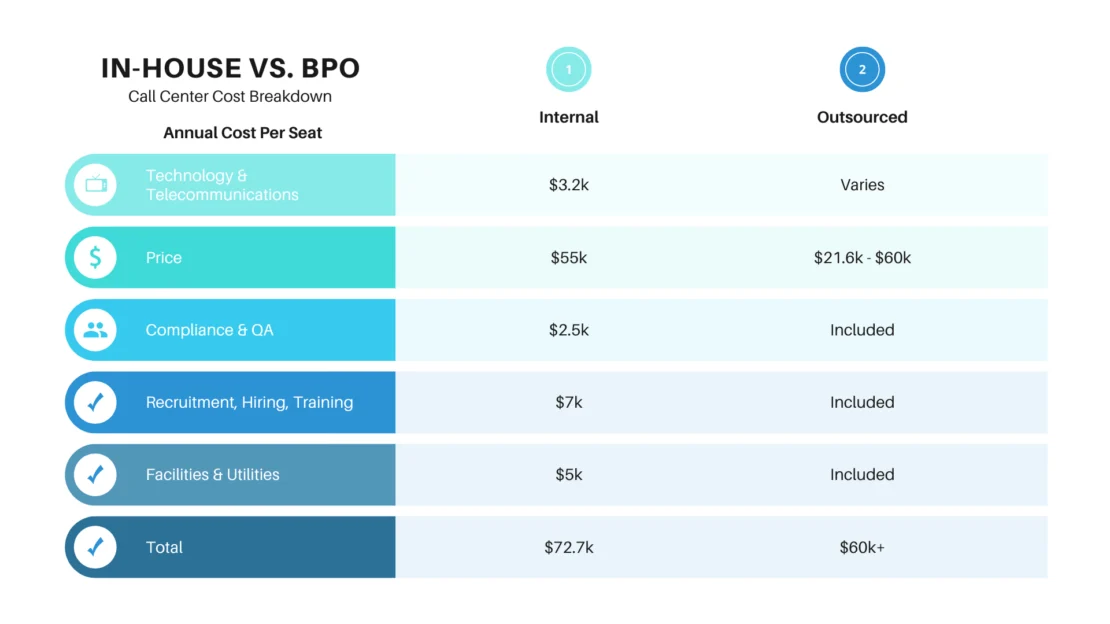
- Per agent salaries range from $30,000 to $60,000 per agent.
- Indirect costs support overall business operations but are not linked to a product or service.
- Includes rent, utilities, and administrative salaries.
- Facility expenses average $2,000 to $5,000 per seat annually for small teams.
- Overhead expenses in customer service cover additional indirect costs.
- Includes salaries, benefits, training, technology infrastructure, management, and scalability measures.
- Benefits alone add 25% to 35% to base salaries.
- Call center attrition can cost companies $10k to $21k per employee.
Between reduced agent rates and near-eliminated overhead expenses, outsourcing offers a lucrative staffing model that also prioritizes high-quality customer care and brand-aligned service.
Why “cost per minute” is a misleading metric
While charging for talk time sounds like the prime way to pay only for the call handling you need, it’s not always as straightforward as you may think. Per-minute pricing can lead to inconsistent monthly costs as demand ebbs and flows or if handle time increases.
Challenge: Scalability.
Unexpected changes in volume or demand make it difficult to optimize costs for long-term growth under per-minute models. Some months require more resources than others, decreasing the effectiveness of your investments as you juggle each month after month.
Challenge: Lack of brand investment.
Inconsistent solutions can also lead to burnout or underutilization of agents, raising call center attrition costs and increasing your reliance on expensive repeat hiring cycles. On the quality side, temporary workers often come with little investment in your company or customer relationships.
Solution: Comprehensive, dedicated care.
Dedicated agent models offer brand flexibility, accommodating ramping needs without sacrificing operational efficiency, onboarding timelines, or service quality. BPOs committed to your success immerse agents in your brand for culturally aligned care at every touchpoint of the customer journey.
The infrastructure cost trap
High overhead costs of an internal customer support team make expanding operations to accommodate growth — let alone seasonality — a futile effort for many companies. Hiring internally is timely and expensive, with long times to proficiency as onboarding and training delay expert care. Sometimes the internal model simply fails to handle surges or to support employees. Overwhelm impacts performance, decreasing your service capacity and quality.
As vital as it is, infrastructure isn’t the place to cut costs without a plan. Secure, high-quality virtual and physical frameworks are key to your contact center’s operational success and your brand health.
Real estate, utilities, and facility maintenance
Facility management can present unique challenges that prevent businesses from making the most of the hefty investment.
Problem: High costs.
The costs of attaining and maintaining a physical location for your operations quickly add up, and streamlining them can be tricky without the proper resources. While these indirect costs average $2,000 to $5,000 per seat annually for small teams, they can jump to $5,000 to $10,000 for medium-sized teams and facilities.
Problem: On-site staffing requirements.
For some industries and their compliance regulations, simply moving to a remote workforce isn’t an option. For others, the culture of the team plays a key role in the entire business strategy, with closeness to brand values an important factor in customer service.
Solution: Secure, high-touch outsourcing.
Outsourcing solves these challenges with compliant setups in global locations, along with secure work-from-home strategies managed by experts you can trust. The right outsourcing partner prioritizes your compliance requirements and performance goals, implementing technology that checks all the boxes of successful operational oversight:
- Removes facility maintenance costs.
- Monitors agents for increased compliance and service quality.
- Evaluates and improves performance with sentiment tracking and live agent assistance, automated reports, and data-informed coaching.
- Increases service capacity through better interaction handling, chatbots, enhanced self-service, and agentic AI.
- Provides deep insights for flexible, expert care.
The high cost of unused capacity
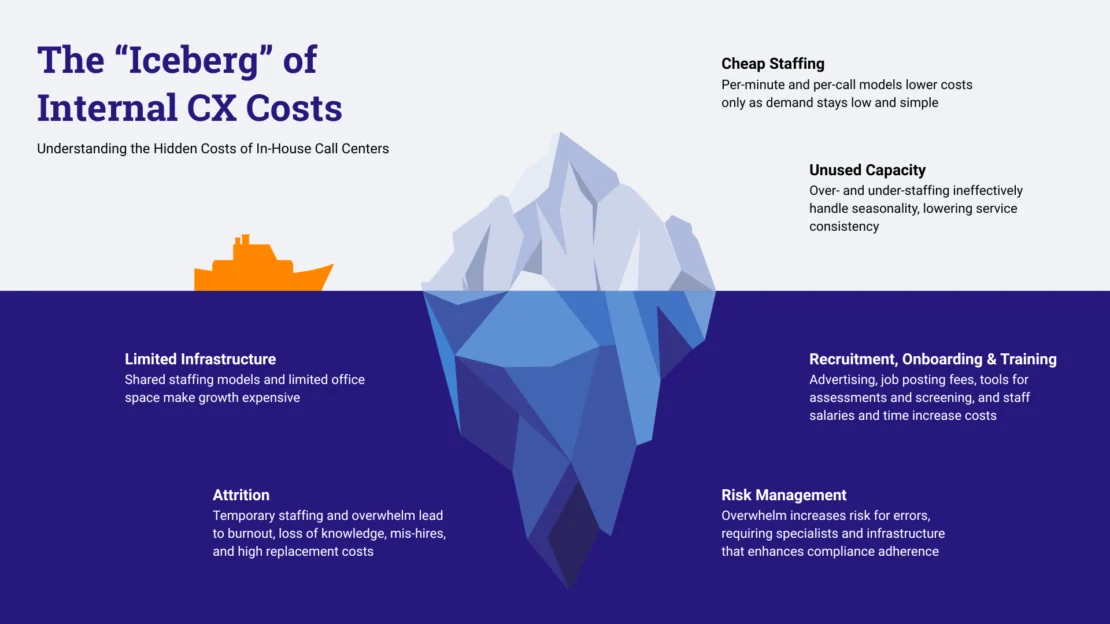
Over- and under-staffing are two sides of the same very expensive coin. Overstaffed teams leave money wasted, and understaffed teams may cut costs but are overwhelmed by demand, unable to meet even standard levels of performance and ultimately leading to these high costs of corrective action:
- Assuaging dissatisfied customers
- Streamlining interaction handling to reduce wait times and increase service capacity
- Resolving compliance issues and paying for any incurred fines or penalties
- Managing brand reputation
When (not if, but when), the scalability struggle becomes clear enough that your teams are struggling (or twiddling their thumbs), even your customers will notice. Teams stuck in reactionary customer service roles struggle to provide the proactive customer care customers expect in this digital era defined by high-touch, instant, personalized service.
The talent treadmill
Customer support teams act as the face of your company, so selecting and maintaining a high-quality team are crucial elements of a plan built to achieve your goals. Throwing money at seats to be filled can have costly consequences from onboarding to interaction handling and beyond. Avoid these challenges by identifying common slip-ups to see where you can succeed.
The financial impact of high attrition
Beyond job posting and recruitment fees, the costs of managing employee turnover can surprise many business leaders. Forbes highlights these additional hidden costs of high attrition all businesses should take care to mitigate:
- Lost productivity
- Employee burnout
- Lost tribal knowledge
- Replacement costs
- Training and mis-hires
Without optimized processes at every stage of your recruiting and employee management cycle, you run the risk of overwhelm, lost knowledge, lowered performance, dissatisfied customers, and reactive processes every time you lose an employee.
Recruitment, onboarding, and training sunk costs
Hiring and training sound straightforward, but finding quality candidates takes time and resources. Break down the direct and indirect recruitment costs to prepare for an effective strategy.
- Direct hiring costs:
- Advertising and job postings
- Recruitment agency fees
- Bonuses or incentives for employee referral programs
- Assessments and tools for screening and background checks
- Indirect hiring costs:
- In-house recruitment team (salaries, benefits, training, and operational expenses)
- Interviewing time and, when relevant, travel and accommodations
- Time and resources required for onboarding and training to full productivity
Outsourcing entrusts these roles to an expert in mitigating recruitment costs and sourcing expert employees ready to onboard on your desired timeline. Learn how Global Response turns your hiring problems into successes for a look into ideal recruitment practices.
Technology and innovation lag
Critical for streamlining processes and gaining deep insights into customer behavior, technology levels up operations, increases service capacity, and boosts performance — but finding and implementing the right one can be a lengthy struggle that puts many brands in a CX technology debt.
Managing CX technology debt
Understand what goes into your CX technology investment to target the most effective platform for your goals and your budget. A host of factors add up to a rising total cost of ownership for CX technology for companies doing it on their own:
- Fees per tool
- Automated QA
- Agentic AI
- AI-powered workforce management
- Live assistance
- Implementation and setup fees
- Maintenance and training expenses
While these features will prove effective with proper management, tools and insights will go underutilized without a clear vision for their application to the overall customer experience. A leader in customer experience management will help brands leverage these technologies for effective day-to-day and year-over-year performance.
- Efficiency and quality: Loss of expertise negatively impacts quality of care, raising response times, handle times, dissatisfaction, and costs of corrective action or repeat processes.
- Costs: Hiring, recruiting, and onboarding require time and resources, often delaying service on urgent timelines.
- Brand reputation: Excessive layoffs and declining quality can earn brands a negative reputation when positive customer relationships are more important than ever.
The cost of maintaining legacy systems vs. BPO innovation
Many brands are hesitant to take the plunge into the ever-changing technology world. Tools are changing as quickly as they are implemented, leaving you to wonder what you should actually invest in, what trends are here to stay, and whether a change is really worth all the fuss of a transition from tried-and-true methods. As mentioned above, transitioning to new CX technology can be costly if it’s not the right fit for your goals or your strategy.
However, failing to upgrade to AI and automation tools simply due to budget constraints will keep your team in reactionary support modes that will put you behind in efficiency and cost optimization as your competitors reap the benefits of a well-made technology plan. Understand the costs and benefits of legacy systems and new tools to confidently make the switch.
Legacy systems
- Are familiar to experienced employees
- Do not incur implementation fees but may require monthly or annual subscriptions
- Do not offer live agent assistance
- Are limited to existing features and brand-specific updates
- Are not made with automation-first capabilities
- May require additional IT support
Innovative technologies
- May require a learning curve
- Implementation or setup fees are often waived by BPO partners
- BPO experts are comfortable with tools, aiding in training and troubleshooting
- Streamline operations, boosting efficiency and saving costs
- Specialize in contact center operations, enhancing CX
- Provide deep insights for generating revenue
Make a BPO cost-benefit analysis to understand the impact of your choice to stay with your legacy system or make an upgrade. Failing to even consider a change due to a scary up-front fee could cost you significantly in operational excellence as customers expect more intuitive, streamlined care in 2026.
Risk and compliance
However well you’ve cultivated the expertise of your internal team, demand overwhelm and inefficient processes can put your operations at risk for more errors, mistakes, and costly miscompliances. You may also lack the specialists required to QA your team, increasing your liability and opening you up to expensive corrective action and a reputational hit to your brand.
Regulatory burdens and security audits
Compliance laws and regulations are complex. They vary by industry and are constantly changing, requiring active monitoring and sometimes regular re-certifications to keep your operations running smoothly. Without the proper resources or dedicated expertise, your team may fall behind and underprepared for audits.
Transferring liability to a BPO partner
In your internal vs. outsourced support cost analysis, take into account how improved performance and compliance adherence will save you time and resources, while boosting your reputation. Consider the benefits of turning these responsibilities to a BPO expert.
- Risk mitigation: BPO experts keep up with compliance updates and implement streamlined processes for auditing to reduce risks of legal and regulatory penalties.
- Costs: BPOs will help you cost-effectively scale while maintaining or improving quality and service capacity.
- Specialized expertise: Customize your team based on what you need by accessing a global agent pool of experts in your field.
- Growth mindset: BPOs dedicated to true partnership not only boost service and compliance adherence; they also enhance overall CX for sustainable growth, empowering all internal and outsourced teams to focus on core competencies and revenue generation strategies.
Learn how Global Response protects customer information for SOC 2 compliance and increases sales and performance. Contact us to see how we can meet your cost-savings and customer support needs.
FAQs
What are the potential call center cost savings for outsourcing?
How much money outsourcing saves depends on the provider, services rendered, technology implemented, staffing levels, and sourcing location. The hidden costs of in-house call centers stack up, limiting scalability, overwhelming internal teams, and negatively impacting quality — costing your business in the long-run. Generally, outsourcing can save companies 40% to 50% in operational costs.
What are the biggest hidden costs of in-house call centers?
The biggest hidden costs of in-house call centers come from direct and indirect costs:
- Unsustainable per-minute or per-call staffing models
- Hiring, training, and recruitment expenses
- Rent, utilities, and maintenance
- Administration and management salaries and benefits
- Costs of attrition
- Penalties of non-compliance
How does a BPO reduce the total cost of ownership for CX?
The right BPO can reduce the total cost of ownership for CX through a comprehensive, scalable strategy that increases service quality and capacity:
- Scalable Staffing Model: Dedicated agents to expertly manage demand throughout fluctuating volumes.
- End-to-End Customer Experience Enrichment: Mapping the customer journey from start to finish for smooth experiences that build loyalty.
- Technology Innovation: Leveraging AI tools to streamline interaction handling, increase service capacity, empower scalability, and enhance compliance adherence and service quality.
Is outsourcing customer service cheaper than keeping it in-house?
With the right BPO company, outsourcing customer service is more cost-effective than keeping customer service internal. Outsourcing removes or decreases direct, indirect, and overhead costs, helping companies scale without investing in office space or resources to hire, train, and onboard new employees. BPO experts also implement strategies to grow your business, build loyalty, and increase compliance adherence, reducing costs of attrition, churn, and compliance issues.
What is the “fully loaded” cost of a call center agent?
Fully loaded costs of an internal call center agent, taking into account salaries, overhead, and attrition costs, can add up to $86,000 per agent.