


Read Time: 13 minutes
Table of Contents
Introduction
Choosing the right call center partner is a crucial decision that can significantly impact your customer experience, brand reputation, and operational efficiency. Launching without a clear operational plan runs the risk of losing out on potential revenue growth and ineffectively engaging with customers. This guide introduces a comprehensive call center checklist designed to help you evaluate potential partners based on technology, infrastructure, compliance, and workforce alignment. Whether you’re launching a new customer support operation or optimizing an existing one, this resource will help you build a checklist tailored to your business goals and growth strategy.
Key takeaways
- A call center checklist ensures alignment between your business needs and a potential BPO partner’s capabilities, covering critical areas like infrastructure, technology, compliance, and workforce management to guide informed decision-making.
- Technology plays a vital role in modern call center operations, with tools such as AI, CRM integrations, IVR, and real-time analytics enhancing efficiency, personalization, and customer satisfaction across omnichannel platforms.
- Continuous improvement and accountability are essential for long-term success, so it’s important to choose a call center that actively tracks KPIs, meets SLAs, and implements structured feedback loops for ongoing optimization.

What is a call center checklist?

A call center checklist is a document that outlines the required qualities, features, and services a company is looking for in a potential outsourced call center setup. The purpose of a call center checklist is to help decision-makers choose the best business partner for their goals, ensuring values and strategies align for a successful partnership.
A single comprehensive checklist can include sections for setup, operational, and compliance needs, or you can create separate checklists for each type of need to ensure you’ve thoroughly covered your bases. The differences between each lies in the technology and strategies that vary between the stages.
This blog will give tips for how to start a call center, including call center software requirements and other details you should make sure to include in your personalized call center checklist.
Pre-launch checklist: Planning and infrastructure
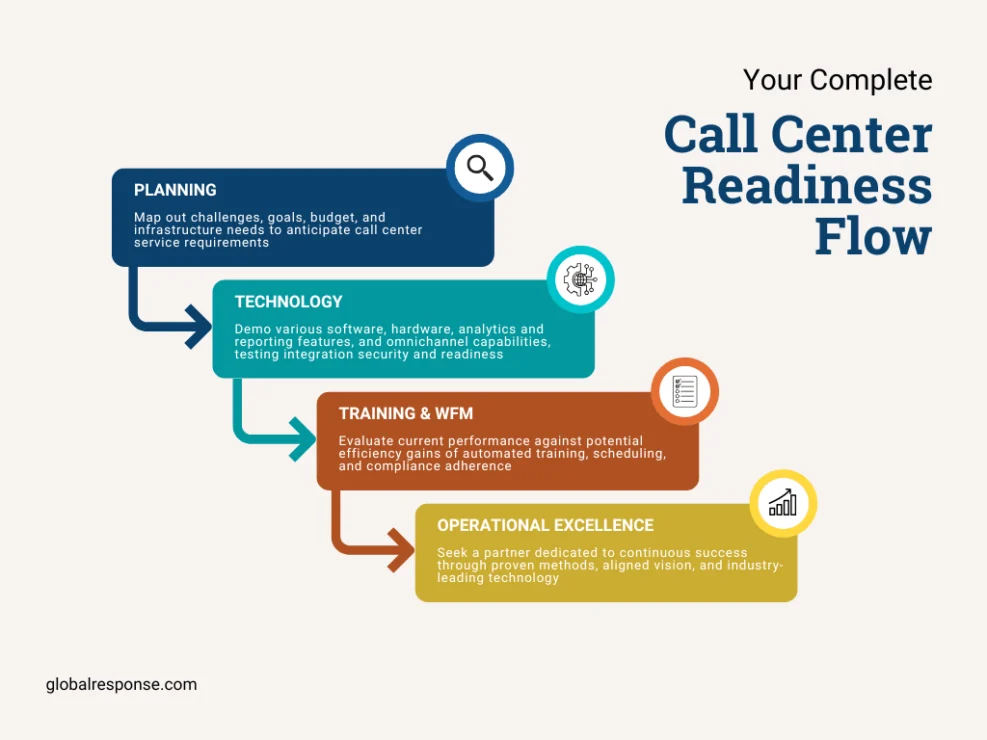
Before you make your checklist, you should have a clear plan for your new outsourced partnership. What do you want it to look like? What do you need? Consider goals, challenges, budget, and infrastructure needs to start honing in on your vision and distinguishing needs from wants. Dive into this initial stage of planning to start forming your checklist.
Define business goals and call center type
You know your business needs better than anyone, but sometimes it can be difficult to know which services will actually enhance operations and bring the results you want. Determine the best strategies for your needs by matching your challenges with the corresponding strategies of different call center designations.
Call centers obviously handle phone calls, but they can be distinguished into different types based on who’s making the phone call and for what purpose. This ensures proper workforce management and appropriate billing strategies for all parties involved.
- Inbound call centers focus on responding to phone calls from customers. A comprehensive call center is also an omnichannel one, with agents adept at utilizing advanced cx technology to respond to emails, text messages, escalated live chat interactions, and social media requests.
- Outbound call centers make calls on behalf of the company to interested customers, or leads.
- Blended call centers handle inbound and outbound interactions.
Certain call centers have requirements for what type of inbound or outbound calls they will handle, with expertise in specific industries or using various technologies.
Physical or virtual infrastructure setup
Call center BPO providers should include the costs of Internet, telephony, hardware, and software in their quotes. Certain technologies may contain higher costs, or costs associated with specific advanced features. Before the prices scare you away, consider the returns you could see with specific solutions.
The other feature that determines what type of call center is right for you concerns physical infrastructure. Where are teams located? What setup do they require, and are you prepared for the associated costs?
- On-premise staffing hosts agents in a designated office, either the property of the business or the call center provider, and offers businesses more control and oversight of teams.
- Remote teams use the Cloud to operate in secure home environments, empowering the scalability of teams and greater work-life balance or agents.
- Hybrid teams combine both remote and in-office agents, allowing for flexibility and collaboration.
Budgeting and resource planning
Outsourcing call center operations removes significant staffing and the overhead costs of hiring internally, but it still requires an investment. Determine the resources you can put toward an outsourced team by considering these factors as you plan your budget:
- Cost reduction: Track the direct savings from reduced operating costs, labor expenses, and overhead.
- Intangible benefits: Improved satisfaction, quality of service, and time to market may not have direct associated costs but significantly contribute to overall ROI.
- Efficiency gains: Outsourcing empowers your business to do more at lower costs, improving customer satisfaction, relationships, and retention.
Calculating cost-efficiency should incorporate a full picture of the immediate and long-term financial gains you’ll see in improved processes and reduced costs.
You can also use this formula to estimate return on investment:
ROI = [(Total benefits − Total costs) / Total costs] x 100
Refer to this guide covering how much it costs to outsource customer service to inform your budget.
Want to scale your business?
Global Response has a long track record of success in outsourcing customer service and call center operations. See what our team can do for you!
Technology checklist: Tools and integrations
Technology is revolutionizing customer experience with advanced features. Artificial intelligence is empowering businesses to scale operations with automated support and real-time analytics for more immediate, nuanced insights. Look for a call center that expertly utilizes these tools and more to make the most out of an outsourcing partnership.
Call center software requirements
A call center leader should know the software they use and how to apply its features to your new business strategy. Look for a BPO provider who uses these software features to level up your support.
Interactive Voice Recording (IVR): An automated system that interacts with callers through pre-recorded messages and menu options, IVRs allow customers to self-serve using voice commands or keypad inputs.
Automatic Call Distribution (ACD): ACD is a telephony system feature that routes incoming calls to the most suitable agents based on predefined rules, availability, and skills, improving wait times and satisfaction.
Customer Relationship Management (CRM) integrations: CRM software manages customer interactions and stores and organizes customer data, including contact information, interaction history, and previous purchases. Integrations should seamlessly work with your existing tech stack for a smooth and secure transition.
Call recording: Automated call recording can assist in quality assurance, training, and accountability. Compliance regulations can restrict the recording of certain calls, so your BPO partner should know when and how to record calls in compliance with regulations.

Analytics and reporting tools
Technology makes analyzing the performance of your call center easy. This is vital not only for determining the success of your outsourced call center but also for better understanding customers and providing results that resonate. Look for these uses of analytics and reporting tools in a call center:
- Customizable real-time dashboards for ensuring a comprehensive view of agent performance and managing training needs.
- Automated reporting to track trends and identify insights.
- Historical data for training AI tools to understand industry-specific terms and changes in customer sentiments, empowering teams to take proactive measures based on data.
Omnichannel support capabilities
Companies and customers expect more coverage, and technology solutions can achieve that via omnichannel interaction handling. Manage support for chat, email, SMS, and social media requests in a single platform with advanced telephony.
Omnichannel capabilities supported by automated responses for simple requests brings measurable improvements in operations and customer sentiments:
- 24/7 coverage
- Better data and insights
- Personalized service
- Trend forecasting customer behaviors, preferences, and needs
Workforce checklist: Hiring, training, and culture
How a call center manages their workforce sets the tone for success and customer and employee satisfaction. Prioritize finding a team that operates with values in harmony with yours. Anticipate performance by breaking down how a call center BPO recruits, hires, and manages teams.
Recruit the right talent
A call center provider should be well-versed in recruitment strategies that attract high-quality candidates ready to transition to your team and learn brand-specific requirements. Your recruitment checklist should include these requirements:
- Call center support skills
- Ability to cross-train and learn new skills based on fluctuating need
- Relevant experience
- Required certifications
Training programs and knowledge bases
Evaluate how your potential BPO partner learns your processes, communicates them to agents, and affects knowledge retention. Specific technology solutions prioritize preserving legacy knowledge while implementing AI-assisted learning strategies and knowledge base references. Demo training programs to put yourself in the shoes of your prospective agents to determine proper fit.
Look for a BPO provider who provides these specific training programs for increased agent confidence, performance, and speed to proficiency:
- Soft skills training emphasizes emotional intelligence, including active listening, empathy, and de-escalation techniques.
- Compliance training sets a standard for strict adherence to relevant laws and regulations to protect customer data and information.
- Product training immerses agents in your brand, teaching culture and messaging surrounding products. This builds bonds with customers, increasing satisfaction, as agents provide specialized product knowledge and support.
Agent scheduling and workforce management
Workforce management can significantly impact the efficiency of your team. Automated tools streamline processes to build shifts, expand coverage, manage breaks, and even align customers with suitable agent matches for enhanced success.
Learn how call center outsourcing strategies, skilled talent, and advanced technology can help companies scale to plan for sustainable growth.
Compliance and security checklist
Entrusting customer data to a third-party outsourcer is daunting: it introduces potential for security risks, but the right call center operates with a compliance-first mentality. Assess how by evaluating these important features.
Call center compliance checklist
Call centers should prioritize the safety of your company and your customers. Ask if they are compliant with or have certifications in these specific common laws and regulations:
- PCI DSS prevents data theft and fraud through secure payment processing and ensuring businesses maintain secure environments when processing cardholder data.
- HIPAA ensures healthcare professionals and support centers protect patient data and privacy.
- SOC 2 focuses on how organizations such as cloud service, software as a service, and BPO providers manage data to protect the privacy and interests of clients.
- GDPR enhances individuals’ control over personal data via protection rights and consent laws for customers in Europe.
READ MORE: Call Center Compliance Guide for Risk-Free CX Operations
Data security and privacy policies
Evaluate how call center BPO companies follow the above protocols and more by inspecting the measures they put in place to ensure data security. Policies should cover the following topics, with specific steps for errors, escalations, and breaches:
- Encryption for data at rest and in transit
- Secure storage to protect against data breaches and unauthorized access
- Access control to limit access based on job functions
Tip: Choose a partner who anticipates, rather than attempts to avoid, audits. This ensures your team proactively tracks, resolves, mitigates, and follows up on risks, increasing transparency and trust with customers. This approach should include documentation of issues so your team can expertly navigate audits when they come.
Operational excellence: Daily, weekly, monthly
Investing in a call center is investing in your business. Increase the effectiveness of your support team without putting in the work yourself by partnering with a call center BPO provider who commits to continuous improvement. Evaluate performance and dedication to achieving measurable results by looking for these quality measurement measures in a call center.
Call quality monitoring processes
Your new partner should monitor more calls and interactions to fully understand agent performance and customer satisfaction. Expert teams should strictly follow regulations preventing the recording or storage of calls.
The call monitoring process aims to ensure peak performance and high-quality service. It follows five general steps:
- Define goals and key performance indicators (KPIs). Establish clear objectives for the monitoring.
- Create a standardized monitoring framework. Develop consistent sets of criteria and scoring systems.
- Provide targeted coaching. Live tips and post-interaction feedback, summaries, and reports encourage continuous improvements in performance.
- Utilize advanced analytics. Real-time sentiment analysis provides deep insights into customer insights.
- Review and adjust. Regularly evaluate insights, customer feedback, and the effects of certain strategies on your goals.
Call center technology streamlines this process, automatically monitoring interactions and providing real-time insights and post-interaction feedback. Test out specific AI features to unlock more data-driven insights.
SLA and KPI tracking
While automations handle the bulk of call monitoring, your outsourced call center team shouldn’t take a back seat to measuring their progress. The account manager should take full proactive measures to meet goals and evaluate agent performance in specific areas and KPIs. Ensure you’re on the same page by tracking these important metrics.
- Service Level Agreement (SLA): Your formal contract with a service provider, SLA outlines the expected level of service to define the scope, quality, and responsibilities of outsourced tasks.
- Average Handle Time (AHT): This measures the amount of time, usually in minutes, it takes agents on average to handle issues from beginning to end, including the time it takes to complete after-call work.
- First Call Resolution (FCR): FCR measures the success of your solutions by measuring the rate at which agents are resolving complaints on the first point of contact with a customer.
- Customer Satisfaction (CSAT): Measured on a scale of 1 to 5 or in a percentage out of 100, CSAT depicts how satisfied customers are with your products, services, and solutions and can help teams identify areas for improvement.
And many more! A BPO provider should regularly check in with you to evaluate performance, discuss challenges, and update you on the status of your solutions.
Feedback loops and continuous improvement
Feedback loops are vital tools for improving services and processes. They help customers feel seen and heard, increasing satisfaction and engagement with your company. Find a call center dedicated to the constant improvement not only of their team’s metrics but also of your strategies, business growth, and relationships with customers.
Ask potential partners what steps they take to commit to continuous improvement and how that vision applies to your growth as a company.

We hope this blog has helped you craft your very own call center checklist tailored to your needs. You can also use or get inspired by our comprehensive call center checklist.
Final thoughts
A proactive, strategic approach to choosing a call center will ensure you’ll find one that is right for you — one who exhibits those same qualities. Keep your standards high in your search. Believe in a call center partner the way you want someone to believe in your own business.
Seek the qualities, services, and strategies you need to surpass your goals to prioritize finding a BPO provider who not only checks all the boxes but also adds value to operations. Invest in a company that takes a positive mindset toward growth, whether that be in productive audits or continuous improvement.
Read our case studies and contact Global Response to see how we can be a good fit for you.
Call Center Checklist FAQs
A call center checklist should include call center type, required infrastructure, clear measures for workforce management, tools for routing calls such as IVR menus and ACD, secure CRM software integrations, compliance adherence, custom analytics and reporting, omnichannel interaction handling, streamlined hiring and training, aligned culture, relevant compliant certifications, objective and measurable evaluation criteria, quality control processes, and regular feedback loops.
Building an internal call center requires hiring full-time staff, securing the space required to host them, building out infrastructure by investing in software and hardware, and hiring a management team. Internal call centers require high financial and time investment with little room to scale.
Call centers require software for handling communications via phone, email, text, SMS, live chat, and social media platforms. This can include a telephony system, and it requires integration with existing CRM platforms to securely handle customer data. Call centers also require software for training, quality assurance, and workforce management.
Compliance standards that apply to call centers include the Telephone Consumer Protection Act (TCPA), Health Insurance Portability and Accountability Act (HIPAA), Payment Card Industry Data Security Standard (PCI DSS), General Data Protection Regulation (GDPR), California Consumer Privacy Act (CCPA), Systems and Organization Controls 2 (SOC 2), and Do Not Call Registry (DNC).
To improve call center efficiency, optimize workflows, utilize technology, train and coach agents, enhance customer experience, and regularly evaluate and adjust processes. Consider partnering with a call center provider to leverage expertise and implement industry-leading strategies to achieve goals.