


Read Time: 9 minutes
Table of Contents
Introduction
Customer feedback represents the voice of your customers, helping brands identify problems or tailor offerings to the ideas of those most invested in your product. But Customer Feedback Management doesn’t begin and end with reviews and surveys.
While important, surveys are only one part of one-half of the CFM framework. Surveys can give you the best, most valuable information for your business, but without the management to interpret data into actionable insights and follow-up, they do little more than fill up your cloud. Failing to use data prevents companies from actively making the most of their customers’ input, leaving them in passive collection that only opens more gaps in communication.
Learn how to address immediate customer concerns and build a long-term strategy for proactive customer care that centers your customers in today’s blog.
Key takeaways
- Feedback without action is wasted insight. Collecting surveys and reviews is only half the job. Real value comes from interpreting feedback, turning it into action, and consistently following up. Without this, feedback becomes passive data instead of a driver of growth.
- A structured CFM framework is essential for scale and impact. An effective Customer Feedback Management system follows a clear loop: collection, analysis, action, and follow-up. This structure ensures feedback is not only captured, but operationalized into measurable improvements across the business.
- Centralization and AI unlock speed, clarity, and decision-making. Managing feedback across channels requires a centralized system. AI-powered tools enhance this by identifying trends, prioritizing urgent issues, and automating workflows, allowing teams to respond faster and more strategically.
- Closing the loop builds trust and long-term loyalty. Communicating back to customers after changes are made is what turns feedback into relationship-building. Transparent updates and proactive follow-ups show customers they are heard, increasing satisfaction, retention, and brand credibility.

What is customer feedback management?

Customer Feedback Management is a system of gathering, analyzing, acting on, and following up on customer feedback so businesses can better serve their customers, boosting satisfaction and building brand loyalty.
Customer Feedback Management streamlines the process of gathering, understanding, acting upon, and following up on customer sentiments and your responses to them. An organized system enables you to analyze massive amounts of data, translating patterns into insights and insights into real business strategies that you can evaluate and adapt to drive continuous success.

Defining the CFM framework
A framework gives you the space and tools to follow the Customer Feedback Management process, closing the loop to ensure you’re doing the most with your data. A clear Customer Feedback Management framework pushes brands past the first step of gathering feedback, organizing the moving parts and assigning a purpose for every step to ultimately drive meaningful business decisions tailored to the customer.
Capture the voice of your customer across all communication channels to get a comprehensive view of customer issues and preferences. Integrate a CFM system to make sense of the vast amounts of data your customers have generously given you. Break up your CFM framework into these stages to find and act on insights.
- Collection: Gathering feedback through reviews, surveys, omnichannel sentiment tracking, and Voice of the Customer (VoC) programs and insights.
- Analysis: Finding patterns and trends in data, often using AI tools such as sentiment analysis to categorize and flag urgent issues.
- Action: Implementing changes for modern CX that improves flaws, closes gaps in service, upgrades workflows, and informs strategy for proactive customer care.
- Follow-up: Analyzing the impact of actions, tracking changes in response times, satisfaction levels, other relevant KPIs, and additional feedback throughout all touchpoints of the customer journey.
Want to scale your business?
Global Response has a long track record of success in outsourcing customer service and call center operations. See what our team can do for you!
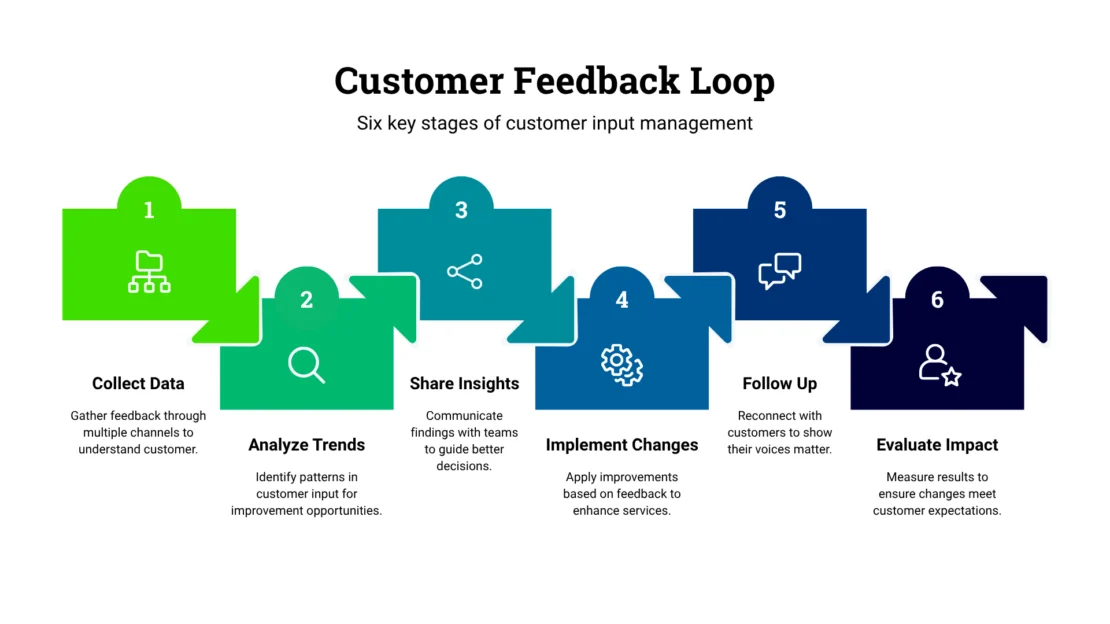
The 4 stages of the customer feedback loop
While the stages of the customer feedback loop are consistent across industries, each brand’s approach should be tailored to their specific needs for strategy that resonates with their customers. Now that you understand the purpose of each stage of the customer feedback loop, you can start envisioning how it’s going to look for your business.
Take a deep dive into what each stage entails so you can customize your efforts to meet your customers’ needs and your business goals.
Data collection across channels
To accurately analyze customer sentiments, you need a full picture of what they’re saying. Capture all feedback by utilizing omnichannel customer feedback management tools with sentiment tracking and survey capabilities. This will track mentions and engagement across a variety of channels, hosting data in a single place for seamless analysis and consistent customer experiences.
Customize your omnichannel data collection tool to the channels you need:
- Phone
- Text
- SMS messaging
- Social media
- In-app messaging and surveys
- Website reviews and tickets
Optimizing your coverage of these channels not only captures more data; it also boosts engagement by meeting customers where they’re at.
Centralized analysis
Gathering more feedback can seem daunting when you have to manually analyze it. Without a centralized space to collect and analyze feedback, your teams will become overwhelmed by the responses, stopping your progress before you can get the feedback loop going. This puts you at risk for these pitfalls of a mismanaged customer feedback process:
- Loss of feedback
- Scattered feedback
- Missed opportunities and sales
- Delayed responses
- Response bias
AI-powered Customer Feedback Management software automates the customer satisfaction improvement process, hosting insights and reports in a single system for proactive, data-informed decision-making. Automated sentiment analysis empowers you to stay on top of a constantly updated flow of feedback, bringing key business benefits:
- Alerts to pressing matters
- Better organization
- Enhanced visibility of all issues
- Increased transparency and accountability
- Advanced analytics
- Customizable reports categorized for issue type and sentiment
- Better engagement and follow-through
Internal distribution
Before you can start implementing ideas, you first have to allocate your resources to the right teams for accurate, timely responses. AI-driven tools facilitate the process, evaluating responses to route customers to the appropriate teams:
- Product support
- Customer service
- Sales
Advanced AI tools can also personalize service in key ways to match customers with the best agents available:
- Skills matching for the specific request
- Historical agent compatibility
- Language alignment
- Self-service options to reduce queues
Seamlessly distributing customers to ideal support solutions significantly reduces wait and hold times, increasing service capacity, business success, and customer satisfaction.
Further break down your Customer Feedback Management by making intentional efforts to communicate process changes to your support team. Automation combines data collection and analytics into one step, but teams should review trend reports to align strategies with business initiatives.
Closing the loop: Communicating resolutions back to the customer
Issue resolution is straightforward enough when wrapping up an interaction with a customer, but communicating that you’ve listened to suggestions even after feedback is given is key to effective customer feedback management.
Why communicate resolutions: Follow-ups alert customers to solutions, help them resolve issues, build brand loyalty, and demonstrate your commitment to continuous improvement. Follow-up also tells you valuable information about the success of your solutions, provides customers with the chance to voice any additional concerns, and fosters positive relationships with customers as you thank them for their patience and feedback.
How to close the loop: The most effective communication channel is the one in which a concern or piece of feedback was given. However, personalized emails allow you to provide detailed resolution updates and phone calls build trust and rapport.
Update frequency: How often you communicate updates depends on the urgency and complexity of the concern, but a general rule of thumb is that updates should be given at regular intervals, such as once a day or once every few hours.
What to include: However frequently communicated, updates should clearly detail the progress of your solution, setbacks to expect, and a timeline for the resolution. Transparency goes a long way in managing expectations and building trust with customers.
Selecting the best customer feedback management software
The software you use to manage your feedback loop will determine the effectiveness of your strategy, potentially impacting other support operations, as well. Invest in a tool that empowers you to understand and better serve customers in the way they need by following these tips for choosing the right Customer Feedback Management software for you.
Key features to prioritize
Technology can only be as effective as they are built to handle your implementation and usage needs. Get your project off the ground and running smoothly by narrowing your options down to solutions with these key features for effective feedback management.
- Integration capabilities: Seamless and secure integrations with your existing systems. For systems such as Salesforce, Slack, or Zendesk, ensure the systems have API access and necessary permissions are in place for communication.
- Real-time dashboards: Customizable reports to gather deep insights by trend, performance metric, customer demographic, and issue type.
- Automated reporting: Regular updates to inform internal decision-making.
Scalability for enterprise
Good contact center software technologies are designed with a specific purpose, sometimes even for different audiences. For example, some are best for small- and medium-sized businesses, while others are built to handle the large data handling capacity for enterprises. The different uses will determine the software’s capabilities, as well as tools available for implementation.
Whether you’re a small business experiencing growth or an established large corporation, you can manage high-volume data without losing granular insights by opting for enterprise feedback management tools and SaaS feedback systems with these capabilities:
- Centralized feedback collection
- Survey management (tracking NPS, CSAT, and CES)
- Real-time analytics and reporting
- Actionable workflows
- Multi-channel integration
- Internal feedback
- AI-powered automation
- Cross-departmental communication

Benefits of formalizing CFM
one for business that is responsive in the best ways and proactive in ways that customers are coming to expect in modern businesses.
CFM is also important for business success — it helps companies of all sizes leverage a host of immediate and long-term benefits with far-reaching consequences. Propel your business toward your goals. Capture these benefits of a well-executed CFM system:
- Reduced churn through proactive issue resolution
- Enhanced product roadmaps with validated user requirements
- Improved brand reputation via public review management
These perks do more than just satisfy customers: they build brand trust and loyalty, boost engagement with your products and your business, and cultivate an environment customers want to keep returning to as they know their issues will be heard and cared for.
Ready to incorporate customer feedback into your business strategy? Contact Global Response to see how we can revolutionize your customer feedback management process for continuous success.
FAQs
- What is the difference between CFM and CRM?
- Customer Feedback Management (CFM) is a framework of collecting, analyzing, acting on, and following up on customer feedback. It includes tracking customer sentiment across all relevant channels and measuring the success of provided solutions for continuous improvement.
- Customer Relationship Management (CRM) refers to the strategy and tools companies use to manage interactions with customers.
- CFM includes tracking sentiments in all interactions, requiring integration with CRM systems, omnichannel data collection, and streamlined communications.
- How do you measure the ROI of Customer Feedback Management?
- To measure the Return On Investment (ROI) of Customer Feedback Management, brands should track detailed performance metrics over time:
- Customer Satisfaction (CSAT)
- Net Promoter Score (NPS)
- Customer Effort Score (CES)
- Retention rates
- Churn rates
- Customer Lifetime Value
- Speed to market
- Issue volume
- Sentiment distribution
- To measure the Return On Investment (ROI) of Customer Feedback Management, brands should track detailed performance metrics over time:
- Which Customer Feedback Management tools are best for small businesses?
- The best Customer Feedback Management tool for your business integrates with your existing systems, tracks responses in all relevant channels, collects the right performance data for your brand, automates data collection and analysis, and suits your budget.
- These SaaS feedback systems are some of the top-rated Customer Feedback Management tools for small businesses:
- Survicate offers NPS, CSAT, CES, and 12 more survey types in one tool, with free plans.
- Sender automates feedback surveys across SMS or email. Automation sequences are triggered by user behavior, making the most of engagement and tracking the most active users.
- involve.me leverages a drag-and-drop no-code builder for easy survey building and automation, with a free-forever plan.
- Ask Nicely, powered by the Net Promoter Score framework, tracks satisfaction in real time through AI analysis and provides recommendations for customer retention.
- WiserReview collects reviews via email, SMS, WhatsApp, QR codes, and website forms. It offers AI-powered review summaries, moderation, and auto-translation services, as well as photo and video review support, Google review sync, multi-store sync, and Shopify and WooCommerce integrations.
- How often should you collect customer feedback?
- Businesses should collect feedback based on customer type, frequency of interactions, and the goals of the feedback collection.
- Transactional customers can provide valuable insights in post-purchase surveys.
- Relational customers value brand trust and loyalty, presenting ideal feedback opportunities in 30-, 60-, or 90-day intervals.
- Regular customers should be contacted for feedback once every six months.
- Automated sentiment tracking collects all sentiments continuously to enhance understanding of the Voice of the Customer.
- Businesses should collect feedback based on customer type, frequency of interactions, and the goals of the feedback collection.