



What is eCommerce customer support and how do I elevate it for my business?
eCommerce customer support is the assistance businesses provide customers throughout the online shopping journey to ensure a seamless and satisfying experience. To elevate it, focus on proactive, personalized support across multiple channels, using tools like AI chatbots, data analytics, and self-service options to anticipate needs and resolve issues efficiently. Investing in omnichannel communication, well-trained support teams, and feedback-driven improvements builds trust, boosts customer loyalty, and drives long-term business growth.
Read Time: 17 minutes
Table of Contents
Introduction
Measuring key performance indicators like CSAT, NPS, and resolution times — along with collecting direct customer feedback — provides actionable insights.
Exceptional customer support has become the cornerstone of successful eCommerce operations. As competition intensifies and consumer expectations rise, businesses must deliver seamless, responsive, and personalized service across every touchpoint. A well-designed eCommerce customer support strategy not only resolves issues but builds trust, drives loyalty, and boosts revenue.
This guide explores the essential components of effective eCommerce customer support. Discover practical insights, proven strategies, and best practices to help you create a world-class support experience that meets the demands of today’s online shoppers.
Key takeaways
- Customer support is a strategic asset that enhances customer satisfaction, reduces churn, and increases revenue. Proactive, personalized, and omnichannel support strengthens trust and builds long-term customer loyalty.
- Combined with human empathy and expertise, AI-powered tools like chatbots, sentiment analysis, and predictive analytics help businesses deliver fast, scalable, and personalized service.

What is eCommerce customer support?

eCommerce customer support is the assistance companies provide customers throughout the shopping journey. From answering product questions to fulfilling orders, processing returns, and resolving shipping issues, eCommerce customer support is vital to the success of a business. It ensures a positive online shopping experience by cultivating relationships with customers through personalized service, which increases loyalty and retention and ensures long-term success and scalability.
Defining the scope of customer support in an online retail environment
Understanding what should comprise your eCommerce customer support strategy is the first step in drafting an effective one. These four areas help companies manage and optimize operations, targeting each stage of the customer journey.
- Marketing and sales: Increasing revenue through brand promotion, conversions, and retention efforts.
- Order fulfillment: Processing, packing, and shipping orders, as well as tracking delivery status.
- Customer support: Providing timely and professional assistance to customers before, during, and after purchases through text, live chat, email, phone, and social media channels.
- Technical support: Ensuring the website is up and running securely and resolving issues quickly and efficiently.
The difference between proactive and reactive support
To meet higher, more intuitive and expert attention customers expect, efforts have adapted from reactionary to proactive strategies. Where teams used to simply answer inquiries and resolve issues when customers brought them to their attention, now, internal and outsourced eCommerce customer support teams collect data to anticipate queries and provide solutions before customers realize they need them.
Proactive customer support requires knowledge of customer behaviors, preferences, and needs. These key eCommerce support tools help teams anticipate customer needs and provide proactive support.
- Omnichannel sentiment tracking collects data about customers’ feelings about products, services, and issues, tracking changes over time.
- Automated customizable analytics to help companies make data-informed insights
- Self-service options such as FAQs, knowledge bases, guides, how-to articles, and web or app portals help customers resolve their own issues.
- Personalized customer support tracks customer histories, aligning them with the best agents based on availability, preferences, and skills.
Why is customer support crucial for eCommerce success?
Customer support is the breath that brings your business to life for your customers. The wealth of options at their disposal means competition has never been higher, and every interaction is a piece of evidence in your favor or against you, a reason to continue their patronage with you or to look elsewhere. Being intentional about your support will ensure you remain a competitive authority in an ever-changing landscape.
Building trust and loyalty with your customers
Start with the basics: building trust with customers. Essential for business growth, trust is rewarded by customers’ wallets, and broken trust increases churn and decreases brand reputation. Use these key strategies to build trust with customers.
- Security-first approach to compliance
- Consistent high-quality service
- Transparent business practices and product information
- Open and honest communication
- Solutions and communications that align with brand values
Reducing shopping cart abandonment
Efforts to retain a customer take significantly less effort and fewer resources than attracting a new customer does. Proactive customer support should ensure a seamless shopping experience to reduce the number of customers who add items to their shopping carts and leave the site before purchasing.
These strategies reduce shopping cart abandonment rates:
- A simplified checkout process with markers indicating where the shopper is in the process to reduce anxiety and confusion
- Transparent pricing, including taxes and delivery fees
- Free shipping thresholds to encourage purchase completion
- A variety of payment options, with security badges clearly displayed
- A functioning website optimized for mobile users
- Abandoned cart email follow-ups
- Personalized shopping experiences
- Clear return policies
Want to scale your business?
Global Response has a long track record of success in outsourcing customer service and call center operations. See what our team can do for you!
Increasing Customer Lifetime Value (CLV)
A crucial metric for businesses and marketers, CLV tells you the total revenue or profit generated by a customer over the entire course of their relationship with your business. CLV can help you identify high-value customers. This focuses your win-back campaign efforts and optimizes marketing, targeting the customers most invested in your business.
Calculate CLV with this formula:
CLV = Number of Purchases Annually x Purchase Profitability x Length of Commercial Relationship in Years
Example: 4 Purchases Annually x $1,000 x 5-year partnership = $20,000 CLV
Historical CLV models evaluate customers’ past contributions while predictive CLV models forecast future contributions based on historical, demographic, and behavioral data. Each model helps companies understand the habits and value of their customers, providing valuable insights into customer retention strategies.
Gaining a competitive advantage
Superior customer support humanizes your company in an increasingly online world, leaving a lasting positive impression on your customers. Try these tips to give your company that extra edge that keeps customers coming back.
- Develop relationships with customers through personalized care.
- Practice active listening and empathy to help customers feel valued and heard.
- Communicate with your audience and foster engagement in forums to engage customers in your culture.
- Implement feedback loops and make changes based on the results.
- Use a combination of artificial intelligence and human emotional intelligence for data-driven insights, automated support, and the irreplaceable human touch.
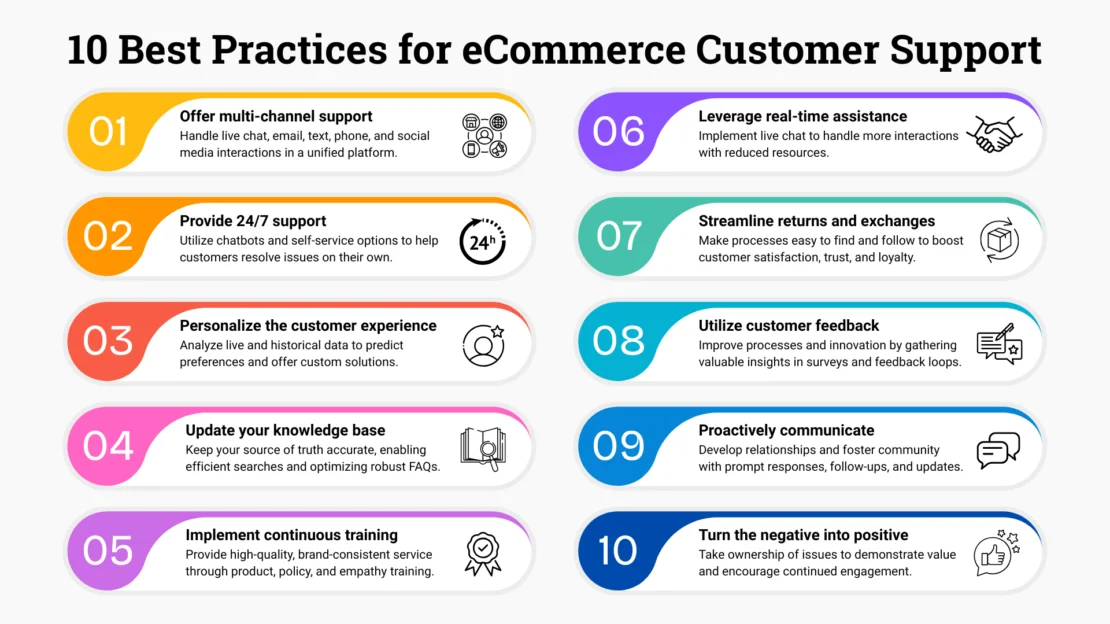
10 best practices for exceptional eCommerce customer support
Craft an eCommerce support strategy that achieves the above goals and more, achieving real results with your customers and your bottom line. Implement these eCommerce customer service best practices to elevate your customer support service standards and push you to the top of your industry.
1. Offer multi-channel support
With the many communication channels, seamless omnichannel support is the new standard for customer care. Customers expect to be able to contact you and receive high-quality care, no matter the method.
Expand your service capacity without investing in internal overhead by partnering with a contact center that can handle live chat, email, text, phone, and social media interactions in one unified platform.
Expert contact centers use a combination of automated advanced technology and live human agents to improve performance, service quality, and customer satisfaction. Secure integrations optimize processes and streamline interactions, achieving key results:
- Reduced transfer times, wait times, and average handle time
- Personalized care
- Live agent assistance
- Continuous agent training
- Data analytics
2. Provide 24/7 support with chatbots and self-service options
Everyone wants around-the-clock care, but employing a full-time staff is not always cost-efficient or productive for your employees. Expand your hours of coverage without ramping up your workforce by implementing virtual assistants (and assistance!) to answer questions outside of business hours.
- Chatbots handle routine requests, leaving notes and conversation history for live follow-up if necessary.
- Web or app portals guide customers through common processes such as order assistance, account history, or returns.
- Blogs, guides, and how-to tutorials empower customers to resolve their own issues, on their timelines.
These simple but powerful solutions increase customer satisfaction and significantly reduce queues, ensuring more efficient experiences with bots or live agents. Agents, in turn, feel more supported as they can dedicate their time resolving complex issues.
3. Personalize the customer experience
Personalized experiences help your company stand out as one that not only knows their customers in general but also the individual, helping them feel seen, remembered, and a part of your community — ultimately, more than just a dollar sign. Personalize the customer journey with these strategies:
- Advanced technologies recall customer history, preferences, and satisfaction scores with specific solutions and agents.
- Anticipate needs through sentiment and behavior data tracking.
- Suggest product or service recommendations based on purchase or browsing history.
- Foster genuine connections.
- Customize solutions to the individual’s needs.
- Utilize loyalty programs and white-glove service.
4. Implement a robust FAQ and knowledge base
Vital to customer self-service and automated agent assistance, FAQ pages and knowledge bases act as a source of truth for users. They answer common questions, reducing the need for customers to contact live agents or for agents to spend excess time searching for answers to questions.
Effective knowledge bases and FAQs have certain features:
- Constantly updated with the most accurate information
- Easy to find on the website and easy to use
- Clear and concise
- Targets common pain points
- Optimized for search engines and AI summaries
- Organized by topic
- Easily searchable and navigable
5. Train your support team on product knowledge and empathy
Your support team reflects your company’s voice and culture. A high-performing team sets the tone regarding accuracy, expertise, professionalism, and care. Get your team on the right page by continuously training them on products and methods most likely to bring success and satisfaction.
Use AI technology such as agent assistants, note takers, summaries, and automated summaries to boost QA scores and provide real-time feedback based on sentiment tracking.
Cover these topics in empathy trainings to align agent behavior with company values, no matter the interaction:
- Active listening
- De-escalation tips
- Patience and empathy
- Problem-solving
- Team collaboration
- Communication styles
6. Leverage live chat for real-time assistance
Live chat is a simple but effective way to handle more requests with fewer full-time employees. Customers can ask questions and receive immediate help, eliminating or significantly reducing wait times and exponentially increasing service capacity and hours of availability.
Live chat for eCommerce benefits customers in distinct ways:
- Answers questions with consistent high-quality, professional responses
- Solves problems with strict adherence to compliance and company guidelines
- Guides customers through processes
- Provides assistance with website navigation
Automating customer service provides a more comprehensive shopping experience for customers. Partner with an expert BPO such as Global Response to reduce implementation costs of utilizing advanced technology and live chat features.
7. Streamline your returns and exchange process
Although returning items decreases revenue, above all, you want your customers to be satisfied with their purchases and happy with their business with you. Smooth, intuitive returns or exchange processes give the customer what they want, increasing their confidence in your products, trust in your brand, and likelihood of returning for further business.
Strict or inconvenient returns or exchange processes can lead to an influx of complaints or negative reviews. Making these actions straightforward is key to cultivating positive experiences and ensuring long-term business success.
Invest in long-term customer value and loyalty by making returns and exchanges easy and accessible. Try these tips to streamlining returns and exchanges:
- Clearly and prominently display transparent policies.
- Make policies accessible across customer touchpoints.
- Address common questions.
- Clarify conditions, timelines, and method of refund.
- Automate processes with return label generation, tracking status, and updated inventory levels.
- Provide FAQs or step-by-step guides to illustrate what customers can expect at each stage.
- Simplify steps.
- Offer in-store, postal mail, and pick-up return options for added flexibility, personalization, and convenience.
- Offer gift cards or store credit.
- Analyze return data and feedback.
8. Use customer feedback to improve and innovate
Customer feedback is vital to building trust with customers, clarifying brand direction, developing a customer-centric brand, and identifying areas for improvement. As users of your products or services, customers are usually passionate about your industry and experts themselves. This grants them a level of insight into product or process development that can revolutionize your offerings and operations.
Implement regular feedback loops and surveys to gather insights crucial to growth. Follow these tips for effective feedback collection:
- Clearly define what you want to accomplish.
- Use qualitative and quantitative methods to capture a wide range of experiences and preferences.
- Act on feedback.
- Communicate actions to customers to establish understanding and encourage future survey participation.
- Request feedback after completed purchases or issue resolution.
- Review and refine feedback methods and business strategies.
9. Be proactive with customer communication
Proactive communication demonstrates to customers not only that you care about their experiences but also that you understand them and that you are the expert in enriching them. Instead of waiting for customers to reach out to you, send emails, texts, or newsletters communicating important updates such as changes in service or new features.
This increases customer satisfaction by providing them with convenient solutions and attention that fosters community. When it comes to its impact on business success, proactive communication encourages engagement, naturally pointing customers to your website or app and boosting open rates, conversions, and sales.
10. Turn negative experiences into positive opportunities
Negative customer experiences can cost businesses worldwide trillions of dollars. Research shows that customers decreased spending after a 38% of poor experiences and stopped spending with a company entirely after another 13% of negative experiences.
Customers are being more intentional in their spending habits than ever, prioritizing high-quality service. In 2024, 64% of customers said that no matter how much they enjoy a product, if the company doesn’t provide good customer service, they will look elsewhere.
While these statistics can be concerning, a proactive approach to customer service takes ownership of challenges before they escalate, demonstrating to customers competency in solving their problems with professionalism, timeliness, and care.
Take these steps to making effective issue resolution a cornerstone of your support strategy:
- Shift your perspective. Look at complaints as valuable feedback with insight into how to make customers happy.
- Empathize. Demonstrate that you’re there to help, listen, and understand. Avoid arguing, and offer solutions that demonstrate a commitment to satisfaction.
- Implement de-escalation training. Call center etiquette skills such as active listening empower agents to handle and mitigate high-stress situations with poise and calm.
- Utilize scripts. Scripts guide conversations to productive solutions, minimizing stress on employees, elevating service quality and consistency, and aligning solutions with company voice and policy.
- Respond quickly and intentionally. Timeliness demonstrates care and respect for customers and prevents situations from spiraling out of control. Utilize automations for routine requests to enable agents to dedicate attention to transforming negative situations.
- Take ownership. Deflecting blame or making excuses is unproductive and only enhances negative emotions for customers. Own the issue and focus on solutions to improve experiences.
- Take action. Resolve the issue. Communicate steps taken, expected timelines, and any necessary actions by the customer. Create value and trust by implementing feedback into processes where possible.
- Follow up. Whether by email, phone, or text, follow-up shows that you are dedicated to customer success. Send surveys to evaluate satisfaction with solutions.
- Express appreciation. Thank the customer for their time and feedback, with customized well wishes to build loyalty.

Tools and software to elevate your eCommerce customer support
Revolutionizing your eCommerce customer support is a significant undertaking, but expert tools, software, and partners abound to reduce workloads and stress for those taking on the task. Tap into these resources to elevate your eCommerce support strategy today:
- Best help desks for eCommerce organizations
- Live chat software and chatbot platforms
- CRM software for a 360-degree customer view
Securely integrating these tools into your operations will target customer issues, helping teams manage a variety of needs at scale.
Measuring the success of your customer support strategy
Evaluating the success of your efforts is a necessary part of enriching and refining support. Utilize advanced technology to streamline the gathering and analytics of data, with customizable reports for a comprehensive view of performance.
Key Performance Indicators (KPIs) to track
KPIs provide data about the performance of your team and about customer sentiments. Trend tracking helps you anticipate common issues and changes in customer behaviors, allowing you to be more proactive about customer service.
These metrics provide a look at how happy your customers are with solutions, interactions, products or services, and your business as a whole.
- Customer Satisfaction (CSAT): On a scale of 1 to 5 or a percentage out of 100, CSAT is vital for measuring ecommerce customer satisfaction. It demonstrates the degree to which a customer feels their expectations have been met by a company’s products or services.
- Net Promoter Score (NPS): This growth indicator asks customers through surveys how likely they are to recommend a brand to friends and colleagues, on a scale of 0 to 10.
- First Response Time (FRT): How long it takes an agent to respond to an inquiry the first time a customer reaches out, FRT tells you how efficient your team is in answering newly created support tickets.
- Average Resolution Time (ART): How long it takes, on average, for a team to resolve a query from the moment the customer reaches out to when the ticket is closed.
- Calculate ART with this formula:
Total Resolution Time for All Tickets Solved / Total Number of Tickets Resolved (in a set period of time).
- Calculate ART with this formula:
How to gather and analyze customer feedback
Feedback collection and analytics should be incorporated into your support workflows for comprehensive feedback tracking. You want a full-scale picture of what customers feel about your company, so you should use these methods to gather feedback.
- Omnichannel sentiment tracking: AI technology tracks live interactions and social media mentions to collect trends about how customers feel about your company.
- Automated surveys: After interactions are complete, automations ask customers how they feel about the service and provided solutions.
- Email or website surveys: Distribute CSAT, NPS, or other surveys that are easy for customers to complete.
- Direct interaction: Encourage customers to share their opinions in community forums or polls on social media.
The future of eCommerce customer support: AI and automation
eCommerce support is evolving with the times. As customers expect more nuanced and immediate assistance, more and more AI technologies are providing solutions tailored to customer needs and operational efficiency. Learn how to meet the future of customer service automation for eCommerce businesses through these trends already changing the industry.
How automation can improve efficiency and reduce costs
AI is helping companies understand customers at higher scales than ever before. Secure integrations of advanced technologies allow teams to access historical and live customer information in a single system, streamlining workflows and improving customer experiences.
AI models use Machine Learning, Natural Language Processing, and data annotation to understand and replicate human language. Automated assistance for customers and agents improve processes and performance results, such as the following:
- Reduced staffing and overhead costs
- Reduced wait, hold, and transfer times
- Reduced Average Handle Times
- Improved First-Call Resolution rates or First Response Times
- Increased service capacity
- Reduced queues
- Higher CSAT and NPS
- Higher customer retention
- Increased agent productivity and satisfaction
- Decreased agent attrition and associated costs
The role of artificial intelligence in personalization
AI models analyze historical and live data to track customer preferences, behaviors, and issues. Automated insights, reports, and analytics help teams adjust marketing and support efforts to more effectively engage customers or prevent issues.
As AI grows to be more autonomous, intuitive, and contextually aware, businesses can continue tailoring solutions to individual needs.
However you use AI to streamline processes and increase productivity, don’t disregard the importance of human support. Customers crave face-to-face support. Utilize a combination of automated assistance and empowered agents to hyper-personalize support for long-term success.
Need guidance? Consider outsourcing eCommerce customer support. Contact Global Response to revolutionize your eCommerce support strategy today.