


Read Time: 12 minutes
How to scale customer support without compromising service quality or escalating costs?
Brands can scale customer support without compromising service quality or escalating costs by outsourcing with a flexible, expert contact center. These BPOs access experts worldwide, tailoring workforce solutions to your needs, on your budget and your timeline. They also leverage advanced technology to streamline workloads and boost quality and service capacity while ensuring sustainable improvements in performance and customer satisfaction.
Table of Contents
Introduction
Scaling customer support is essential for businesses experiencing seasonal demand fluctuations and hoping to build on growth. Scalability involves streamlining workflows, incorporating self-service and automations into support, and rapidly adjusting workforces to accommodate demand while optimizing service quality and costs. Access these solutions and more on your budget and timeline by working with an outsourced contact center with proven experience scaling operations for your industry.
Let’s take a look at some of the most effective customer retention strategies that your company can use to boost your results and gain greater lifetime value (LTV) from every existing customer.
Key takeaways
Small businesses and enterprises can effectively scale operations by partnering with a BPO who can implement advanced technology solutions alongside optimized workforces tailored to their needs.
Scaling customer service is important because it provides seamless, consistent service while growing operations in peak seasons and enhancing productivity in slow seasons.
Scalability utilizes AI solutions beyond chatbots, such as agentic AI, to provide personalized service at scale.
Optimized knowledge bases, performance management, training, routing flows, and community forums are key features of a scalable model.

What is scalable customer support?

At one point or another, every successful business has to adjust operations to accommodate growth or fluctuating demand. Busy seasons overwhelm small teams, leading to long response times and service that makes customers feel rushed and unheard. Dissatisfaction increases churn, costing your business not only financial but also reputational capital.
The natural response: grow your support team. But come slow season, employees are underutilized and time, expenses, and resources are wasted. Staff are let go, and as attrition rates rise, service consistency dips, again failing to solve your support challenges. Repeat training cycles drain resources faster than they make use of all the work that has gone into building them, causing businesses to lose their footing before the momentum of growth has even gotten a chance to take off.
Enter scalable customer support. Scalability is the way brands grow or shrink workforces to accommodate demand without sacrificing service quality, consistency, costs, or hiring timelines. Knowing how to scale customer support ensures businesses can build upon growth and effectively interact with audiences no matter how busy seasonality gets.
Scaling customer service requires a staffing and workforce model that meets key requirements:
- Accurately forecasts demand, taking into account customer behaviors across all channels
- Streamlines processes, reduces inefficiencies, and empowers higher service capacity
- Onboards large teams on flexible timelines
- Preserves talent and skill in a unified training program using an updated, standardized knowledge base, and
- Optimizes costs throughout ramps.
Finding a sustainable long-term solution for scalable customer support can seem like a shot in the dark. Shared agent models price per call or per minute but might fail to offer the dedicated attention brands seek for relationship building as agents work for multiple brands at once. Expensive temporary employees, similarly, can lack commitment to a brand as short-term projects offer band-aid solutions.
Contact center outsourcing offers companies the ability to solve these issues, swiftly navigating fluctuating needs with dedicated scalable care. The suggestions in this blog cover customer support scaling strategies for startups and enterprise businesses.
Why is scaling customer service important?
While not every business has a busy season, organizations of all industries and sizes will experience fluctuating levels of customer support demand. These common situations can highlight the need for cost-effective ways to scale customer service.
- Sudden growth
- Business acquisitions
- Social media virality and increased web traffic
- Increasingly high customer expectations for personalized service
- Technical issues
- Rising operational costs, particularly with hiring internally
- Limited office space for large workforce needs
Scalability empowers companies to expertly manage these situations and more, resolving challenges and capturing additional key benefits.
- Turning reactive customer support to proactive customer care
- Empowering teams to predict and manage demand surges, reducing overwhelm, burnout, and inefficiencies
- Streamlining processes, reducing wait times and raising customer satisfaction
- Understanding customer behaviors and preferences, enabling personalized service
- Capturing deep insights through data tracking
- Increasing service capacity and revenue generation opportunities
- Optimizing costs throughout seasonality
A brand can only meet customer expectations when they have the tools and infrastructure to understand and adapt to evolving needs. Scalability plays an essential role in elevating and maintaining customer satisfaction and loyalty.
Tips for scaling customer support
Scaling customer support teams requires a powerful, affordable operational strategy that meets support needs on short- and long-term scales. This enables businesses to manage fluctuations in demand with flexible workforces, reducing overwhelm for consistent service, optimized costs, and continuous success.
A scalable support strategy has these key components.
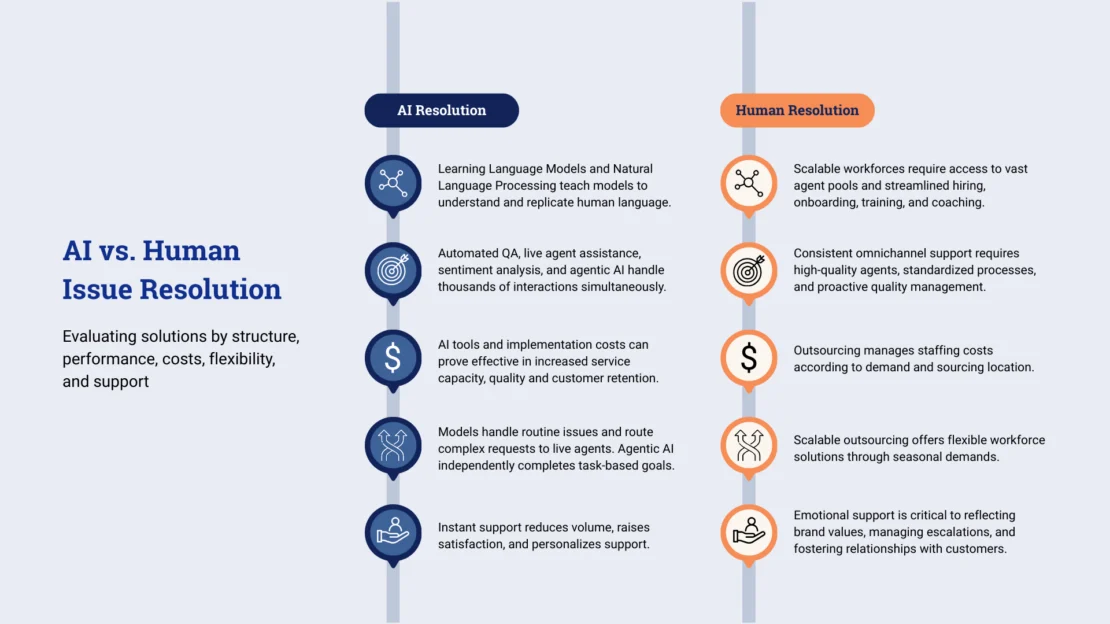
- Agent pool: BPO experts access a vast selection of specialists ready to onboard on custom timelines.
- Omnichannel technology: Advanced systems securely integrate, streamline processes and interaction handling, and accurately forecast demand across platforms to inform staffing needs.
- Streamlined training: Updated knowledge bases, hands-on learning, and AI-powered programs optimize learning for faster speed-to-proficiency and better retention.
- Continuous coaching: Quality monitoring tools highlight areas for improvement, from technical knowledge to brand voice to soft skills and de-escalation techniques.
- AI solutions: AI tools such as agentic programs, automated routing and QA, and live agent assistance handle routine queries, maximizing support capacity for higher quality, satisfaction, and efficiency.
Learn about the strategies that address your needs — and the ones that fail to do so — to effectively scale customer support for your brand.
Want to scale your business?
Global Response has a long track record of success in outsourcing customer service and call center operations. See what our team can do for you!
The failure of linear scaling
Organizations experiencing ebbs and flows can struggle to accurately staff workforces to accommodate demand. Repeat hiring cycles waste time and resources, leading to burnout or failing to position even large teams to capture or build upon growth. Scaling customer support for SaaS, retail, healthcare, food and restaurants, and a host of other industries requires dynamic strategies.
Why hiring more agents isn’t the solution
Sure, when volume surges, so does the need to hire more staff. But without a plan to manage the ensuing demand drops, layoffs become the only option. While all companies experience attrition, excessive turnover can introduce challenges that significantly affect operational efficiency, costs, brand reputation, and support quality.
- Efficiency and quality: Loss of expertise negatively impacts quality of care, raising response times, handle times, dissatisfaction, and costs of corrective action or repeat processes.
- Costs: Hiring, recruiting, and onboarding require time and resources, often delaying service on urgent timelines.
- Brand reputation: Excessive layoffs and declining quality can earn brands a negative reputation when positive customer relationships are more important than ever.
The hidden costs of manual support at scale
Solely relying on human agents to handle all customer support inquiries can prove unsustainable as labor costs rise. Manual workflows waste valuable time on repetitive tasks, causing teams to miss these opportunities:
- Revenue generation
- Complex interactions handling
- Relationship building
- Proactive compliance monitoring
- Innovative business strategy
Pairing your workforce strategy with advanced technology empowers teams to focus on core competencies, making the most of each business decision.
Building a self-service-first infrastructure
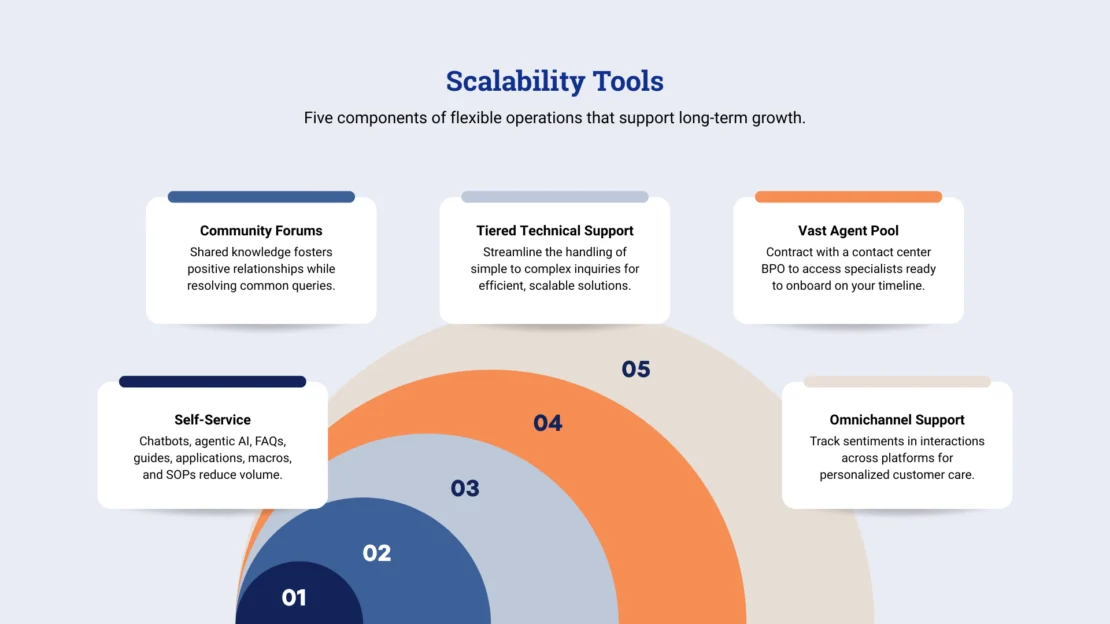
Self-service empowers customers to answer routine questions or find guided assistance on processes and technical issues. This reduces queues, wait times, agent overwhelm, and inefficiencies so employees can dedicate attention where it’s needed most.
A self-service-first infrastructure prioritizes assistance on websites, applications, IVR menus, and more. Include these self-service features for a comprehensive contact center self-service solution:
- FAQs
- Guides
- Self-checkouts, returns, and order assistance
- 24/7 text and chatbot assistance
- Agentic AI models
Self-service should be optimized, easily found on each platform, user-friendly, easy to understand, succinct, accurate, and up-to-date.
Optimizing the knowledge base for search
A top-notch knowledge base is foundational to effective self-service, agent-facing interactions, and workflows. Optimize your knowledge base to enable agents and AI models to access relevant information quickly, reducing training time, speed-to-proficiency, and handle times.
Try the Knowledge-Centered Service approach, or KCS Methodology, to harness collective knowledge, optimize self-service, and collect data for your optimized knowledge base. The model is broken into two loops to capture and improve upon insights.
- “The Solve Loop” captures, structures, reuses, and improves upon knowledge. It involves understanding context, ensuring consistency, readability, and usability; identifying issues; and updating knowledge.
- “The Evolve Loop” reflects on interactions and lessons to be learned from them, focusing on content health, process integration, performance management, and leadership and communication to promote learning and growth.
Using community forums to deflect volume
As investors and users of a product or service, customers are some of the most indispensable experts companies can leverage for support. Develop relationships with and among customers in a community forum on your website, mobile application, or social media pages.
Community forums are crucial online spaces that fulfill a variety of purposes for businesses and customers:
- Boost positive customer engagement
- Proactively manage concerns, reducing escalations
- Build trust through transparency
- Share community knowledge
- Answer commonly asked questions
- Reduce amount of routine inquiries to live agents
Contact page redesign: Directing users to solutions before tickets
Each type of self-service should have a clear place on your website, purpose for its usage, and engaging design to effectively answer questions and reduce ticket volume. A “Contact Us” page is an essential way for teams to connect with customers or potential leads, but without clear direction for how a form submission will be used, audiences will submit irrelevant requests to the team who receives them, failing to receive responses in a timely manner and wasting company resources.
Remove bottlenecks, clogged pipelines, and support delays by redesigning your contact page. Customize these steps to what’s right for your brand and your audience for a contact page that drives meaningful engagement.
- Analyze all inquiries. Pull and customize reports on interactions handled within a certain time frame to grasp most pressing concerns.
- Prioritize. Organize by volume and type to target significant issues and identify the most relied-upon teams.
- Optimize your website. Align solutions with provided resources and web design for a unified experience.
- Choose your angle. Whether you highlight distinct teams or website resources, choose a format that clearly states how customers can find the answers to their questions.
- Implement. Direct users to self-service options, with continuous monitoring for improvement.
Leveraging AI and automation as first-line defense
Automated assistance is becoming more essential for handling routine queries and increasingly complex technical tasks. Utilize these AI strategies and tools to provide the immediate responses and personalized assistance customers expect.
Beyond chatbots: Implementing agentic AI for resolution
Agentic AI models complete task-based requests with limited human supervision. While chatbots can answer questions, they are typically limited in actions they can take to resolve advanced requests. Agentic AI models, by contrast, set goals, reason, adapt, and execute decisions independently. This brings significant benefits for brands and customers:
- Faster responses
- Higher engagement and satisfaction
- Increased efficiency
- Increased service capacity
- More opportunities for revenue generation
- Integrating AI with human-led support
Automated triage: Routing by complexity and sentiment
Customers expect relevant, instant support, but getting to the right teams can take more effort than they expect, lowering expectations and heightening negative emotions before they even receive attention. IVR menus and transfers for complex issues can cause delays, lowering satisfaction.
Automated routing matches customers to agents likely to provide the best-quality service based on inquiry type, personal history, preferences, and behaviors. This AI feature enables hyper-personalized service at scale, bringing powerful process improvements.
- Simplified workflows
- Reduced wait times
- Deep insights into customer behaviors, sentiments, and preferences
- Live assistance for better service and escalation management

Macro and template audit: Reducing time-to-resolution
Fast resolution times go a long way in meeting rising customer expectations and increasing service capacity, enabling sustainable scalability that meets service standards. Utilize macros and templates for faster issue resolution and more scalable, automated, AI-assisted live support.
- Macros: Automated processes record and execute repetitive tasks, streamlining efficiency and reporting for increased accuracy and service capacity.
- Templates: Standardized forms and documents ensure consistent service and process adherence for automated solutions.
Auditing macros and templates ensures processes and materials are up-to-date and compliant. Audits should also track and clearly outline escalation processes and steps, including when to incorporate human agents in the loop, for expert care.
Designing a scalable team hierarchy
While AI solutions are key to leveling up your operational efficiency and service capacity, they should not replace human support. Live agents are the face of your company, reflecting brand values and resolving concerns where automated support is insufficient. Incorporate these tips into your support strategy and team hierarchy to achieve the results you seek.
- Transition from generalists to specialists to provide advanced care alongside automated assistance.
- Follow a tiered support model for effective resource allocation and organized issue resolution in technical support.
- L1 handles basic queries.
- L2 resolves complex issues and escalations.
- L3 manages critical issues and long-term solutions.
- Engineering liaisons facilitate communication and collaboration between teams.
- Know when to outsource. Demand dictates scalability needs. Talk with an expert to determine if a completely outsourced team or a hybrid model can work for your needs to leverage internal employees and powerful BPO strategies.
Tool consolidation and tech stack optimization
Resource allocation puts tools and technology where they can leave the most positive impact on operational efficiency and quality. As you switch your support model, audit tools and management systems to reduce redundancies and maximize impact. This ensures you avoid tool sprawl in high-growth environments, securely integrating CRM data for personalized service at scale.
Metrics that matter during expansion
Performance monitoring during surges ensures teams accurately assess and meet needs, providing the right assistance to agents at varying levels of demand. This ensures operations are properly equipped to deliver consistent service throughout fluctuating demand, optimizing costs without sacrificing quality.
Remain dedicated to high-quality service and effective resource allocation amid growth. Track these key metrics to determine the success of your scalability solutions.
- Cost per Interaction (CPI) to quantify efficiency and resource allocation.
- Deflection rate to measure the success of self-service.
- Scaling efficiency score to determine success of scalability efforts.
- Customer Satisfaction (CSAT) to evaluate how customers feel about provided solutions, informing improvements and enhancing relationships.
If you’re ready to change up your CX strategy to retain more customers and reduce the cost of your services, get in touch with us today to see how Global Response’s contact center outsourcing solutions can strengthen your retention efforts!
Scaling Customer Support FAQs
How do you scale customer support without hiring?
Businesses can scale customer support without hiring by utilizing advanced technology features to streamline processes and boost support capacity. Self-service options, community forums, optimized Contact pages, and AI solutions can handle routine queries and increasingly complex requests while personalizing service at scale.
What is the ideal support agent-to-customer ratio?
The ideal support agent-to-customer ratio depends on a variety of factors, such as average handle time, issue complexity, revenue model, growth projections, and monthly volume. Use this formula to calculate your agent-to-customer ratio: Number of Agents = Total Monthly Tickets / Average Tickets Per Agent Per Month.
With an average handle time of 2 to 3 minutes, a team of 3 agents should be able to handle 60 to 80 calls per day.
When should a startup start scaling its support operations?
A startup should start scaling customer support when business growth proves unsustainable for current operations. Demand surges overwhelm internal teams, distracting them from core functionalities and negatively affecting support quality and customer satisfaction. Tracking interaction handling and performance over time will help startups project seasonality and scaling needs.
Why is it important to scale customer service as a business grows?
Scaling customer service through business growth is important because it ensures teams can provide consistent, high-quality, personalized care vital to retaining customers and boosting loyalty. This ensures sustainable growth and allows specialists to focus on revenue-accruing activities without sacrificing customer support.
Can automation help in scaling customer service?
Automation plays a key role in scaling customer service. Automation features — chatbots, IVRs, agentic models, and automated routing — effectively handle routine queries, streamlining efficiency, raising service consistency, reducing the amount of interactions live agents have to handle, and boosting service capacity.
How do you maintain quality while scaling?
Businesses should prioritize performance management throughout scaling to maintain quality as agents train, onboard, and start handling interactions. Automated QA, sentiment tracking, and automated reports provide deep insights into the success of provided solutions, informing coaching efforts and strategic adjustments required to improve performance or meet Service Level Agreements (SLAs). Track these performance metrics to maintain quality through scaling.
- Average Handle Time (AHT)
- Average Speed of Answer (ASA)
- Abandonment Rate (ABA)
- First-Contact Resolution (FCR)
- Customer Effort Score (CES)
- Customer Satisfaction (CSAT)
- Cost Per Interaction (CPI) or Cost Per Call (CPC)