



Read Time: 10 minutes
Table of Contents
Introduction
When customers need help from a company, chances are they are going to reach out regardless of whether it is open or not. Customers live in an on-demand world where they expect help whenever they need it. Providing 24/7 customer service has never been more crucial to companies looking to stay competitive.
Here is the tricky part: keeping a team online round the clock can feel almost impossible. But there is a way to provide the support your customers need without burning out your team. We are going to walk through the importance of 24/7 customer service, typical obstacles companies run into, and strategies that can help you deliver it.
Key takeaways
24/7 customer service is now a competitive requirement, not a nice-to-have.
Always-on support directly impacts revenue, retention, and brand trust. Companies that fail to meet customer expectations for immediate help risk losing sales, renewals, and long-term loyalty to competitors that are available around the clock.Building 24/7 support in-house is costly and unsustainable for most organizations.
Staffing night shifts, preventing burnout, and maintaining infrastructure creates significant financial and operational strain. Without a smarter approach, internal teams face higher turnover, rising costs, and inconsistent service quality.The most effective 24/7 support strategies blend automation, outsourcing, and self-service.
AI tools, help centers, and outsourced teams allow businesses to scale support without overloading internal staff. A data-driven, hybrid model ensures urgent issues receive human attention while routine requests are handled efficiently, delivering strong ROI and a better CX.

Why 24/7 Customer Service Is No Longer Optional

Customers are going to expect a response within minutes and according to Hubspot, providing that service makes them more likely to come back. Fail to provide that service and your customers are going to look elsewhere.
Imagine a customer adding items to their cart at 1 a.m., only to encounter an error at checkout. Not having after-hours support available will make you lose that sale, and potentially the customer. However, if live chat customer support 24/7 is in place to troubleshoot that issue immediately, you have saved the transaction and strengthened customer trust.
Retention is one of the strongest arguments for investing in round-the-clock customer service. Salesforce even found that almost 90% of customers will remain loyal to a company when provided an excellent customer service experience.
For example, SaaS providers that can’t provide customer support during off hours are at risk of clients switching to a company that does. The availability of 24/7 customer support solutions can be a deciding factor in contract renewals.
While customer experience and 24/7 support are valuable in any industry, some sectors have virtually no choice but to provide it:
- E-commerce & Retail: Shoppers browse and buy at all hours of the day.
- Travel & Hospitality: Customers booking hotels, flights, or rental cars expect immediate confirmation and help with disruptions.
- Technology & SaaS: Enterprise clients demand continuous technical support.
- Healthcare & Insurance: Emergency calls and claims cannot wait until morning.
- Financial Services: Customers need real-time support to help them deal with fraud alerts and mobile banking.
Companies in these industries that don’t provide 24/7 customer support are essentially leaving money on the table.

Challenges of Offering 24/7 Support Internally
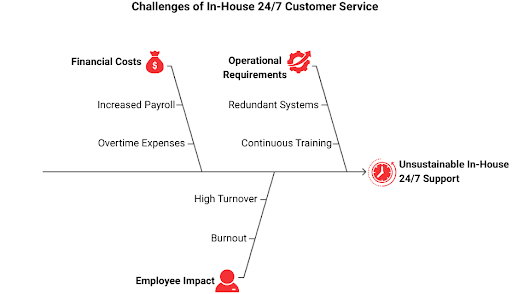
Covering all 24 hours in-house means scheduling night shifts, hiring more staff, and sometimes even paying overtime. This can quickly inflate payroll budgets and for smaller companies, it is often unsustainable.
Larger enterprises also have to consider the effect it has on their employees. A study by NAMI shows that just over 30% of employees feel their productivity suffers because of burnout. Burnout often leads to higher turnover which compounds costs through rehiring and retraining.
Providing round-the-clock support requires redundant systems, secure data access, and continuous training. Here are a few examples of what in-house 24/7 support can require:
- Night shift agents need to have the same knowledge base as day staff.
- Technical infrastructure must withstand increased traffic and avoid downtime.
- Processes for escalations need to function effortlessly at 3 a.m.
The infrastructure investment needed to support 24/7 coverage internally is often out of reach for most companies.
Scalable Solutions to Offer 24/7 Customer Service
You don’t have to hire a ton of new agents or ask your team to work crazy hours to provide 24/7 customer support. Leading companies typically use a mix of technology, partnerships, and self-service tools to keep customers covered 24/7. It’s a balanced system that delivers round-the-clock customer service that doesn’t burn out your team or drain your budget.
AI-Powered Customer Support Tools
Chatbots have improved so much over the years and are a great way to provide your customers support after hours compared to traditional live chat.. Now they use natural language processing (NLP) to:
- Help understand intent
- Answer FAQs
- Guide troubleshooting
- Process simple transactions.
The customer support they provide helps ensure customers never have to wait long for a response.
Pairing AI with a searchable knowledge base helps customers resolve issues on their own. The benefit of this is customers are consistently provided with accurate information and your team is not overwhelmed. It is a smoother process all around.
If a bot can’t resolve the problem, CRM-integrated tools can ensure no issue slips through the cracks. It provides agents with the full customer history so they can understand what is going on. This takes away the frustration that comes from customers constantly having to repeat themselves.
Businesses that adopt customer service automation tools reduce resolution times and help improve consistency.
Want to scale your business?
Global Response has a long track record of success in outsourcing customer service and call center operations. See what our team can do for you!
Outsourcing and Offshore Support
The fastest way to provide true after-hours support is via outsourcing. External partners have everything they need to get going including trained agents, infrastructure, and coverage across multiple time zones. Outsourcing is a great option for companies that want to get rid of the cost and risk that comes with building everything in-house.
The key to strong outsourcing relationships is having strong alignment which should include:
- Clear KPIs and service level agreements (SLAs)
- Shared knowledge bases and training
- Regular meetings to ensure goals are being met
This helps provide smoother customer service whether they are talking to an in-house agent or a member of your global customer service team.
Sometimes, a hybrid approach might be the best option to go with. This might look like automations handling basic customer inquiries, outsourced teams covering customer support during off hours, and in-house teams handling escalations. It’s a great way to balance cost savings with high-quality service.
Self-Service Portals and Help Centers
A recent survey was able to discover that almost 70% of customers prefer self-service options rather than contacting an agent. Companies that invest in 24/7 help centers empower customers to get answers without waiting.
FAQs, tutorials, and community forums are also a great way to provide customers with answers without waiting on an agent. Self-service resources handle a large share of inquiries automatically and provide faster round-the-clock customer support.
Platforms like Zendesk, Freshdesk, or Help Scout make it easy to create help centers. They help your company track which questions are most frequently searched and continuously improve your knowledge base. Providing customer self-service options complements automation and outsourcing.

How to Build a 24/7 Support Strategy
Understanding how to offer 24/7 customer service starts with taking a look at where your customers are interacting with your brand. From there you can use data-driven insights to create a support plan that is useful and sustainable.
The first step is to audit every place customers connect with your brand, keeping in mind that not all channels carry the same weight. For instance, your audit might show that chat and email dominate after-hours inquiries, while phone support tapers off. Finding out where these interactions are happening will provide you with a better understanding of where you need to prioritize after-hours support. You might even find some channels you didn’t realize were pulling in significant traffic.
The next step after you find out where customers are reaching out is to understand what they need and how urgent those needs are. You should prioritize based on volume and urgency because not every interaction is going to need a live agent. This is where segmentation comes in:
- Low urgency issues, like password resets, can be taken care of with customer service automation tools.
- Mid-level needs, like shipping updates or FAQs, can be handled by live chat customer support.
- High-priority issues, like billing errors, should be tasked to a human agent, even during off-hours.
This approach keeps your resources focused on what matters most.
Lastly, no strategy is complete without data. Tracking when and how customers are reaching out helps uncover patterns in demand that aren’t immediately visible. Customer analytics are a gold mine because they can give you a clearer understanding of peak times, the most commonly used channels, and types of requests that occur outside of business hours. Keeping up to date on analytics will help your organization take a more proactive approach when it comes to customer needs.
A strong 24/7 customer support strategy is about coverage and care because customers are loyal to companies that make them feel like their time matters. With a clear strategy in place, the next step is to understand how to measure the impact of 24/7 customer service.
Measuring the ROI of 24/7 Customer Service
Investing in 24/7 customer support solutions pays off in measurable ways. Looking at customer satisfaction, resolution times, and revenue impact, will show you exactly how round-the-clock support drives growth.
Customers that know they can reach you at any time trust your brand more. That trust is reflected in customer satisfaction and loyalty metrics like the CSAT and the Net Promoter Score (NPS). Customers will rate interactions higher when they get immediate responses regardless of how big or small their issue is. Being able to rely on your brand helps improve satisfaction and brand advocacy.

The faster an issue is resolved, the happier the customer. Providing live chat customer support 24/7, paired with automation and self-service, reduces the average time to resolution. This shortens wait times for customers and prevents ticket backlogs from piling up. Shorter resolutions provide a win-win situation where customers get quick answers and agents spend less time managing frustrated escalations.
Here’s where the numbers really speak. Offering round-the-clock customer service can help prevent customer churn and unlock new revenue opportunities. In e-commerce for example, 24/7 support saves late-night purchases that might otherwise be abandoned. In SaaS or B2B industries, immediate help can prevent a client from switching to a competitor. Brands that deliver consistent, after-hours support will often gain a reputation for reliability which attracts new customers. The financial ROI comes from protecting the revenue you already have and creating new growth through availability.
Final Thoughts
Customers expect 24/7 support because problems don’t just occur during business hours. If a company is not providing round-the-clock support, their customers will move onto a competitor who actually cares about their time.
The good news is that you don’t have to exhaust your team to make it happen. You just need the right tools, self service options, and trusted outsourcing partners. Let technology handle the routine tasks, and people step in for moments that require care and empathy. Together that balance builds loyalty.
Global Response helps companies bring this balance to life. Our teams work around the clock so yours do not have to. If you are ready to make 24/7 support a reality, get in contact with one of our experts today.
24/7 Customer Service FAQs
Customers want answers or help on their time, regardless of business hours. Delayed responses have the potential to create a negative brand impression and even hurt revenue. Offering 24/7 customer service shows customers that you value their time and that will build trust and help your brand stay competitive.
Small businesses do not need a huge in-house team to provide always-on support. Affordable options include:
- Outsourcing
- AI-powered chatbots
- Self-service help centers
These approaches keep costs down and help improve the customer experience.
Popular customer service automation tools include AI chatbots, live chat software, CRM integrations for ticketing, and knowledge base platforms. Together, these tools handle common questions, provide instant responses, and free up agents to focus on complex issues.
Yes. Outsourcing customer support allows companies to tap into global customer service teams that work across time zones. It’s one of the most cost-effective ways to scale 24/7 coverage without burning out your in-house staff. With the right partner, you maintain quality while expanding availability.
Industries where downtime directly impacts customer experience or revenue benefit most from after-hours support. This includes e-commerce, travel, financial services, healthcare, SaaS, and telecom. In these sectors, customers expect immediate help, and round-the-clock support builds trust and keeps operations running smoothly.