


Read Time: 11 minutes
Table of Contents
Introduction
Service desk outsourcing is the practice of contracting with a third-party to handle service desk operations, or facilitating communications and support between a business and its employees, customers, and partners. Learn how to make the most of your service desk outsourcing by learning how to find the right service desk outsourcing partner for your goals. Achieve the benefits of service desk outsourcing, including reduced costs, increased operational efficiency, access to 24/7 expert multilingual IT support, improved SLAs and KPIs, and enhanced user satisfaction.
Key takeaways
- Outsourcing a service desk boosts efficiency, scalability, and cost-effectiveness by providing 24/7 expert IT support, reducing internal staffing costs, and providing flexibility to scale support based on demand.
- Choosing the right outsourcing partner is critical to success. Selecting a provider with the right certifications and strategies means streamlined onboarding, enhanced KPI tracking, and secure data management.
- Common pitfalls include poor SLAs, onboarding, and KPI misalignment, but businesses can avoid these by defining clear service expectations and utilizing expert tools to ensure long-term success.

What is service desk outsourcing?

IT services hold your entire company’s operations together, but unless you’re an expert, it can be confusing to distinguish between service desks and help desks and make the crucial decision to outsource an IT team or keep it internal. Thankfully, we’re here to help. This guide serves as a deep dive into service desks, from learning the basics to informing and enhancing your company’s IT service desk outsourcing.
First, understand what a service desk is. Service desks serve as a single point of contact between a business and its employees, customers, and partners. A service desk handles service requests and facilitates communications and support for users.
While help desks focus on technical support, service desks manage requests ranging from technical issues to system outages and can help with technology-related issues when help desk services are unavailable. Service desks can also assist with product or service-related questions and manage IT assets.
READ MORE: 11 Top Benefits of Outsourced Help Desk Support Solutions
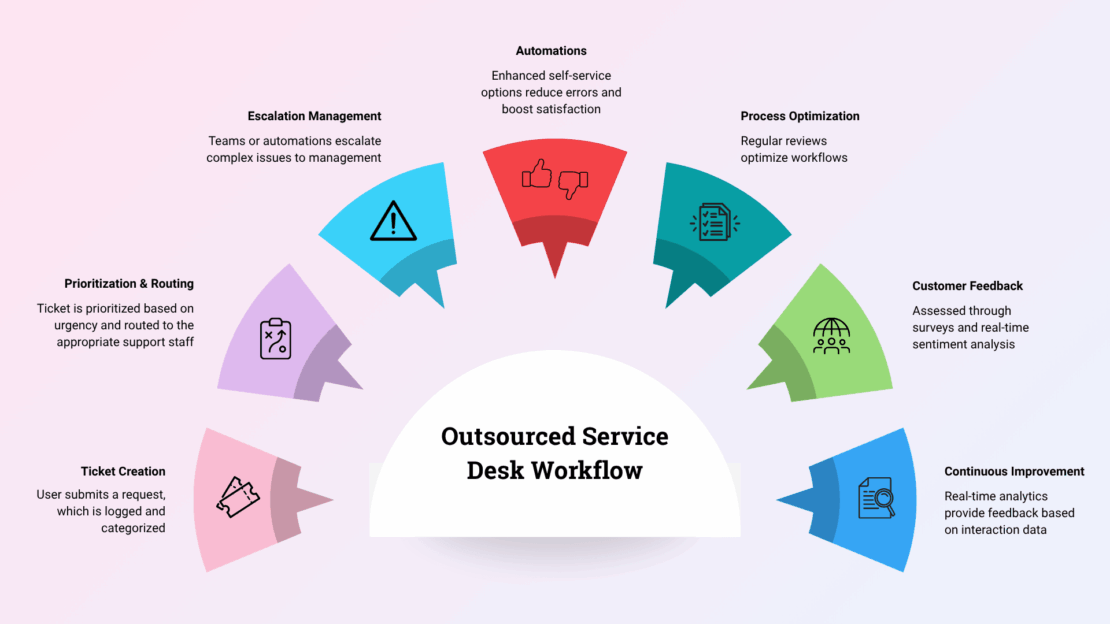
Why companies choose to outsource their service desk
Outsourcing saves companies significant resources while providing expert assistance, and an outsourced service desk is no different. In fact, outsourced service desks pack a punch: companies can access multilingual experts, expand their service coverage, and improve performance with scalable outsourced service desk teams.
Cost savings and operational efficiency
Staffing an internal IT team requires high cost investments, from salary to office space and overhead. As a result, your team size and capabilities are fixed, with little room to adapt to demand surges or lulls, and cost- and operational efficiency wane as your team struggles to keep up with demand or make the most of their time.
On the other hand, outsourced teams are scalable by nature. Your BPO provider maximizes cost-efficiency through key methods:
- Forecasts demand based on historical and real-time data
- Manages your workforce to match support demand needs
- Reduces staffing costs with a flexible team
- Provides opportunities to act on cost-generating opportunities such as upselling and cross-selling
Access to 24/7 IT support
Ensure around-the-clock IT support by investing in an outsourced service desk as a service. IT support outsourcing companies tailor solutions to your needs, meaning they work on your timeline, staffing the hours you need covered. They achieve this by utilizing teams based in locations that match customers’ time zones or staffing more employees to expand coverage. Unify your needs with your price point by staffing teams for after-hours or overflow support.
An outsourced service desk provider can also help you implement automations and self-service options to enable hyper-personalized customer support, improving customer experiences and enriching your understanding of nuanced customer needs.
Improved SLAs and user satisfaction
Unlock the power of outsourcing by creating a clear plan to leverage outsourced help desk solutions to meet the specific needs of your customers and boost the performance of your team. Measure your success in doing so — and how you achieve the benefits of service desk outsourcing — by tracking these key metrics:
- Reduced costs – in time and resources spent handling issues and increased operational efficiency
- Faster resolution times, first-contact resolution rates, and average handle times, improving user experience and service capacity
Customer Satisfaction and Net Promoter scores from proactive surveying and real-time and post-interaction analytics
In-house vs. outsourced service desk: Key differences
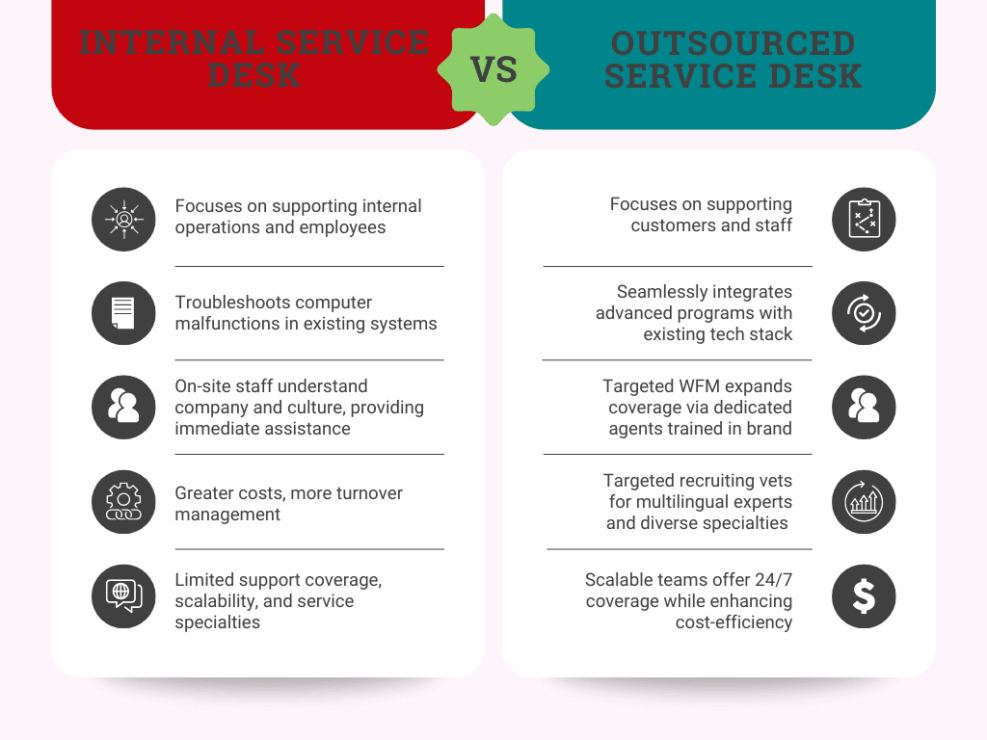
The decision to outsource ultimately is the decision not to internally hire. This affects not only any existing staff but also how your customers and your organization operate and receive technical or product assistance. Compare these key differences of internal vs. outsourced help desk solutions to determine which is best for your company.
Internal service desks focus more on supporting the company’s internal operations, troubleshooting computer malfunctions and guiding employees through various processes. Internal service desk professionals understand your company and use existing technologies to provide immediate assistance to on-site teams.
Cons of internal service desks:
- Greater costs
- More workforce management, including managing turnover
- Limited coverage
- Limited specialties
Outsourced service desks define roles and goals by service provided, utilizing dedicated agents and advanced technology integrations to handle customer requests in a unified ticketing and CRM platform. Direct your BPO to recruit based on skills needed for a flexible yet results-driven hiring model.
Cons of outsourced service desks:
- Remote support can struggle to understand company culture
- Requires trust to securely handle IT systems
Choosing internal vs. outsourced service desks can come down to how much control or oversight you want to have over the IT team and where you want to put your money. Evaluate your current systems and performance to evaluate the cost of outsourcing service desks and if it could help your company thrive in the long run.
How to choose the right service desk outsourcing partner
We highly recommend you outsource IT support to get the most out of your tech, product, and service support strategy. However, we know how easy it is to say you’ll make the change, but freeze when encountering just how many options abound for service desk outsourcing. Finding the right fit is vital to setting your customers and employees on a path for success. Ensure you invest in the right partner by looking for these qualities in the IT support outsourcing companies you consider.
What to look for in a managed service desk provider
Researching outsourced IT support includes assessing their services, certifications, and integration tools. Look for these certifications and features to find a service desk provider that operates in secure frameworks relevant to your organization.
- IT Infrastructure Library (ITIL): A global customer experience service delivery framework, ITIL recommends best practices for IT service management. ITIL certification represents skills in the framework.
- ITIL 4 uses a modular, tiered approach to develop a comprehensive view of service management, focusing on specific areas of knowledge.
- International Organization for Standardization (ISO) covers business operations, quality management, environmental management, information security, and more.
- ISO 9001 ensures consistent quality in products and services via quality management systems.
- ISO 14001 relies on environmental management systems to reduce environmental impact.
- ISO 45001 ensures workplace safety in occupational health and safety management systems.
- ISO 27001 protects sensitive information in information security management systems.
- ISO 22000 ensures food safety throughout the supply chain in food safety management systems.
- IT Service Management (ITSM) integration: Planning, implementing, managing, and optimizing IT services require secure tools and consistent frameworks. Seamless integration in one platform will increase operational efficiency and security.
Questions to ask before signing a contract
Your new managed service desk provider should have the expertise you seek, the experience to back it up, the frameworks to securely manage operations, and the vision to meet or surpass your goals. Meet with potential partners and ask these key questions to assess your potential fit and to accurately envision the possible working relationship with each potential provider.
- What cybersecurity frameworks do you use?
- What is and isn’t covered in your support contract?
- What is your incident response plan?
- Do you use a pay-as-you-go, break-fix hourly support, or managed service support annual contract model?
- How will our data be secured?
- How do users provide feedback?
- How does your 24/7 support work?
- What technology partnerships do you utilize, and which would apply to my program?
Want to scale your business?
Global Response has a long track record of success in outsourcing customer service and call center operations. See what our team can do for you!
Common pitfalls and how to avoid them
Even the most compatible partnerships on paper can fail to succeed without the proper tools or strategies vital for project set-up. Avert these common hurdles to service desk outsourcing by learning how they occur and how to avoid or resolve them.
Problem: Lack of SLAs. Every partnership should include a clear discussion of expected service levels, but sometimes partnerships fail to cover this because the company wishes to safeguard poor performance data — or the BPO provider simply forgets to ask.
Solution: Realistic and achievable SLAs require upfront communication. Determine your service level agreement by assessing how strategies can boost performance in a certain amount of time. Discuss the challenges affecting your service quality to accurately adjust services to target them.
Problem: Poor onboarding. Not every BPO is an expert in every service. Inefficient recruiting, hiring, onboarding, and training lead to excess time and resources spent getting agents up to speed. At worst, poor onboarding can put your security systems and customer and employee data at risk.
Solution: A superior service provider should know how to onboard your new service desk operations efficiently and securely. Find a partner with the certifications that demonstrate expertise transitioning operations while reducing or mitigating risk.
Problem: Misaligned KPIs. More than just your SLA, key performance indicators provide valuable data about how your team is performing and the effectiveness of provided solutions. Failing to track comprehensive KPI data will cause the team to miss out on opportunities to grow or learn based on data-driven feedback.
Solution: Prioritize tracking KPIs such as Average Speed of Answer (ASA), Average Hold Time, Average Handle Time (AHT), First-Call Resolution (FCR), and Customer Satisfaction (CSAT). Implement technologies that track and interpret customer sentiments through AI models and predictive analytics.
Real-world use case: Outsourcing in action
Service desk outsourcing can transform operations, from resolving ticketing issues to ensuring an optimized end-to-end user experience. Evaluate just one example of how effective these solutions can be through this case study.
Tech CX Solves Jewelry Store Ticketing Issues
Global Response supplied tech support for a jewelry brand’s brick-and-mortar stores, providing direct vendor integration to resolve issues with equipment. Global Response excelled where no other BPO could as weekly service desk trainings empowered agents to effectively resolve issues at an 80% FCR, reducing ticket turnaround from weeks to hours.
Seeing no downtime and no stores out of service, Global Response drastically improved the team’s capabilities. Each agent supported 25 to 35 stores, equipping the retail brand with the technological resources to expand as business grows. Global Response consistently met and exceeded service level agreements, demonstrating strong performance and reliability. Despite the addition of more than 30 new stores since Global Response took charge of support, Global Response maintained 7 agents by effectively managing workloads, playing a key role in troubleshooting and ensuring prompt replacements when needed.
READ MORE: 7 Signs It’s Time to Outsource Your Technical Support

The future of service desk outsourcing
BPO providers live and breathe by change. A proactive mindset is vital not only to keeping up with changing customer preferences, needs, and behaviors, but also to leveraging emerging technologies and strategies that enhance service quality and capacity.
Industry leaders are noticing the impact of AI programs on customer experience and satisfaction, and your team deserves an expert who knows how to leverage these tools to enhance your service desk as a service program.
Partner with a third-party who pushes the envelope by using chatbots, automated messaging, and predictive ticketing to streamline operations while expanding coverage at reduced costs, with more diverse expertise.
Contact Global Response to see how we could be a good fit for your IT service desk outsourcing needs.
Service Desk Outsourcing FAQs
Service desk outsourcing is when a company contracts a third-party service provider to handle their service desk operations, or to act as a single point of contact between customers and the company while providing assistance for products, services, and technical support requests.
The benefits of service desk outsourcing include reduced costs, increased operational efficiency, access to 24/7 expert multilingual IT support, improved SLAs and KPIs, and enhanced user satisfaction.
The cost to outsource IT support varies depending on the service scope and business size, but basic helpdesk support can cost approximately $75 to $150 per user per month. Flat-rate monthly IT services range from $1,000 to $5,000 per month. Hourly or ad hoc support costs can be upwards of $100 per hour. Ongoing app maintenance is estimated at $1,000 to $5,000 per month. Managed IT services generally cost between $125 to $255 per computer user per month.
A help desk focuses more on troubleshooting issues and providing customer support. A service desk provides IT support within a company for employees and can provide assistance regarding products and services.
A managed service provider (MSP) is a third-party company that takes on the management and maintenance of an organization’s information technology (IT) infrastructure, applications, and end-user systems.