


What is back office outsourcing and how can it benefit your business?
Back-office outsourcing is when a company contracts with a third-party provider to handle non-client-facing tasks for the business. It benefits a business reducing costs and accessing global expertise for dedicated fulfillment of administration, HR, compliance, data management, payroll, and IT responsibilities.
Read Time: 13 minutes
Table of Contents
Introduction
In today’s fast-paced, tech-driven business environment, companies are constantly seeking ways to improve efficiency, reduce costs, and stay agile. One of the most effective strategies for achieving these goals is back-office outsourcing, a solution that allows organizations to delegate essential, non-customer-facing functions to specialized external partners. Whether you’re a startup looking to scale quickly or an established enterprise seeking operational optimization, outsourcing your back-office tasks can unlock significant value.
This comprehensive guide explores everything you need to know about back-office outsourcing — from what it is and why it matters to the services you can outsource and how to choose the right provider. With insights into trends, technologies, and best practices, you’ll gain the knowledge you need to make informed decisions and transform your internal operations for long-term success.
Key takeaways
- Back-office outsourcing drives operational efficiency and cost savings. Outsourcing non-client-facing tasks allows businesses to streamline internal processes, reduce overhead, and reallocate resources.
- Outsourcing enables businesses to scale flexibly and focus on core functions, enabling them to quickly adapt to market fluctuations while maintaining quality and performance.
- Choosing the right outsourcing partner is critical to success. Successful outsourcing hinges on clearly defined goals, thorough vetting of potential partners, and alignment on communication, compliance, and security standards.

What is back-office outsourcing?

Outsourcing allows companies to streamline processes, workflows, and workforce management. Back-office outsourcing is a foundation of outsourcing — one of the most common ways that businesses of all industries improve operational efficiency through external support. Back-office outsourcing experts handle business-essential, non-customer-facing tasks at reduced costs.
With so many cogs in your business machine working together, opportunities abound for enhancing performance through global expertise. Learn the ins and outs of back-office outsourcing to start your outsourcing journey. Scale operations from within to streamline processes and keep your well-oiled machine of non-client facing tasks running smoothly.
The growing trend of outsourcing back office functions
The COVID-19 pandemic catapulted workforces into remote work, and businesses everywhere noticed how impactful back-office outsourcing was in removing human error in tedious, manual tasks and in building a scalable workforce. Companies across industries discovered the power of leveraging external experts to handle back-office tasks so internal staff could most effectively do the work they were hired to do.
When workforces returned to in-office work, on-site staff supported by outsourced back-office experts could better interact with clients, developing relationships that kept customers coming back. Business boomed as outsourced administrative or technical tasks enabled companies to scale workforces with demand flow and optimize efficiency, performance, and costs.
Since then, outsourcing continues to work with human insight to keep up with evolving technologies and customer expectations. AI-powered solutions kick operations into high-gear, automating support and enhancing operations at unparalleled efficiency. Increased service capacity empowers customers to receive assistance when and how they need it, increasing customer engagement, satisfaction, and retention.
What’s the difference between back office and front office?
Picture an office and the placement of employees, and back office and front office are just what they sound like: back office refers to the unseen yet essential administrative functions that keep a business running. Front-office work is customer-facing, responsible for sales and service. Let’s dive deeper to understand the functions and opportunities of each.
Front-office functions (client-facing)
Directly interacting with customers, front-office employees are responsible for generating revenue and building customer relationships. These roles fall into front-office work:
- Marketing
- Sales
- Customer support
While face-to-face interactions build valuable relationships, particularly in brick-and-mortar stores and offices, the digital age is bringing more virtual engagement in these roles, making front-office tasks more and more ideal for outsourcing. Reduced staff, expert assistance, and automated support enhance digital front-office opportunities.
Back-office functions (non-client-facing)
Back-office tasks don’t require employees to interact with customers, but they revolve around the work required for a business to remain operational. They also support front-facing roles utilizing advanced technologies for more efficient, automated, and personalized support.
These roles operate behind the scenes and ensure the operational success of an organization:
- Data management
- Compliance
- Payroll
- IT support
- And many more!
While these roles may not generate revenue on their own, they manage resources and ensure cost-effectiveness of solutions. Back office BPO services significantly reduce costs by helping companies scale with demand fluctuations via low-cost workforces. Streamlined processes enhance operational efficiency of each team, increasing service capacity and productivity.
Want to scale your business?
Global Response has a long track record of success in outsourcing customer service and call center operations. See what our team can do for you!
Why should you outsource your back office?
Making the decision to outsource your back office is a significant one with lasting effects on your team, your work culture, and the work itself. Make the best decision for your company by assessing these benefits of outsourcing back offices.
Cost savings
Determining cost-efficiency of any plan includes an honest look at your current solutions and associated costs and comparing them with the efficiency and costs of the new course of action.
Let’s compare the costs of in-house vs. outsourced back offices.
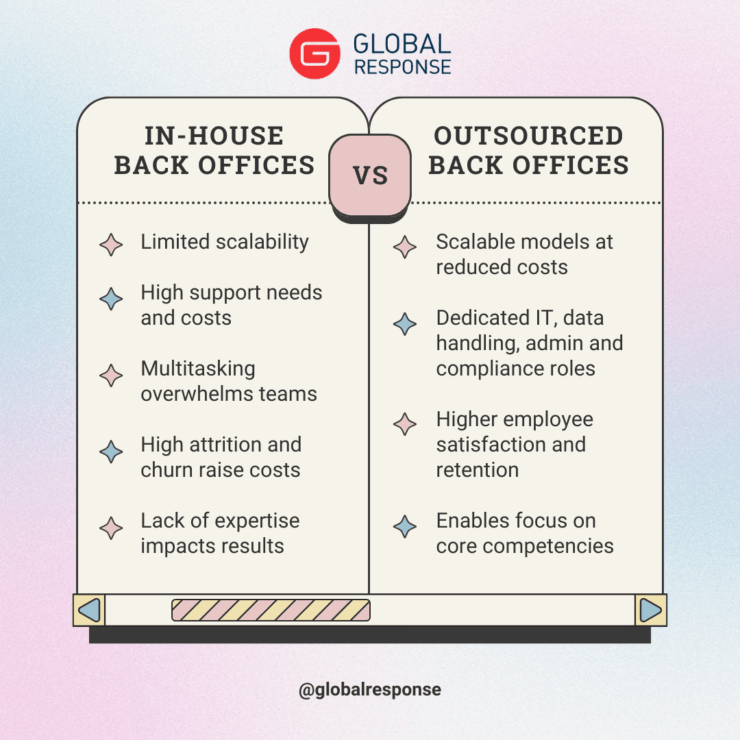
In-house back office costs | Outsourced back office costs |
A fully staffed team with full-time salaries and benefits | Low-cost global expertise at varying price points (onshore vs. nearshore vs. offshore), all lower than internal staffing |
Costs of securing, maintaining, and expanding offices to support a full-time staff | Remote work removes overhead costs |
Equipment, hardware, and software costs | Reduces equipment, hardware, and software costs |
Costly measures required to keep up with demand surge | Technology support, streamlined processes, and scalable workforces ensure the smooth handling of fluctuating demand |
Overwhelm and burnout impact service quality, attrition, and churn, requiring costly restorative actions | Increased support for agents and customers boosts satisfaction, engagement, trust, and retention |
Increased efficiency and productivity
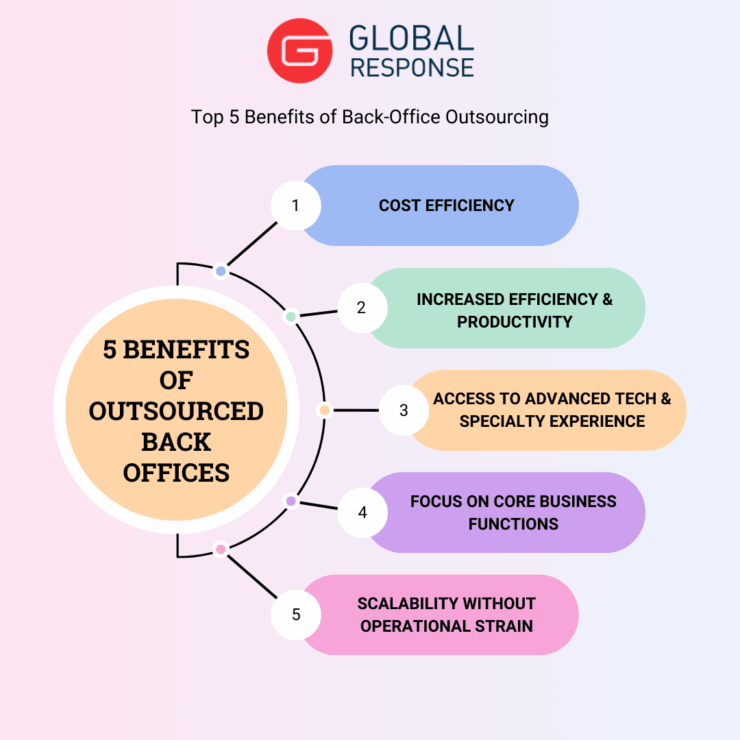
Back-office outsourcing increases operational efficiency by assigning administrative tasks to dedicated agents, reducing the need for your internal team to split their time between their normal responsibilities and back-office tasks. Optimized teams focus their time and attention on the work through enriched processes, allowing them to do more with better accuracy.
Experts these strategies to increase productivity and quality:
- Cloud-based systems to increase data analytics and reduce manual error.
- Automated processes to handle routine requests at higher capacity and consistent quality.
- Streamlined workflows to enhance end-to-end customer experiences.
- Secure frameworks to protect customer privacy.
With the proper tools and infrastructure, your back office support services boost service efficiency and the productivity of your teams.
Access to specialized skills and technology
Internally hiring the experts you need for certain back-office tasks requires a full team of high-demand specialists. Throw in the required technology, including hardware and software, and costs can exceed your budget, management, and support capabilities.
Back office outsourcing companies connect you with relevant expertise, technologies, optimized processes, and management at reduced costs. Customize skills by partnering with an expert who knows which global teams can best reach or surpass your goals.
BPO experts also use automation to personalize customer support, empowering hyper scalability while still prioritizing customer care.
Focus on core business functions
Outsourcing is as effective as it is because it eliminates the burden internal teams face as they struggle to manage multiple job functions among themselves. These internal employees don’t always have the qualifications or tools to efficiently or skillfully fulfill the job duties, which can lead to errors, decreased morale, burnout, high attrition, and increased security risks for your staff and your customers.
Setting up external back-office teams removes these burdens, allowing internal employees to expertly fulfill their own job functions and back-office teams to set your company up for unprecedented success.
The result? Increased service capacity and quality of front- and back-office teams without significantly raising costs. Customers receive the support they need, and employees feel heard and supported.
Increased customer and employee satisfaction benefits your business in key ways:
- Encourages loyalty and retention.
- Increases understanding of customer behavior.
- Reduces costs.
- Increases opportunities for growth and revenue generation.
- Builds a positive business reputation.
Scalability and flexibility
The key to day-to-day and long-term success is scaling operations to accommodate demand with cost-effectiveness and quality. Throwing money at band-aid fixes leads to an unsustainable model of business that burns through your wallet and burns out employees.
In high demand, low service capability makes current staffing solutions ineffective and costly. Similarly, low demand and high availability can lead to unproductive workforces. The skill lies in finding that sweet spot of demand that pushes your business forward and a workforce that expertly manages it, empowering you to grow with your audience.
A scalable workforce is a vital piece to the puzzle of operational efficiency. Back-office outsourcing experts achieve scalability tailored to niche markets through these main methods:
- Advanced technology integration that streamlines processes and supports agents.
- Tapping into global workforces to meet demand needs on urgent timelines.
- Proactively anticipating customer needs through historical and real-time data tracking.
- Efficiently allocating resources to where they’re needed most.
- Continuously training agents and expanding skillsets.
What back office services can be outsourced?
The world of outsourcing is full of countless opportunities to optimize your back office. With experts in countries including the Philippines, South Africa, Tunisia, and the United States, you and a BPO partner can customize your team to meet your language, hours of operation, budgetary, and back-office skill needs.
Before you’re ready to consult with a BPO provider, determine which of these common outsourced back-office services you require for fully optimized operations and support teams.
Data entry and management
From transcribing handwritten documents to entering claims, image, invoice, and product data to fulfilling accounting needs and managing documents, data management is a full-time job requiring skill, efficient QA, and technical support.
Outsource data entry services to improve the accuracy, focus, and productivity of your team. Follow these steps:
- Determine the scope of your data entry needs. Some businesses have specific requirements such as data capture, data mining, data conversion, and data extraction.
- Set clear turnaround timelines. A provider’s experience and strategies in handling time-sensitive matters directly affects customer experience and the success of your partnership.
- Establish quality frameworks. Assess a potential provider’s processes to ensure the accuracy, consistency, and adherence to guidelines.
- Support teams with continuous training. Personalize training by immersing agents in brand-specific needs via hands-on, results-based learning.
Accounting and bookkeeping
Businesses can save up to 30% on operational expenses by outsourcing bookkeeping, payroll, tax preparation, and financial reporting. Contracting with accounting experts ensures you follow all compliance guidelines and capture actionable insights into business performance and financial reports.
An ideal outsourced accounting team adds value beyond transaction recording. They contribute to high-quality service in key ways:
- Integrate seamlessly with existing systems
- Prepare for audits
- Delegate tasks to experts
- Make informed decisions
- Ensure a healthy cash flow for your business
- Leverage software for accuracy
- Keep company in the loop with regular updates and reports
Human resources
A core piece of any business, HR departments must seamlessly scale with your operations to support employees and keep operations running smoothly amid varying business conditions. Enhance operational efficiency regardless of market conditions by implementing the strategic initiatives of HR outsourcing.
These common outsourced HR tasks reduce administrative burdens on internal teams:
- Payroll processing
- Benefits administration
- Recruitment, hiring, and training
- Compliance management
Determine your HR needs based on business size, purpose, and workforce management requirements.
IT support and helpdesk
Technical support is another vital component of your company’s framework that enables the functionality of back-office and front-office teams. IT helpdesk teams provide technical support and assist customers with troubleshooting. They also build self-service resources for customers such as FAQs, guides, and manuals.
Learn the 11 benefits of outsourced help desk support solutions to increase productivity, uptime, customer satisfaction, and more through professional expertise.
Content moderation
A potentially strainful but necessary task, outsourced content moderation protects business reputation and customer safety by assessing texts, images, and video in community spaces. Manually reviewing and removing hateful or harmful content puts intense strain on in-house teams, increasing attrition, unreviewed content, reactive strategies, and all associated costs.
Outsourced moderation mitigates the negative impact on human moderators through a combination of AI technology and human expertise.
- AI solutions flag or remove blatant violations.
- Human moderators review ambiguous content, applying nuance and contextual knowledge for accurate moderation.
Safeguard audiences in discussion forums or community spaces and employees behind the scenes by enlisting outsourced support to handle content moderation with expertise and sensitivity.
Image and video annotation
Data annotation enables your AI models to understand and replicate human language and behavior. The process follows these steps to teach the models to interpret images and videos:
- Human agents or technology programs label images, videos, and even audio with frame-by-frame tags to teach the AI models how to recognize and interpret facial expressions and body language.
- The program identifies, analyzes, and responds to stimuli and sentiments.
- Annotators continuously evaluate and refine datasets.
- Programs track sentiments throughout an interaction and provide data-driven insights to improve performance.
Ensure contextually accurate data annotation in your BPO partnership to keep your processes and automations optimized and relevant to audiences.
How to choose the right back office outsourcing partner
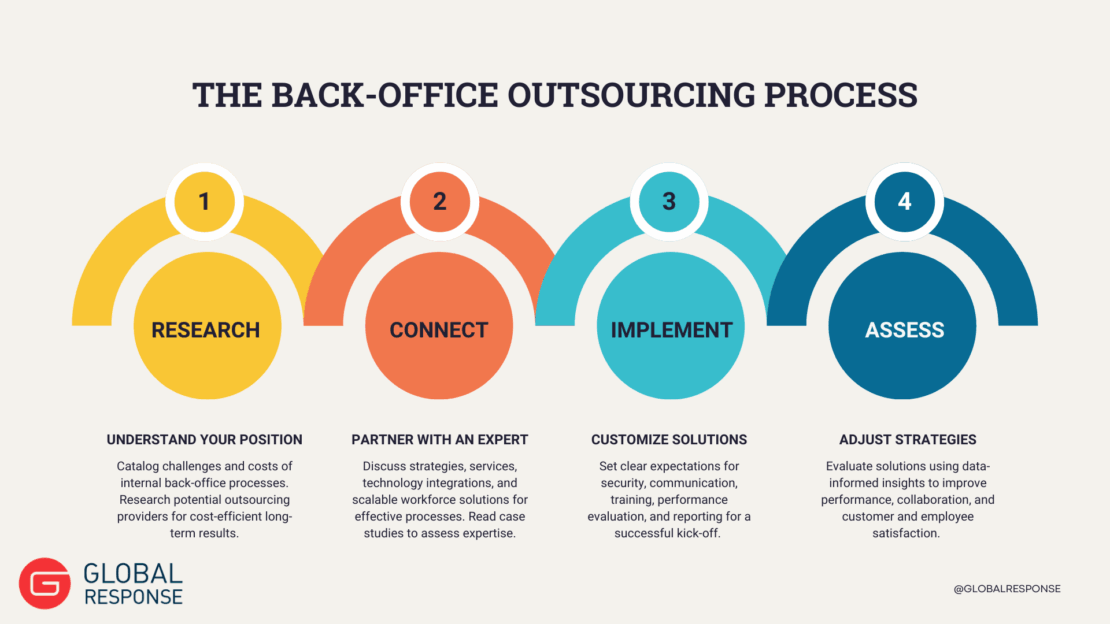
Understanding exactly what is back office support sets you on the right path to choosing a professional and capable back office outsourcing partner. Continue setting your partnership up for success by choosing the best fit for your company. Align your goals and working preferences with each by following these steps.
- Define your needs and goals. This ensures you choose relevant services and your partner strategizes and assesses performance accordingly.
- Research and vet potential partners. Read reviews, evaluate strategies, and ask about management and reporting measures.
- Consider experience and expertise. Read case studies showcasing performance and compliance in similar tasks for similar businesses and industries.
- Assess security and compliance measures. Evaluate security and quality assurance frameworks, access controls, audit preparation, and compliance protocols.
- Evaluate communication and collaboration tools. Interview with a contact face-to-face and ask about communication styles, challenges and results, and performance reporting.
Following these steps to enriching your back-office processes with outsourced expertise will support everyone in your organization, from internal front-office teams to newly hired agents. Now that you know back office best practices, get the ball rolling!
Back Office Outsourcing FAQs
Risks of outsourcing back-office services include unstable frameworks, compliance issues, inaccurate data, unskilled workforces, lack of cultural understanding, and unexpected expenses.
The cost of outsourced back-office services vary according to the BPO provider, the services chosen, and the country sourced from. On average, back-office support can average $25 per hour. Small businesses spend between $500 and $2,500 per month for outsourcing. Specialized services such as tax preparation and financial reporting range from $500 to $1,500 per month.
Business process outsourcing, or BPO, is the process of contracting with a third-party provider to handle business processes. Back-office outsourcing refers to a specific type of work businesses often outsource. Back-office tasks are administrative tasks that employees fulfill without interacting directly with clients. They can include payroll, IT support, data management, HR, accounting, content moderation, data annotation, and more.
Businesses outsourcing their back office team don’t require personal internal management of the team. The provider offering the services manages the team and collaborates with the business’ point of contact to discuss strategies, results, and improvements. This removes the need to manage the back-office teams, allowing the employees to focus on core competencies.